Most lists of product management skills are safe to nod at and easy to ignore. Communication. Prioritisation. Stakeholder management. True, and useless, because every one has a counterfeit that looks identical from the outside.
The counterfeit is the version that survives a busy week. It feels like the skill, it fills the same slot on your calendar, and it does the opposite job. You can spend years getting good at the impostor and wonder why the work never lands.
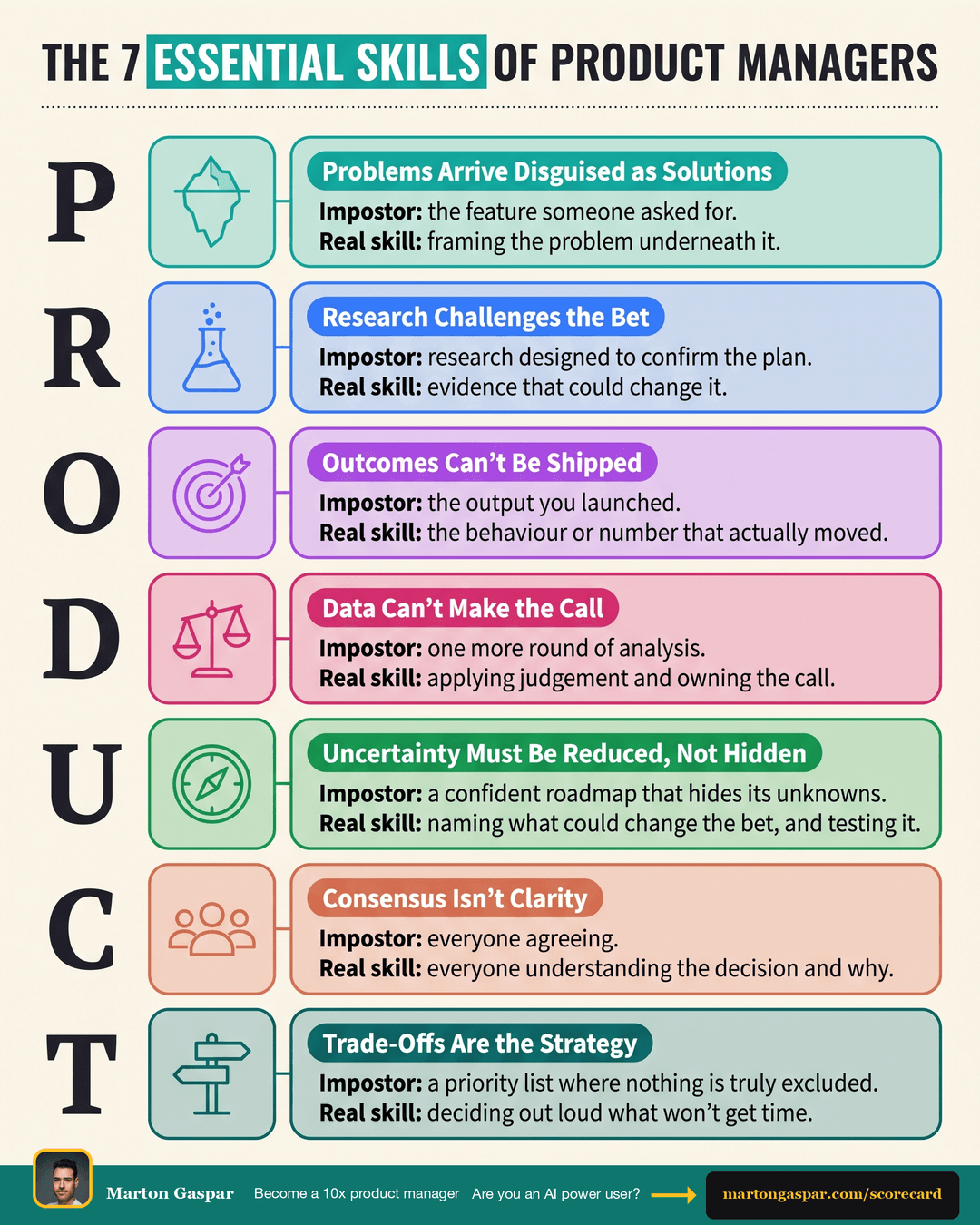
Here are the seven that matter, each next to the fake it hides behind. They spell PRODUCT, so the whole thing fits on one page you can keep where you plan.
P: Problems arrive disguised as solutions
The impostor is the feature someone asked for. It comes pre-scoped, with a sponsor and a deadline, and it feels like progress the moment you write it down.
The real skill is framing the problem underneath it. Someone asks for a filter; the problem is that they can't find last month's orders. Build the filter and you've closed a ticket. Frame the problem and you might solve it three cheaper ways, one of which nobody thought to ask for.
Every request is a solution in a trench coat. Your first job is to take the coat off.
R: Research challenges the bet
The impostor is research designed to confirm the plan. You've already decided, so you go looking for the five users who agree, screenshot the quotes, and call it validation.
The real skill is gathering evidence that could change the bet. Good research is set up to lose. You write down what you expect to hear, then go hunting for the version of the truth that would kill your idea. If it survives that, you have something. If it doesn't, you just saved a quarter.
Research that can only say yes was never research. It was a press release with a sample size.
O: Outcomes can't be shipped
The impostor is the output you launched. The feature is live, the release notes are written, and the burndown looks beautiful. So you move on.
The real skill is watching the behaviour or the number that actually moved. Shipping is the cost, not the result. The result is whether anyone renewed, activated, came back, or stopped churning. A team that celebrates output is a team that will happily build the wrong thing on time, every time.
You didn't finish when it went live. You finished when it changed something.
D: Data can't make the call
The impostor is one more round of analysis. The numbers are close, the room is nervous, so you ask for another cut, another dashboard, another week. It feels rigorous. It's usually fear wearing a lab coat.
The real skill is applying judgement and owning the call. Data narrows the range; it rarely picks the answer. At some point the evidence runs out and a person has to decide, on the record, with their name on it. That person is you. The good ones don't wait for certainty, because certainty never turns up.
More analysis is only progress until it becomes a place to hide.
U: Uncertainty must be reduced, not hidden
The impostor is a confident roadmap that hides its unknowns. Every quarter is full, every date is firm, and the risks live in your head where the plan looks clean.
The real skill is naming what could change the bet, then testing it. Certainty theatre buys you a good planning meeting and an ugly quarter. State the assumptions the plan rests on, rank them by how much damage a wrong one does, and go pressure the top one first. A roadmap that admits what it doesn't know is worth more than one that pretends it knows everything.
Confidence you can't defend is just risk with better presentation.
C: Consensus isn't clarity
The impostor is everyone agreeing. The meeting ends, no one objected, so you write it up as aligned. Two weeks later three teams are building three different things, all technically inside the agreement.
The real skill is everyone understanding the decision and why. Silence is not agreement; it's often confusion being polite. Clarity is when someone can explain the call and the reasoning back to you when you've left the room. Chase that, not the absence of pushback.
Nodding is cheap. Being able to repeat the decision is the thing you actually needed.
T: Trade-offs are the strategy
The impostor is a priority list where nothing is truly excluded. Everything is P1, everything is important, and the list grows until it means nothing. It reads like strategy and commits to none.
The real skill is deciding out loud what won't get time. Strategy is the no said in public, where the people who wanted a yes can hear it. If your plan doesn't visibly disappoint someone, you haven't chosen; you've stapled everyone's wishes together and called it a roadmap.
A strategy that fits everything in isn't a strategy. It's a queue.
The whole word, on one page
P.R.O.D.U.C.T. Problems under the request, research that can lose, outcomes over output, judgement past the data, uncertainty named not buried, understanding over agreement, and the trade-off said out loud.
None of these are new. What's hard is holding the real version when the week gets busy and the impostor is right there, easier, and good enough to pass. That's the whole job.
Download the one-page version and keep it where you plan the next thing.