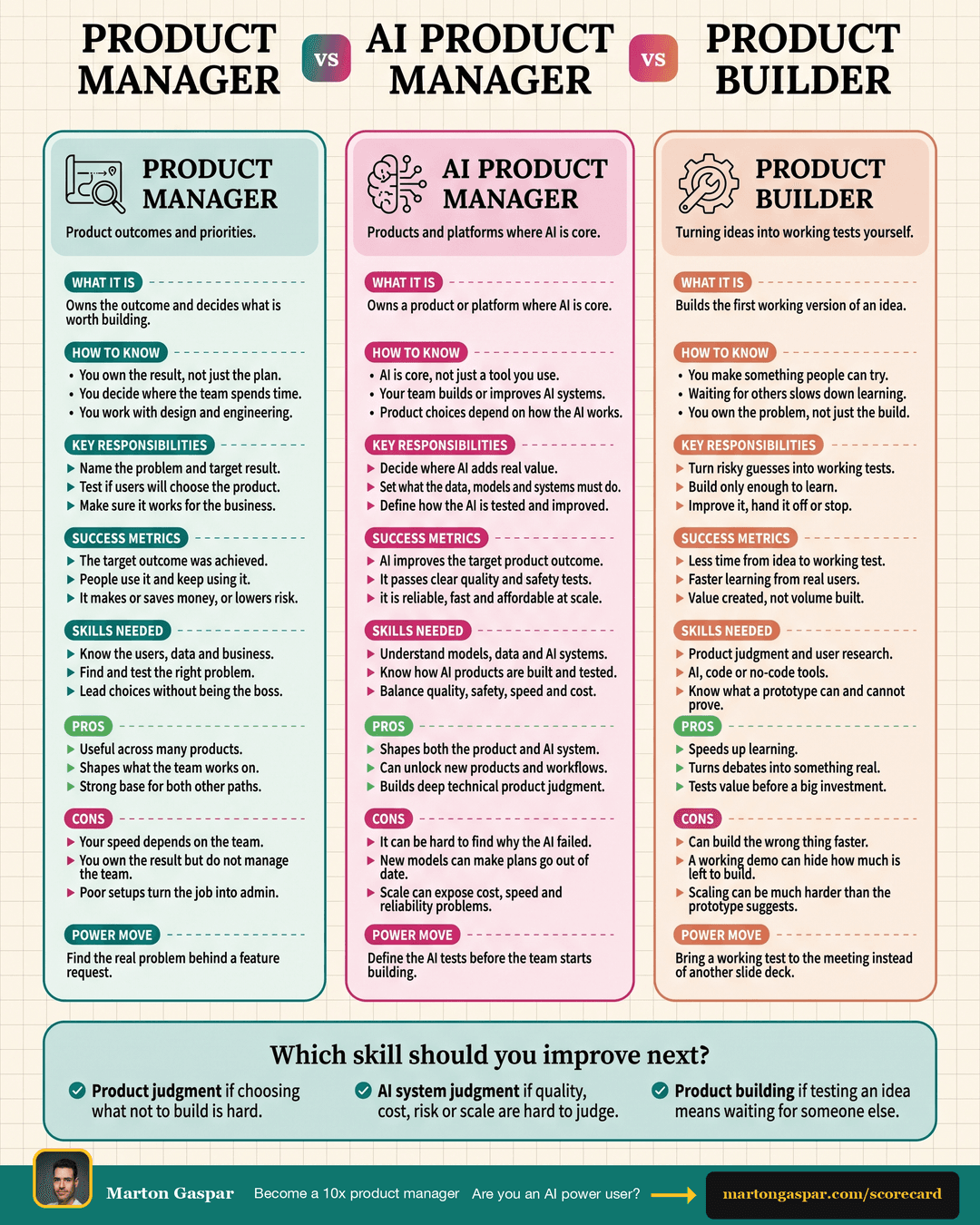
Three job titles, and everyone argues about which one is the good one to have. That is the wrong argument. They are not levels, and they do not sit on one line.
Product manager, AI product manager, product builder. People stack them like a career ladder and ask which one to climb next. But each one answers a different question about your work. One is what you own. One is what you work on. One is how you work. You can be one of them, two of them, or all three at the same time. Reading them as a ranking is what makes them so easy to confuse.
Product manager: what you own
This one is about what you are accountable for. A product manager owns the outcome and the priorities. You decide which problem matters, what is worth building, and how you will know if it worked. You do not need line authority over the team to hold this, and most of the time you do not have it. What you have is the call on where the effort goes and the answer for whether it paid off.
The move this week: take the loudest feature request on your list and, before you scope it, write down the real problem behind it. Not the feature. The change for the user that the feature is meant to create. If you cannot name that change, you have found the thing worth owning before anyone builds the wrong version of it.
AI product manager: what you work on
This one is about your domain, not your seniority. An AI product manager owns a product or platform where AI is core to how it works or where the value comes from. The job changes because the material changes. The same request can return different answers, quality can drift after launch, and good is harder to define. So the work leans into deciding where AI actually adds value, defining what a good answer looks like, and building the tests that catch it when it slips.
The move this week: for one AI feature you own, write the test cases before you pick the model. Decide what good enough means and how you will measure it first. Choosing the model before you can score it is how teams end up shipping something that demos well and fails without warning in front of real users.
Product builder: how you work
This one is about capability. A product builder turns a decision into a working version of the idea instead of only describing it. When a debate stalls, you bring something people can actually try. The point is not to build a lot. It is to build just enough to answer the question and to shorten the gap between an idea and real evidence. Handoffs slow that loop down, so builders close it themselves.
The move this week: take the next meeting booked to argue about a spec, and bring a rough working test to it instead of another slide. Even a scrappy one changes the conversation from what we think to what actually happened when someone used it.
They stack, they do not rank
Here is the part the ladder framing hides. These are three axes, not three rungs. You can own the outcome, work in an AI-core domain, and build the first version yourself, all in the same job. Plenty of people do. Calling one of them the senior one is how you end up chasing a title instead of getting clearer about the work in front of you.
Which one should you strengthen next?
The useful question is not which label is best. It is which of these you are weakest on right now, because that is usually what is capping your impact without ever showing up as a single obvious problem. If the team ships but the outcomes do not move, the gap is product judgement, what you own. If AI is core but quality, cost or risk are hard to judge, the gap is AI-product judgement, what you work on. If the problem is clear but testing an idea always means waiting for someone else, the gap is building, how you work.
Most people are strong on one, fine on the second, and steering around the third. The one you avoid is usually the one worth naming. That is a truer career map: not a title to reach, but the question you can already answer, sitting next to the one you keep stepping around.
So the question to sit with is simple. Of the three, which can you answer with confidence today, and which is the one you have been avoiding?