The best-paid product managers were specialists. That's just not true anymore.
For a long time the career advice was simple. Pick a lane. Go deep on growth or payments, and let the depth carry you. For years, recruiters told me I wasn't specialised enough. I heard it often enough to half believe it.
Here is what changed. You get paid for the decisions you're trusted with, not the work you can do. And the expensive decisions rarely sit inside one function. They sit between functions, where no specialist owns the answer.
Why depth used to be the safe bet
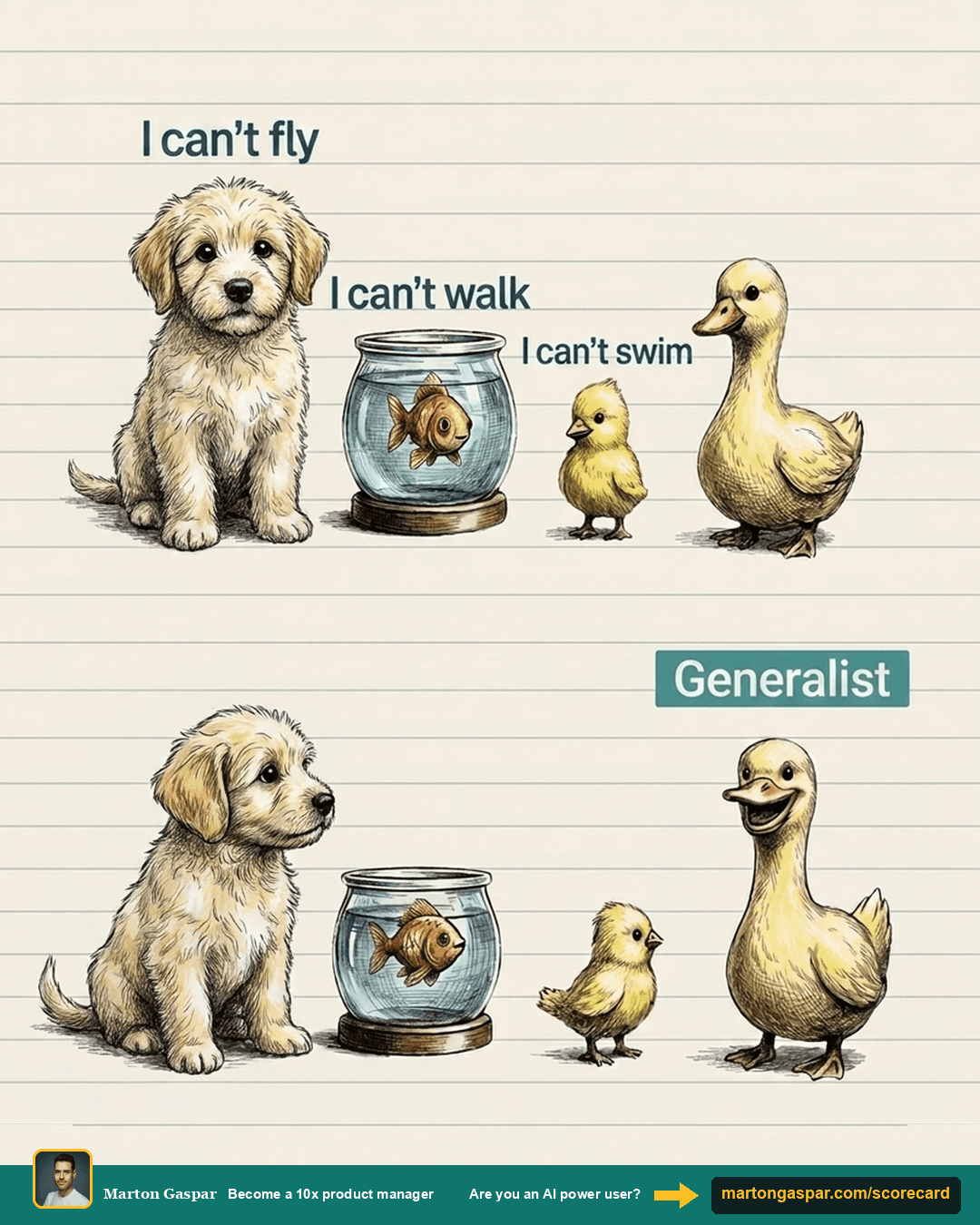
Look at the picture. The dog says it can't fly. The fish says it can't walk. The chick says it can't swim. Each one is good in its own element and stuck outside it. The duck, labelled generalist, does all three. None of them perfectly, and it's the one grinning.
Depth paid because experience bought speed. Someone who had done the same kind of work many times could do it faster than anyone else, and that speed was worth money. It made the specialist the safe hire and the safe promotion.
That trade has shifted. AI is fast without the experience. The first draft of the analysis or the spec now turns up quickly for anyone who asks. Speed on its own stops setting people apart. What's left is knowing which of those fast outputs to trust, and what to decide next.
Depth still gets you hired. It's just no longer the whole reason you get paid.
The expensive decisions sit between functions
Think about the calls that cost a company the most when they go wrong. Whether to stop work that's half built. Whether a launch date is worth the risk. Whether a change that helps one team is worth what it costs another. None of those calls has a single owner. Each function sees its own slice clearly and the joins much less.
Those joins are where the generalist earns their keep. They don't need to be the best engineer, designer or analyst in the room. They need to hold those views at once and make the call nobody inside one function can make.
Here are the five skills that pay the most right now, each with one move you can try on the next decision in front of you.
Killing work
Most of a roadmap never pays for itself. Every item on it had a good reason to get there, and nothing on it says what would make it stop.
The move: write the number that kills the feature before you build it. Pick the measure, set the line, and agree up front that if the line isn't met, the work goes. That agreement is easy to get before anyone is attached to the thing, and very hard to get after.
A feature without a kill number only ever gets more expensive.
Judging AI output
Anyone can generate it. The spec, the synthesis, the competitor scan, all of it arrives in seconds. Spotting the wrong one is the rare part, because a wrong answer reads every bit as confident as a right one.
The move: name the one assumption that would sink it, and check that first. Don't read the whole thing hunting for small errors. Find the claim the rest depends on and test that.
Fluent is cheap. Knowing which part to doubt is the skill.
Calling it
The default is to keep testing until everyone feels sure. The meeting ends with a request for more data, and a week later it ends the same way. Enough evidence is whatever would change your answer. If no result could move you, the test was never going to decide anything.
The move: write what would change your mind before the test runs. Then when the result comes in, you already know what it means, and so does everyone else in the room.
Evidence you didn't define in advance just becomes a longer argument.
Pricing the delay
Waiting is the cost nobody brings to the argument. Every option on the table gets a price, a risk and an owner. The option of not deciding yet gets none of those, so it looks free.
The move: put a weekly cost on the top item. What does another week without this decision cost in revenue, in team time, in a customer who stays stuck? It doesn't need to be exact. It needs to sit on the table next to everything else.
Once the delay has a price, "let's come back to it next week" stops sounding safe.
Sizing reversibility
Most calls can be undone. They get argued like they can't. A small change you could roll back in a day gets the same meetings and the same sign-off chain as a decision that locks the company in for years.
The move: ask what it would cost to reverse, before the meeting. If the answer is small, make the call and move on. Save the long debate for the few decisions where going back is expensive.
Treating every decision as permanent is how teams slow down without noticing.
Deciding skills, not specialist skills
Put the five side by side. Killing work, judging output, calling it, pricing the delay, sizing reversibility. None of these are specialist skills. All five are deciding skills, and each one lives in the gaps between functions, where a single discipline can't see the whole picture.
The gaps between functions are why the career question has changed. It used to be how deep you are. Now it's which decisions you're trusted with. A useful self-check: look at the last few calls you were part of and ask which of the five got used, and which got handed to another meeting. Whatever you find there is the gap worth working on.
If you want the craft underneath each of these calls, the piece on the 7 essential skills of product managers is the companion to this one.
Depth still gets you hired. Making the connections nobody inside one function can see gets you paid.
Download the one-page version and keep the five moves where you make the next call.