A product manager's work depends on people who do not report to them.
Engineers report to an engineering manager. Designers report to design. Sales, marketing, legal and finance all have their own bosses and their own targets. The PM is asked to get all of them pointing the same way, with no power to tell any of them what to do.
That is what influence without authority means in practice, and the title on your badge changes less than you might think. Your influence comes from how decisions get made: who you talk to before the meeting, how the room runs once you are in it, and what happens after the call is made. Those three stages are open to anyone willing to shape them, whatever their level.
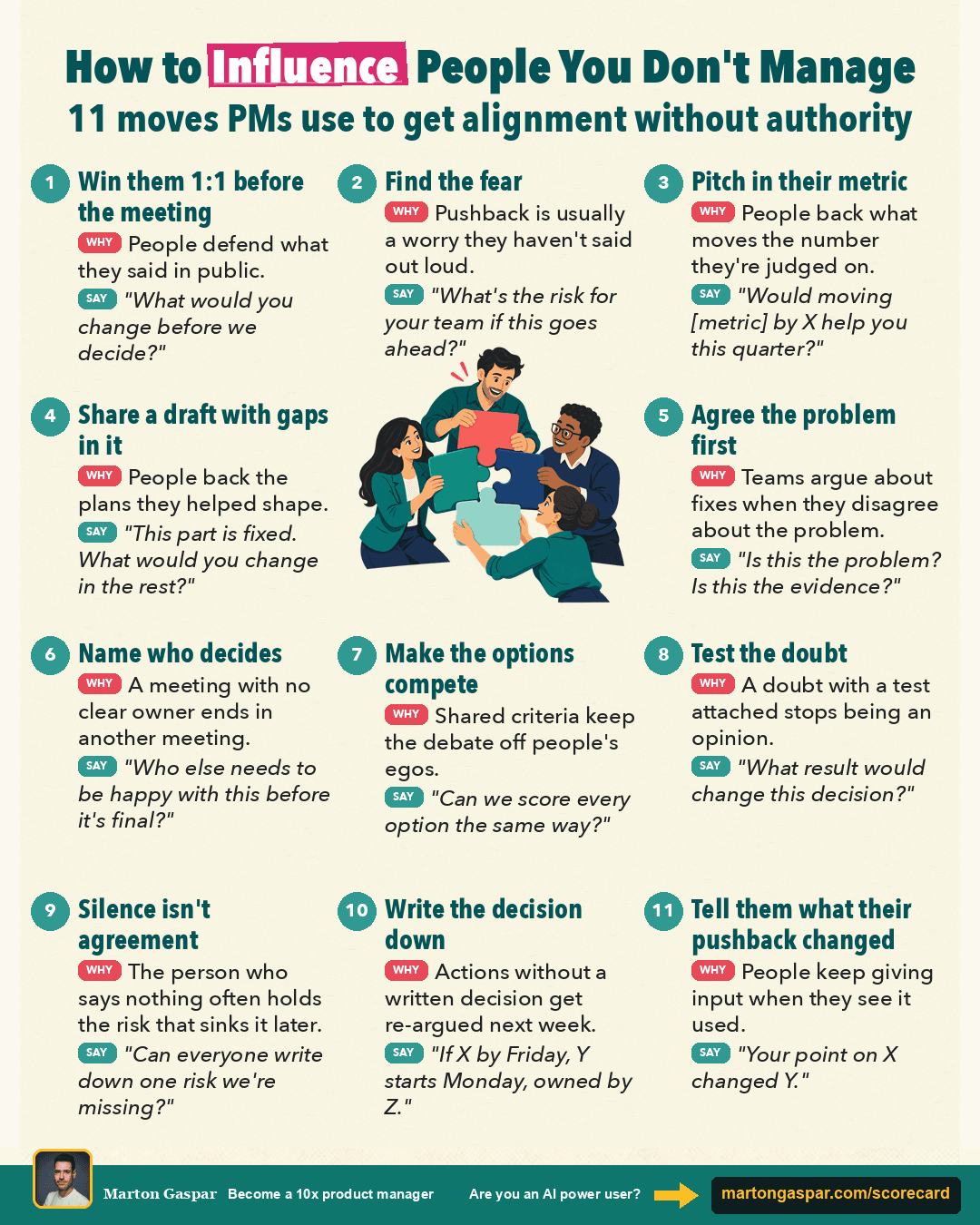
Below are 11 moves for getting alignment without authority, grouped by stage. Each comes with the reason it works and a line you can say word for word.
Before the meeting: do the work one to one
A lot of alignment is won or lost before anyone walks into the room.
The first move is to win them 1:1 before the meeting. The reason: people defend what they said in public. Once someone has objected in front of their peers, backing down costs them face, so the objection hardens. Catch the concern in a private conversation and they can change their mind without an audience. The line to use is "What would you change before we decide?" It invites the objection early, while it is still cheap to act on.
The second move is to find the fear. Pushback is usually a worry they haven't said out loud. The objection you hear ("the timing is wrong", "we need more data") can stand in for something else: extra work for their team, a target they might miss, a promise they already made to someone else. Ask "What's the risk for your team if this goes ahead?" Then deal with that risk, not the surface objection.
The third move is to pitch in their metric. People back what moves the number they're judged on. Your roadmap metric matters to you; their quarterly target matters to them. Translate the proposal into their terms with "Would moving [metric] by X help you this quarter?" If the answer is no, you have learned something useful about where support will and won't come from.
The fourth move is "Share a draft with gaps in it". People back the plans they helped shape. A finished plan invites people to find faults. A draft with deliberate gaps invites them to fill them, and a plan someone helped write is one they will defend. Circulate it with the firm parts marked: "This part is fixed. What would you change in the rest?" The fixed part protects what is not up for debate. The open part gives them real ownership.
All four moves give people a way to shape the decision before it goes public, which is when changing their mind costs them least.
In the room: run the decision, not the debate
The fifth move is to agree the problem first. Teams argue about fixes when they disagree about the problem. Two people pushing different solutions are often solving different problems without realising it. Before options go on the table, ask "Is this the problem? Is this the evidence?" Once the room agrees on those two answers, the list of sensible fixes gets much shorter.
The sixth move is to name who decides. A meeting with no clear owner ends in another meeting. Find out who has the final call, and who holds a veto they haven't mentioned yet. "Who else needs to be happy with this before it's final?" brings the hidden approver into view now, rather than two weeks after everyone thought it was agreed.
The seventh move is to make the options compete. Shared criteria keep the debate off people's egos. When an option belongs to a person, criticising the option feels like criticising them. Agree the criteria first, then put every option through the same test: "Can we score every option the same way?" The argument moves from whose idea wins to which option scores best.
The eighth move is to test the doubt. A doubt with a test attached stops being an opinion. A vague doubt from someone senior can stall a decision for weeks. Turn it into something you can check by asking "What result would change this decision?" Now there is a test to run and a result the group has agreed to accept in advance.
The ninth move is to remember that silence isn't agreement. The person who says nothing often holds the risk that sinks it later. A room with no objections can feel like consensus when it only means the person with the biggest concern didn't want to raise it in front of everyone. Ask "Can everyone write down one risk we're missing?" Writing gives the person who won't speak up a way to be heard, and asking every person for one risk makes raising a concern normal instead of awkward.
Each of these moves takes the decision off personalities and puts it on something the group can see: a problem statement, an owner, a set of criteria, a test, a written list of risks.
After the decision: make it stick
The tenth move is to write the decision down. Actions without a written decision get re-argued next week. Memories differ, and anyone who lost the argument has every reason to remember it differently. Close with one sentence that names the condition, the action and the owner: "If X by Friday, Y starts Monday, owned by Z." Send it the same day, while everyone still remembers the meeting the same way.
The eleventh move is to tell them what their pushback changed. People keep giving input when they see it used. If someone raised a concern and it shaped the plan, say so directly: "Your point on X changed Y." It closes the loop on the fear you found in move two and the gaps you left in move four. It also tells the people you don't manage that engaging with you is worth their time, which makes the next round of alignment easier.
Influence comes from the process around the decision
Read the 11 moves together and a pattern shows. None of them depend on seniority or a reporting line. They depend on the order things happen in: private conversations before public ones, the problem before the solution, criteria before options, a written decision before action.
That is good news for any product manager without a big title. The process around a decision is open to whoever is willing to run it well. Run it consistently and people start bringing you in earlier, because the decisions you run tend to stick.
These moves are about winning support for a decision. When the job is turning down a request without losing the relationship, How Product Managers Say No (11 Phrases That Keep the Conversation Open) covers that side of the work.
Pick the stage where your decisions stall most often, before, during or after the meeting, and try one move from it this week.