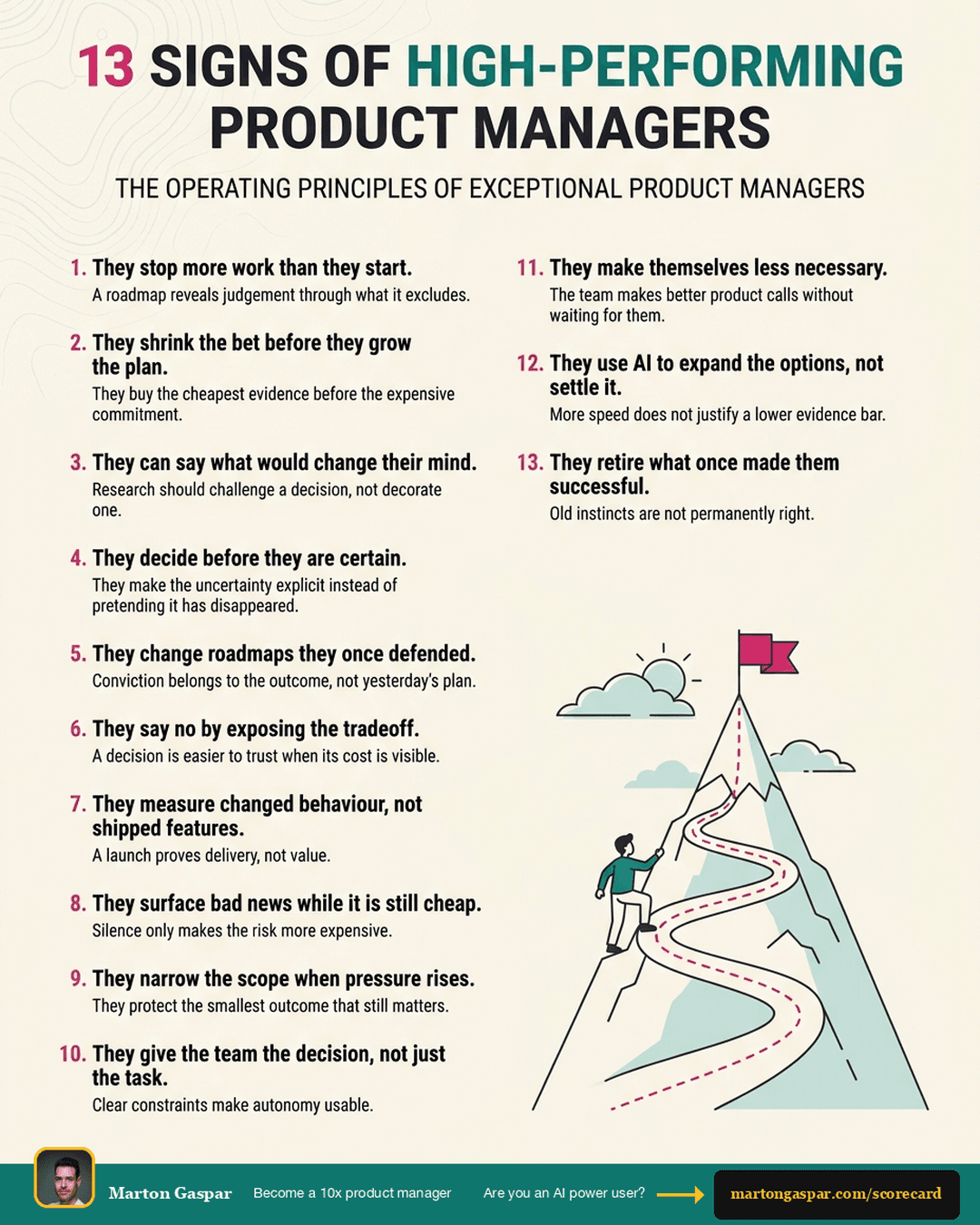
High-performing product managers often look like the problem.
They stop work people are excited about. They reopen decisions everyone wants closed. They don't do it because they enjoy the friction. They do it because a weak bet gets more expensive every day the team keeps moving on it.
Good product judgement creates friction before it creates visible value. None of it shows up as a win on the dashboard, because the win is the expensive mistake that never happened.
I have worked with PMs who make these calls by instinct. For everyone else, these are standards you can learn to hold.
Below are the 13 operating principles of exceptional product managers, grouped into five themes. Run them as a self-check. For each one, ask a plain question: do I still hold this standard when the week gets busy? The ones you hesitate on are the gap worth looking at.
They leave things out
They stop more work than they start. A roadmap reveals judgement through what it excludes. The default is to keep adding, because every item has a sponsor and stopping one means a hard conversation. The better move is to treat the stop list as seriously as the build list.
They shrink the bet before they grow the plan. They buy the cheapest evidence before the expensive commitment. A few days testing the riskiest assumption can save a quarter of building on top of it.
They narrow the scope when pressure rises. When the deadline tightens, the instinct is to cut a little from everything. They protect the smallest outcome that still matters, and let the rest go.
The check: when did you last take something off the roadmap on purpose?
They decide before they're comfortable
They can say what would change their mind. Research should challenge a decision, not decorate one. If you can't name the evidence that would make you drop the plan, the research can only ever say yes.
They decide before they are certain. They make the uncertainty explicit instead of pretending it has disappeared. Waiting for certainty feels safe, and it usually costs more than a clear call with its risks written down.
They say no by exposing the trade-off. A decision is easier to trust when its cost is visible. A bare no sounds like a preference. A no that names what it protects gives people something to argue with, and something they can accept.
The check: for your biggest current bet, could you say out loud what would make you stop?
They let go of yesterday
They change roadmaps they once defended. Conviction belongs to the outcome, not yesterday's plan. Defending the plan you pitched can feel like consistency. Changing it when the evidence moves is the actual job.
They retire what once made them successful. Old instincts are not permanently right. The habits that worked on one product, team or market may need retiring on the next, and the ones that worked best are the hardest to let go.
The check: which of your instincts are you still running on mainly because they worked last time?
They measure value, not activity
They measure changed behaviour, not shipped features. A launch proves delivery, not value. The real result is whether people do something differently afterwards.
They surface bad news while it is still cheap. Silence only makes the risk more expensive. A slipping date or a weak number costs little to raise early and a lot to raise late.
They use AI to expand the options, not settle it. More speed does not justify a lower evidence bar. AI can widen the set of ideas and drafts in minutes. The call on which one is worth building still needs evidence.
The check: what was the last piece of bad news you raised before anyone asked?
They build a team that needs them less
They give the team the decision, not just the task. Clear constraints make autonomy usable. A team handed a task waits for the next one. A team handed the decision and its limits can act without every call routing through one person.
They make themselves less necessary. The team makes better product calls without waiting for them. That can feel like losing importance. In practice it's the clearest sign the judgement has spread beyond one person.
The check: which decisions still wait for you, and do they need to?
The standards you hold under pressure
Every one of these calls is easier to skip once the pressure is on. Saying yes is faster. Keeping the plan is calmer. Staying quiet about the bad news buys a week.
High-performing PMs aren't defined by how much they know or how much they ship. They're defined by the standards they hold when pressure makes lowering them easier.
You already know what the right call is. The test is whether you still make it when saying yes would be easier, especially when it means killing something the team is proud of.
So pick the one standard on this list that's hardest for you to hold. That's the one worth practising first.
Download the one-page version and keep it where you make the calls.