Your CEO's bad idea isn't the real problem. Here's what is.
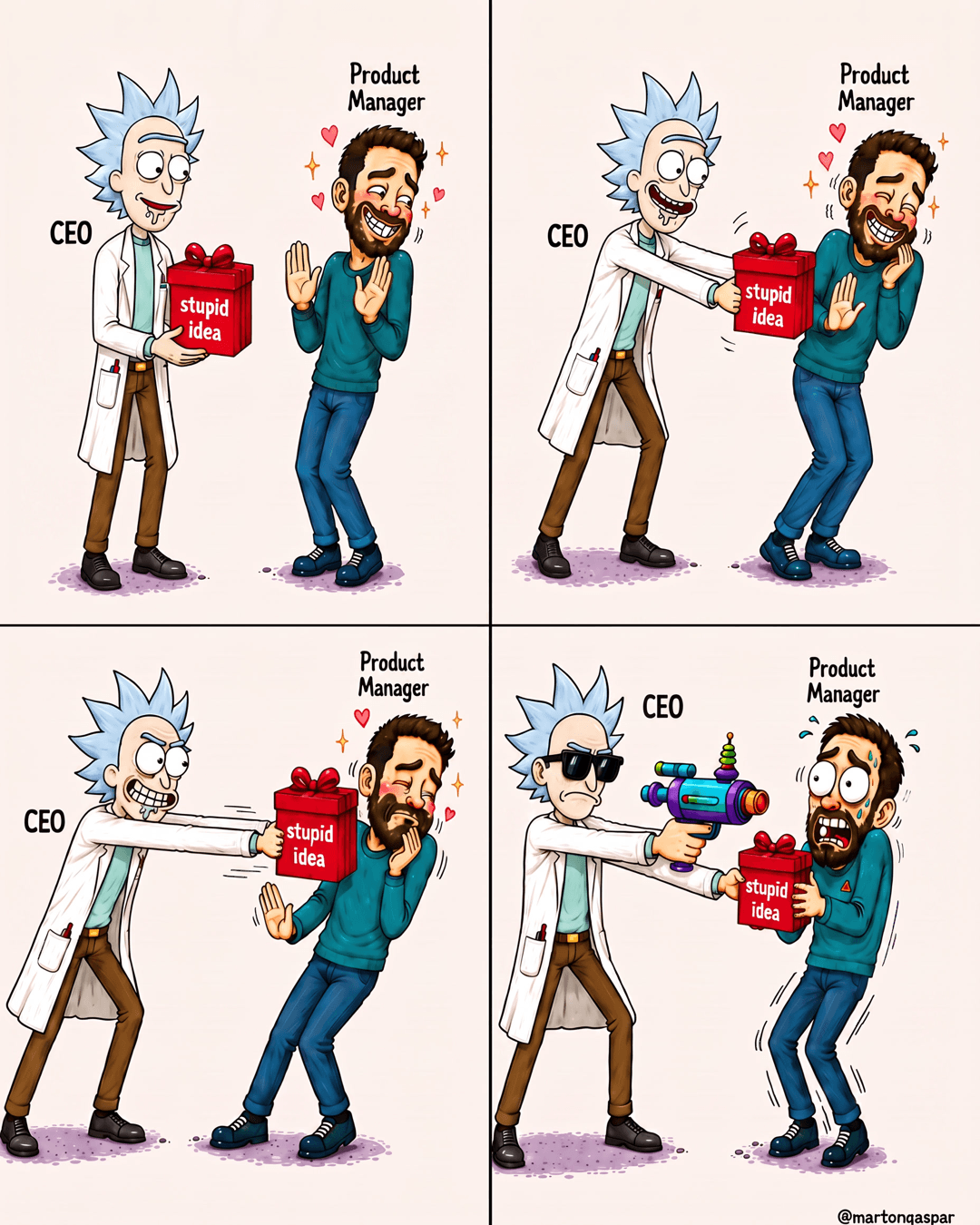
The comic that goes with this piece shows a CEO holding out a gift box with "stupid idea" written on the side. The product manager smiles, blushes, leans away and holds up both hands. The CEO keeps pushing. By the last panel the box is in the product manager's arms and the CEO is wearing sunglasses and holding a toy ray gun.
It's funny because the pattern is familiar. An idea arrives from the top, the product manager tries to decline it politely, and the pressure goes up until the idea gets built anyway. Nobody in that loop is a villain. The loop is the problem.
Fear or insight
Here's what I've found. A CEO pushing an idea usually isn't attached to the idea itself. Often, they're scared. A board meeting is coming, a competitor moved, a number went the wrong way, and the idea is the first thing that looked like a response.
Sometimes it's the opposite. The CEO has seen something you haven't: a conversation with a big customer, a shift in the market, a pattern across the business that doesn't show up in your backlog. Then the idea isn't bad at all. It's early, and it's missing its reasoning.
What I do first is work out which one I'm dealing with. Fear or insight. The response is completely different. Fear needs reframing. Insight needs accelerating.
The seven questions below are how you find out, and how you use what you find.
Ask why now
Before you debate the idea, find the trigger. Ask "what changed?"
An idea that appears on a Tuesday rarely came from nowhere. Something happened: a call, a report, a meeting. That trigger tells you more than the idea does, because the trigger is the real problem and the idea is one guess at solving it.
Debate the idea first and you're arguing with a guess. Find the trigger first and you're working on the problem together.
Name the outcome
Ask "if this worked, what would be different?" Then write the answer down in their words, not yours.
This does two things. It moves the conversation from the build to the result the CEO actually wants. And it gives you something you can hold every option against later. When the outcome is written in their language, they'll recognise it when you bring it back.
The idea is negotiable. The outcome is the part worth agreeing on.
Test the evidence
Ask "what tells us how large or urgent this really is?"
The evidence question is where fear and insight start to separate. Insight usually comes with something behind it, even if it hasn't been said out loud yet. Fear usually comes with a feeling that something must be done now. Neither is wrong to have. But the size of the response should match the size of the problem, and you can't know the size without looking.
Ask it with curiosity, not as a trap. You're trying to understand the problem, not win the meeting.
Surface the constraints
Find out what is already promised, and to whom. Then ask whether the idea itself is fixed, or just the outcome.
This is the question that saves the most time. If the CEO has already told the board or a customer that something is coming, your options are narrower than they look. If only the outcome is fixed, you have room to find a better route to it. You need to know which before you start building alternatives.
A plan that ignores a promise already made is a plan nobody will back.
Bring back options
Come back with options, and keep the CEO's idea in the set. Make the options compete, not the people.
This matters more than it sounds. If you bring back only your alternative, it becomes your idea against theirs, and now it's personal. If their idea sits next to two others, all judged against the outcome they named, it becomes a decision about the best route. They can pick their own idea if it wins. They can also let it go without losing face.
Options turn a standoff into a choice.
Price each option
Every option costs something, so say what. "If we build it now, the billing fix moves to Q3."
That sentence is a cost, not a refusal. You're not saying no to the idea. You're showing what yes takes away. Most ideas look better when they appear free, and every roadmap has a fixed amount of time in it. Putting the price next to each option lets the CEO make the trade-off with their eyes open.
A clear cost does more work in the room than a polite objection.
Recommend the smallest credible next step
End with a recommendation: the smallest step that moves toward the outcome. That might be a cheaper route to the same result, or a test before the full build.
If it was fear, a small visible step is often exactly what's needed, because it shows movement without betting the quarter. If it was insight, a quick test is how you speed it up, because it proves the idea faster than the full build would.
The smallest credible step serves both, which is why it's usually the right thing to recommend.
Find the fear and you get a seat at the table
There are three ways this conversation can go. Say yes and you get tasks. Say no and you get worked around. Find the fear, or the insight, and you get a seat at the table.
The seven questions aren't a script for managing a difficult CEO. They're a way of taking the idea seriously enough to find out what's underneath it. Why now, the outcome, the evidence, the constraints, the options, the price, the next step. Each one moves you from the person who receives ideas to the person who helps make the decision.
Which of the seven do you skip most when the pressure is on? That's the one to practise first.
Download the one-page version and keep it for the next time an idea arrives from the top.