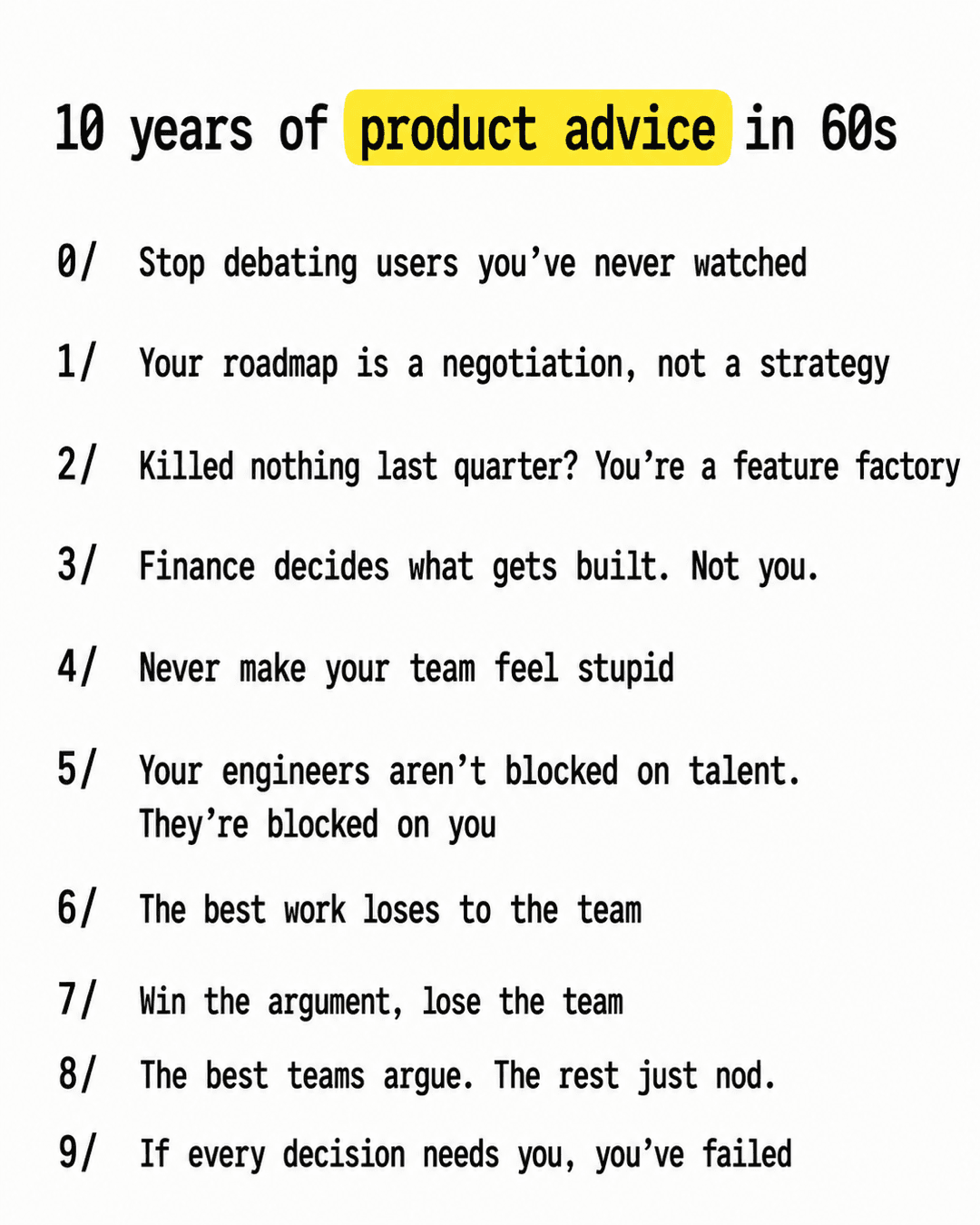
Ten years of product advice, short enough to read in a minute.
None of these are about frameworks or tools. They're about the parts of the job that don't show up on a job spec: who watched the users, who says the no, who controls the money, and whether your team feels safe enough to tell you the truth. Each one looks obvious written down. Each one is easy to lose in a busy quarter.
Here they are, grouped into five themes, with the one line they all come back to at the end.
Watch the users before you argue about them
The default in most product rooms is debate. Everyone has a view on what users want, and the meeting runs until someone wins.
Stop debating users you've never watched. The loudest opinion in the room belongs to whoever watched the fewest users. Opinions are cheap to hold when nothing has tested them. Watching a real person use the product ends arguments that meetings can't.
Watched beats argued, every time.
A roadmap shows what you had the nerve to cut
Your roadmap is a negotiation, not a strategy. Half of it is a no that nobody had the nerve to say out loud. Every stakeholder got a slot, and the result reads like a plan while committing to nothing. The way to spot the unspoken no is to ask, for each item, what would happen if it disappeared tomorrow. If the answer is nothing much, it's there to keep someone happy, not to move the product.
The same test applies to the past quarter. If the team killed nothing last quarter, it's running a feature factory. Good product isn't what you ship. It's what you had the guts to stop. Stopping a feature is the decision nobody praises, and it's the one that frees the team to do something that matters.
A roadmap earns the word strategy when someone can see what it left out.
Learn how the money moves, and tell the story
Finance decides what gets built. Not you. Budget follows the people who understand how the money moves, so learn how it moves, or watch your best ideas lose to someone who did. That means knowing which numbers the people holding the budget watch, and putting your idea in their terms rather than yours.
The second half of the same lesson: the best work loses to the best story. A strong idea without a clear story competes badly against a weaker idea told well. Learn to tell yours, or a worse idea takes the budget.
Good ideas don't fund themselves. Someone has to make the case.
Build a team that tells you the truth
Never make your team feel stupid. Ask the dumb question first. Nobody flags a risk in a room where looking stupid has a cost, so the risks stay hidden until they're expensive.
Win the argument, lose the team. Being right is cheap. The cost shows up later, in the people who stop telling you what they think.
The best teams argue. The rest just nod. A nodding team isn't aligned. It just backs whoever sounds most sure. Real alignment sounds louder than that, because people disagree in the room instead of after it.
The team that feels safe to push back is the team that catches problems early.
Let decisions run without one person
Engineers are rarely blocked on talent. They're blocked on the decision they're waiting for. Three weeks waiting for a call that could be made in a day costs more than any sprint.
The trap behind it is how good it feels when every call starts routing through one person. It feels valuable. It looks like leadership. And it turns that person into the queue for the whole team. If every decision needs one person, the system has failed. When two people disagree, lock them in a room and let them own it.
Owning the outcome is different from making every call. The job is setting the context well enough that the people closest to the work can decide without waiting.
The goal is a team that decides well when you're not in the room.
Build less. Decide better.
Strip all ten back and it's one line: build less, decide better.
Watching users, cutting the roadmap, stopping features, learning the money, telling the story, keeping the room safe, letting others own the call. Every one of them is a decision about what not to do, or who gets to decide. Output is easy to add. Better decisions are what make the output worth anything.
Download the one-page version and keep it for your next planning week.