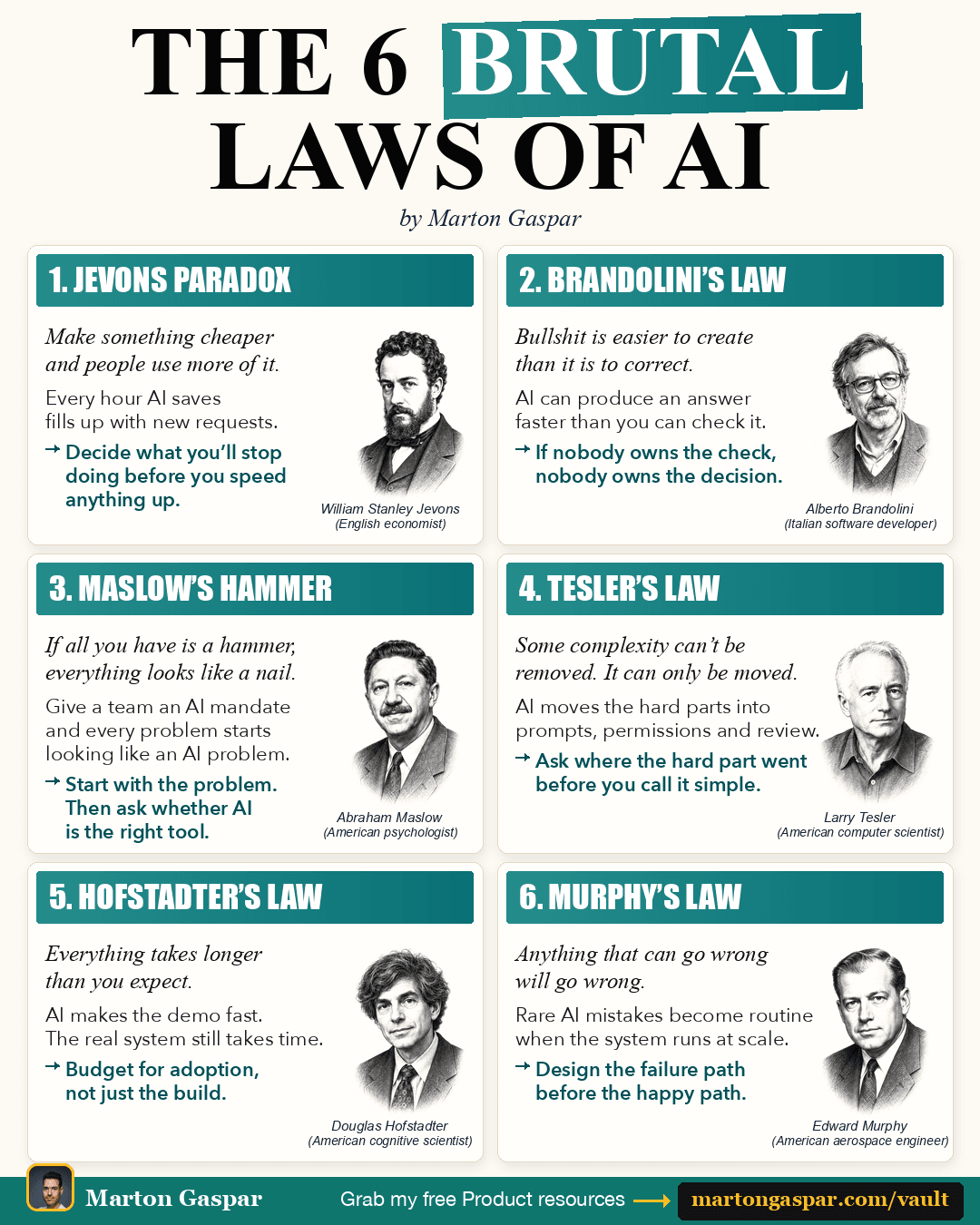
Six laws that weren't written for product teams. But they explain why so many AI features fail at scale.
None of these laws is about the model. They are about judgement. Each one turns into a question, and each question kills the wrong decision before it burns a quarter.
The laws didn't change. The cost did. AI just lets you build the wrong thing faster than ever. Below are the six, in the order to ask them, with the question to bring to your next planning session.
Maslow's hammer: would we still build this if AI weren't in the pitch?
Abraham Maslow was an American psychologist. His hammer is the old line: if all you have is a hammer, everything looks like a nail.
Give a team an AI mandate and every problem starts looking like an AI problem. The roadmap fills with features that exist because AI is available, not because a customer needed them.
The question: would we still build this if AI weren't in the pitch? If the answer is no, the problem may not be real. Start with the problem. Then ask whether AI is the right tool.
Jevons paradox: what will we stop doing with the time AI saves?
William Stanley Jevons was an English economist. His paradox: make something cheaper and people use more of it.
Applied to AI at work, every hour AI saves fills up with new requests. The time you expected to win back never arrives, because the cheaper work invites more work.
The question: what will we stop doing with the time AI saves? Decide what you'll stop doing before you speed anything up. Otherwise the saving gets spent before anyone chooses how.
Brandolini's law: who checks the output, and how long does it take them?
Alberto Brandolini is an Italian software developer. His law, in politer words: nonsense is easier to create than to correct.
AI can produce an answer faster than you can check it. That moves the real work from making the output to reviewing it, and the reviewing often lands on someone who never planned for it.
The question: who checks the output, and how long does it take them? If nobody owns the check, nobody owns the decision.
Tesler's law: what are we making harder for someone else?
Larry Tesler was an American computer scientist. His law: some complexity can't be removed. It can only be moved.
AI moves the hard parts into prompts, permissions and review. The feature looks simpler on the surface, while the difficulty has gone somewhere else: to another team, to support, or to the customer.
The question: what are we making harder for someone else? Ask where the hard part went before you call it simple.
Murphy's law: what happens the day it's wrong in front of a customer?
Edward Murphy was an American aerospace engineer. His law needs no introduction: anything that can go wrong will go wrong.
With AI, rare mistakes become routine when the system runs at scale. A failure that almost never happens in testing will happen regularly once enough customers use the feature.
The question: what happens the day it's wrong in front of a customer? Design the failure path before the happy path.
Hofstadter's law: are we planning for the demo or the system?
Douglas Hofstadter is an American cognitive scientist. His law: everything takes longer than you expect.
AI makes the demo fast. The real system still takes time: the edge cases, the reviews, the change in how people work. A plan built on demo speed will run late on system reality.
The question: are we planning for the demo or the system? Budget for adoption, not just the build.
The laws didn't change, the cost did
Read the six together and they point the same way. Each one warns about a decision that gets made by default when nobody makes it on purpose. Maslow asks whether the problem is real. Jevons asks where the saved time goes. Brandolini asks who checks. Tesler asks where the hard part moved. Murphy asks what happens when it fails. Hofstadter asks whether you planned for the real thing.
A simple way to use them: put the six questions at the top of the planning document for any AI feature, and treat a blank answer as a reason to wait. A question with no answer at kickoff tends to come back later as a problem, when it is far more expensive to fix.
Ask them before the kickoff, not in the post-mortem. AI made the demo cheap. It never made the decision cheap.
If these six are useful, the earlier set (Pareto, Goodhart, Sturgeon, Conway, Kidlin and Brooks) covers the decisions that sit under every roadmap, AI or not: /vault/6-brutal-laws-of-product.
Which law do you see people skipping?