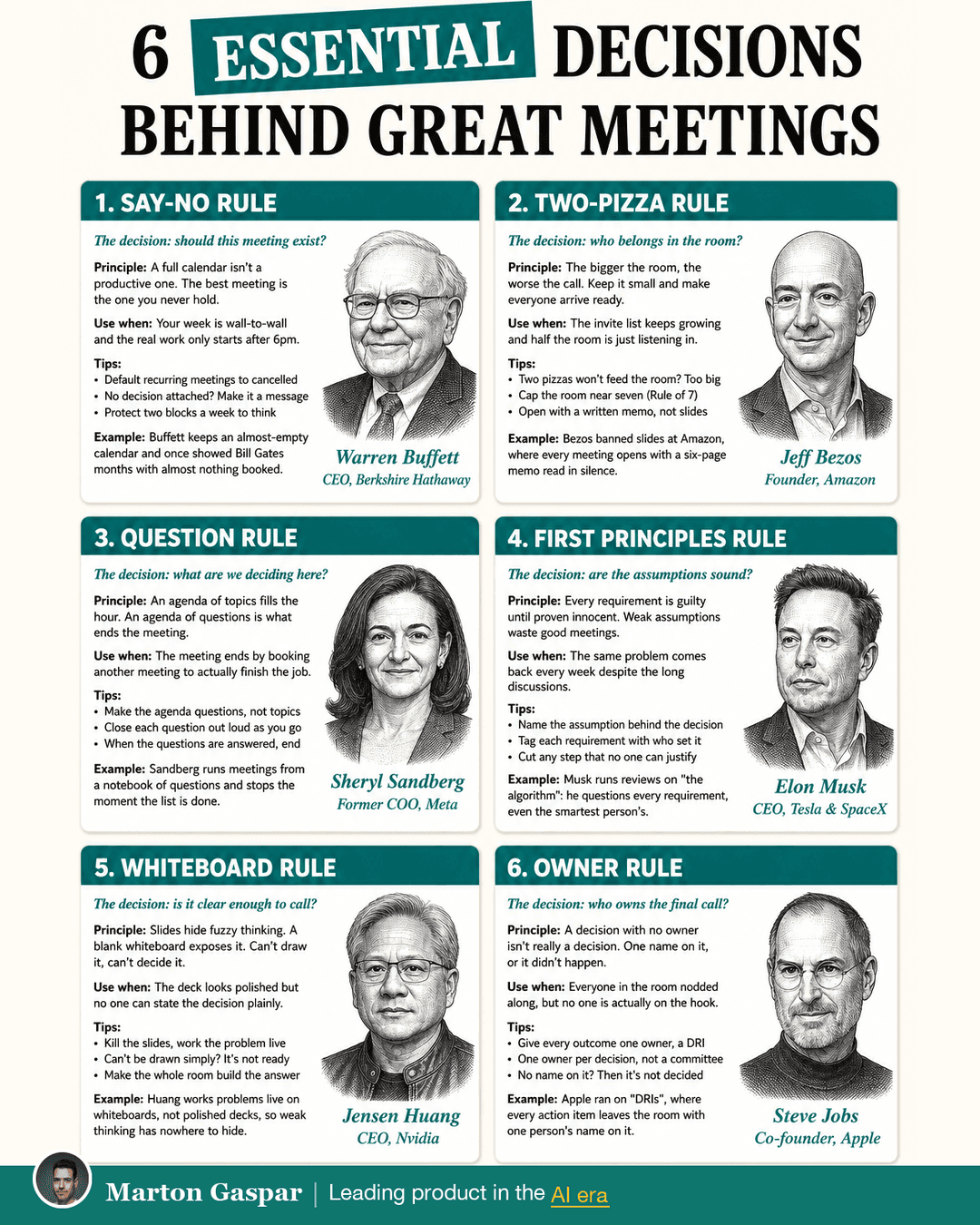
Most meetings fail before they start.
The leaders with the best meetings are not better facilitators. They make six decisions before the meeting ever begins. The strongest leaders I've watched don't use meetings to discover the decision. They use them to challenge it, refine it and commit to it.
Most meeting advice is about running the meeting: timekeeping, energy, who speaks when. Most meeting problems were created earlier, when someone sent an invite for a decision that was never ready to be made. When the decision is clear before the invite goes out, everything gets easier. Fewer people need to be in the room. Discussions get shorter. Ownership stops needing to be chased. The same issue stops coming back every week.
The goal isn't fewer meetings. It's better decisions. Here are the six decisions, each with the principle behind it, the moment you need it and a few ways to apply it.
Decide whether the meeting should exist (the say-no rule)
The first decision is the one most calendars skip: should this meeting happen at all?
A full calendar isn't a productive one. The best meeting is the one you never hold. You need this rule when your week is wall-to-wall and the real work only starts after 6pm.
Three ways to apply it. Default recurring meetings to cancelled, so each one has to earn its place back. If there is no decision attached, make it a message instead. Protect two blocks a week to think.
The infographic uses Warren Buffett as the example: he keeps an almost-empty calendar, and once showed Bill Gates months with almost nothing booked.
Decide who belongs in the room (the two-pizza rule)
The bigger the room, the worse the call. Keep it small and make everyone arrive ready.
You need this when the invite list keeps growing and half the room is just listening in. A simple test: if two pizzas won't feed the room, it is too big. Cap the room near seven, sometimes called the Rule of 7. Open with a written memo, not slides, so people arrive having thought about the problem rather than meeting it for the first time.
The example here is Jeff Bezos, who banned slides at Amazon, where every meeting opens with a six-page memo read in silence.
Decide what you are deciding (the question rule)
An agenda of topics fills the hour. An agenda of questions is what ends the meeting.
You need this when the meeting ends by booking another meeting to finish the job. Make the agenda questions, not topics. Close each question out loud as you go, so everyone hears the answer. When the questions are answered, end the meeting, even if there is time left on the clock.
The infographic's example is Sheryl Sandberg, who runs meetings from a notebook of questions and stops the moment the list is done.
Decide whether the assumptions are sound (the first principles rule)
Every requirement is guilty until proven innocent. Weak assumptions waste good meetings.
You need this when the same problem comes back every week despite long discussions. That pattern usually means the group keeps debating the answer while the assumption underneath it never gets tested. Name the assumption behind the decision. Tag each requirement with the person who set it, so it can be questioned at the source. Cut any step that no one can justify.
The example given is Elon Musk, who runs reviews on "the algorithm": he questions every requirement, even the smartest person's.
Decide whether it is clear enough to call (the whiteboard rule)
Slides hide fuzzy thinking. A blank whiteboard exposes it. If you can't draw it, you can't decide it.
You need this when the deck looks polished but no one can state the decision plainly. Kill the slides and work the problem live. If it can't be drawn simply, it isn't ready. Make the whole room build the answer, so the thinking belongs to the group and not to whoever made the deck.
The example is Jensen Huang, who works problems live on whiteboards rather than polished decks, so weak thinking has nowhere to hide.
Decide who owns the final call (the owner rule)
A decision with no owner isn't really a decision. One name on it, or it didn't happen.
You need this when everyone in the room nodded along but no one is on the hook. Give every outcome one owner, a directly responsible individual. One owner per decision, not a committee. If there is no name on it, it isn't decided yet.
The infographic's example is Apple under Steve Jobs, which ran on "DRIs", where every action item leaves the room with one person's name on it.
The meeting is the last step, not the first
Read the six together and they form a sequence. Should it exist? Who needs to be there? What exactly are we deciding? Are the assumptions sound? Is it clear enough to call? Who owns it afterwards?
Miss one and the meeting gets harder. Miss a few and you spend an hour discussing something that was never ready for discussion in the first place. None of this needs a new tool or a new ritual. It needs ten minutes of thinking before the invite goes out, by the person sending it.
If decisions in your team tend to stall once they leave the room, Influence Without Authority (/vault/how-to-influence-without-authority) covers the conversations before and after the meeting that make a decision stick.
Pick the decision you see missed most often, and try fixing only that one in your meetings this week.