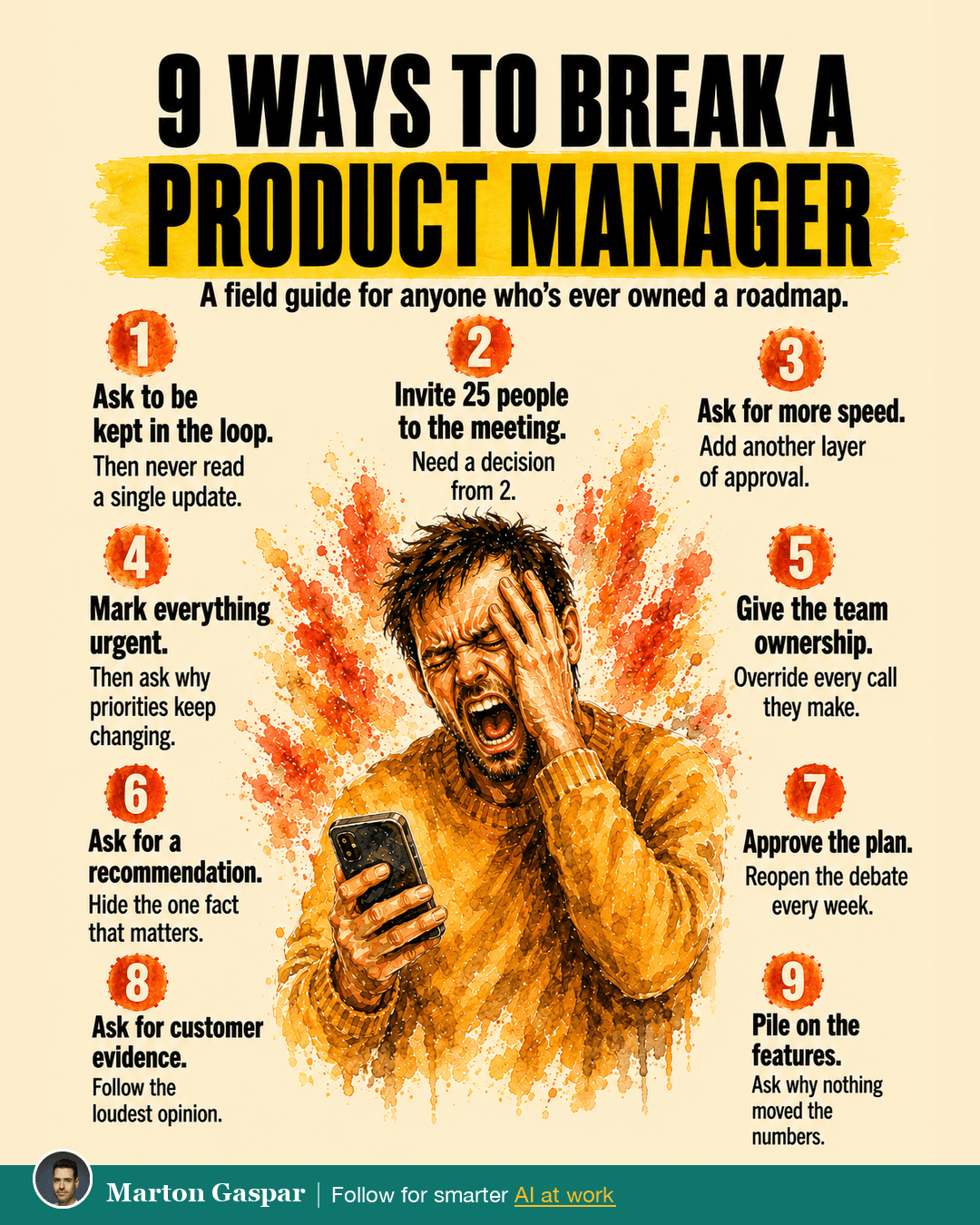
Nine things at work drive you up the wall. One pattern sits underneath them. Spot it, break it, and the nine fix themselves.
Anyone who has ever owned a roadmap will recognise the list below. Each one looks like a separate frustration. Read them together and the same tell shows up nine times over. Catch it early, and the cycle never starts.
The nine ways
Ask to be kept in the loop, then never read a single update.
Invite 25 people to the meeting, when you need a decision from 2.
Ask for more speed, then add another layer of approval.
Mark everything urgent, then ask why priorities keep changing.
Give the team ownership, then override every call they make.
Ask for a recommendation, and hide the one fact that matters.
Approve the plan, then reopen the debate every week.
Ask for customer evidence, then follow the loudest opinion.
Pile on the features, then ask why nothing moved the numbers.
If you have ever been on the receiving end of more than one of these in the same week, you know how it feels. It is easy to blame the process, the org chart or the person in front of you.
Some of them waste time. Some of them waste trust. The worst do both: a plan approved on Monday and reopened on Thursday costs the week's work, and it teaches the team that no decision is ever final.
The pattern underneath: one fear
I have coached enough leaders to stop blaming the process. Nearly every time, the root is one fear: being the one who got it wrong.
The tell is always the same. A decision with one owner becomes everyone's problem. More people. Another meeting. A committee. No single name on it.
Look back at the list. The extra approval layer, the 25-person invite, the plan reopened every week, the call the team owned that gets overridden anyway. Each one spreads a decision across more people so that nobody has to carry it alone. A meeting is just fear with a calendar invite.
And the fear rolls downhill. It lands on you, and you pass it on without noticing.
You can't remove the uncertainty
The uncertainty is real. Nobody gets to make product decisions with all the facts in. What you can change is how you decide inside it.
Here are six moves to decide without needing to be right.
Make it a bet, not a verdict
You are backing the decision, not promising it is right. A verdict has to be correct. A bet only has to be a good call on what you knew at the time, and that is a standard anyone can meet.
Decide at good enough, not perfect
Waiting for every fact is how fear buys time. Complete information rarely arrives in product work, and one more round of data can look responsible while it keeps the decision safely unmade. Set the point where you know enough to move, and move when you reach it.
Make being wrong cheap
Small, reversible, dated. If you can undo it by Friday, it is a test. The smaller and more reversible the decision, the less anyone needs to be certain before making it.
Say up front what would change your mind
Name the signal that would make you change course before you start. Then new data is a signal, not an ambush. Nobody has to defend the decision against evidence, because the evidence was part of the plan.
Put one name on the decision
Yours. By committee, it waits forever. One named owner is what turns a discussion into a decision, and it is the direct answer to the tell above. It also means giving ownership and then leaving it alone. Ownership that gets overridden every time is not ownership, and the team can tell.
Make being wrong safe to say
"On me if it misses," said out loud. That starves the blame. When the person who made the call owns the miss in advance, nobody else has a reason to protect themselves.
Go first
None of these moves needs more certainty. They just need you to go first.
On one stuck decision this week, say it out loud:
This one's mine.
We're betting it works. We'll know by Friday.
If I'm wrong, it's on me, and we move fast.
Now there is nothing left for the fear to do.
That is the job. Not being right every time. Being the one who makes it safe to be wrong. Be where the fear stops.
When the pressure arrives as a pile of urgent requests, How to Push Back on Urgent Requests (/vault/how-to-push-back-on-urgent-requests) has the questions to ask first.