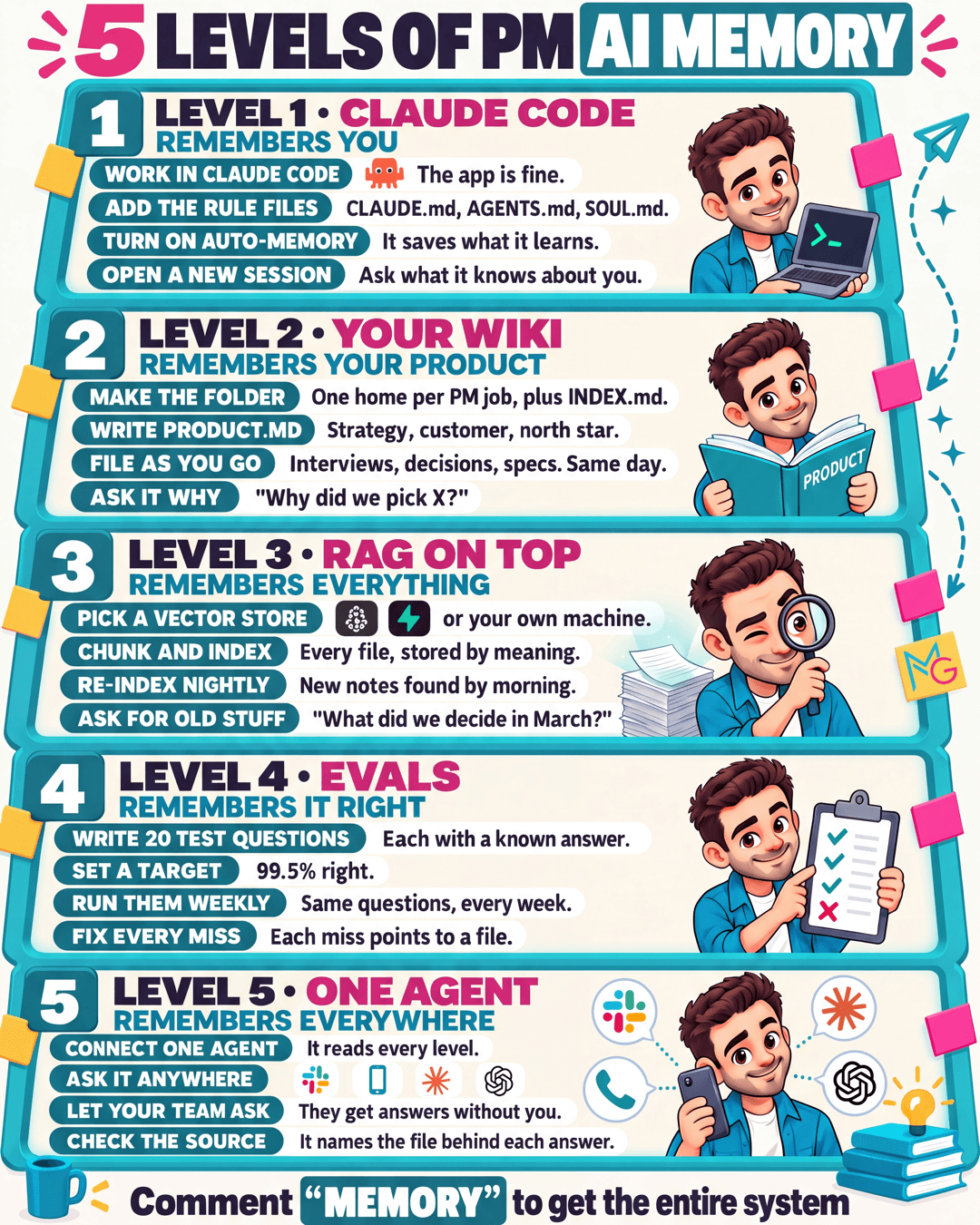
I explained my product once. My AI recalls it at 99.5%.
For months I pasted the same context from Notion into a chat window. Every single chat. The strategy, the customer, the decision we made last month and why. Then the window closed and the AI forgot all of it.
A product manager's value sits in context: why this customer and not that one, what you said no to, which number you steer by. If your AI can't hold that context, you end up as its copy-paste service, and the answers stay generic because the input is generic.
So I built a system instead. It has five levels. Each one fixes a problem you probably already feel every week, and you don't need all five on day one.
Level 1: Claude Code remembers you
A chat window forgets you when it closes. Claude Code reads your files before you type a word.
Start with one folder holding three files: CLAUDE.md, AGENTS.md and SOUL.md. Between them they say who you are, how you work, and your never-do list. Then type /memory to check that auto memory is on, so it saves what it learns as you go.
The test is simple. Open a new session and ask what it knows about you. If it gets you wrong, a line is missing from SOUL.md. Add the line and ask again. You are fixing the source, not arguing with the output.
Level 2: Your wiki remembers your product
At level 1 your AI knows you. It still can't tell you why you picked this customer over that one.
Make one folder for each stage of the product manager's job, plus an INDEX.md that the AI reads first. Then write PRODUCT.md before anything else: your strategy, your customer, and the one number you steer by. Rough is fine. A rough page it can read beats a polished one in your head.
From then on, file every interview and every decision the day it happens, with the why. The why is the part that matters most, because it is what lets the AI answer "why did we pick X?" months later. The idea comes from Andrej Karpathy's LLM Wiki: a folder of plain pages the AI reads, instead of context scattered across old chats.
Level 3: RAG search remembers everything
Past a hundred or so files, the index stops being enough. You can't expect the AI to open every page to find one line.
Search by meaning fixes that. It finds the note even when your question uses different words from the note itself. Ask Claude to set up the memory-search skill. By default it runs on your own machine, free and private. If you want it in the cloud, point it at Pinecone or Supabase instead.
Schedule a nightly re-index so new notes are found by morning. Then ask the questions that used to cost you an afternoon of digging: "Have we heard this complaint before?" or "What did we decide in March?"
Level 4: Evals make sure it remembers right
Finding a note isn't the same as the note being true. A memory system that answers confidently from a stale page is worse than one that says it doesn't know.
Write 20 questions you already know the answers to. Your customer. Your last big call. What you are not doing this quarter. Then run the memory-evals skill every week. It answers from the folder only and logs the score.
Aim for 99.5% over time. That is the recall score my own system reached. A wrong answer shows you which file to fix. Fix the file, never the answer. If you patch the answer, the same gap will show up in the next question you didn't think to test.
Level 5: One agent remembers everywhere
A memory only you can reach still runs through you. If your team has to ask you so that you can ask the AI, every answer still waits on your calendar.
For you, use Claude Code with Remote Control, so you can ask from your phone. For your team, set up a Claude or ChatGPT Project loaded with only your shareable files. Or drop Claude into Slack on a Team or Enterprise plan.
Whichever you pick, make it cite the file for every answer. Then anyone can check it, and a wrong answer points straight at the page that needs fixing.
Build the level you need next
Read the five levels together and the pattern is clear. Each level answers the question the one before it leaves open. Level 1 knows you but not your product. Level 2 knows your product but can't search it at scale. Level 3 searches it but can't tell you if it is right. Level 4 checks it is right but only for you. Level 5 hands it to everyone.
You don't need all five on day one. Start with the level that fixes the problem you feel most this week. Build them once, and you never re-explain your product again.
There is a craft point under the tooling too. Writing PRODUCT.md, filing decisions with the why, and writing 20 questions with known answers are product management habits first. The AI just makes it obvious when they are missing. If you want the wider argument for building a system around your role rather than buying the next model, see /vault/best-ai-system-cannot-be-bought.