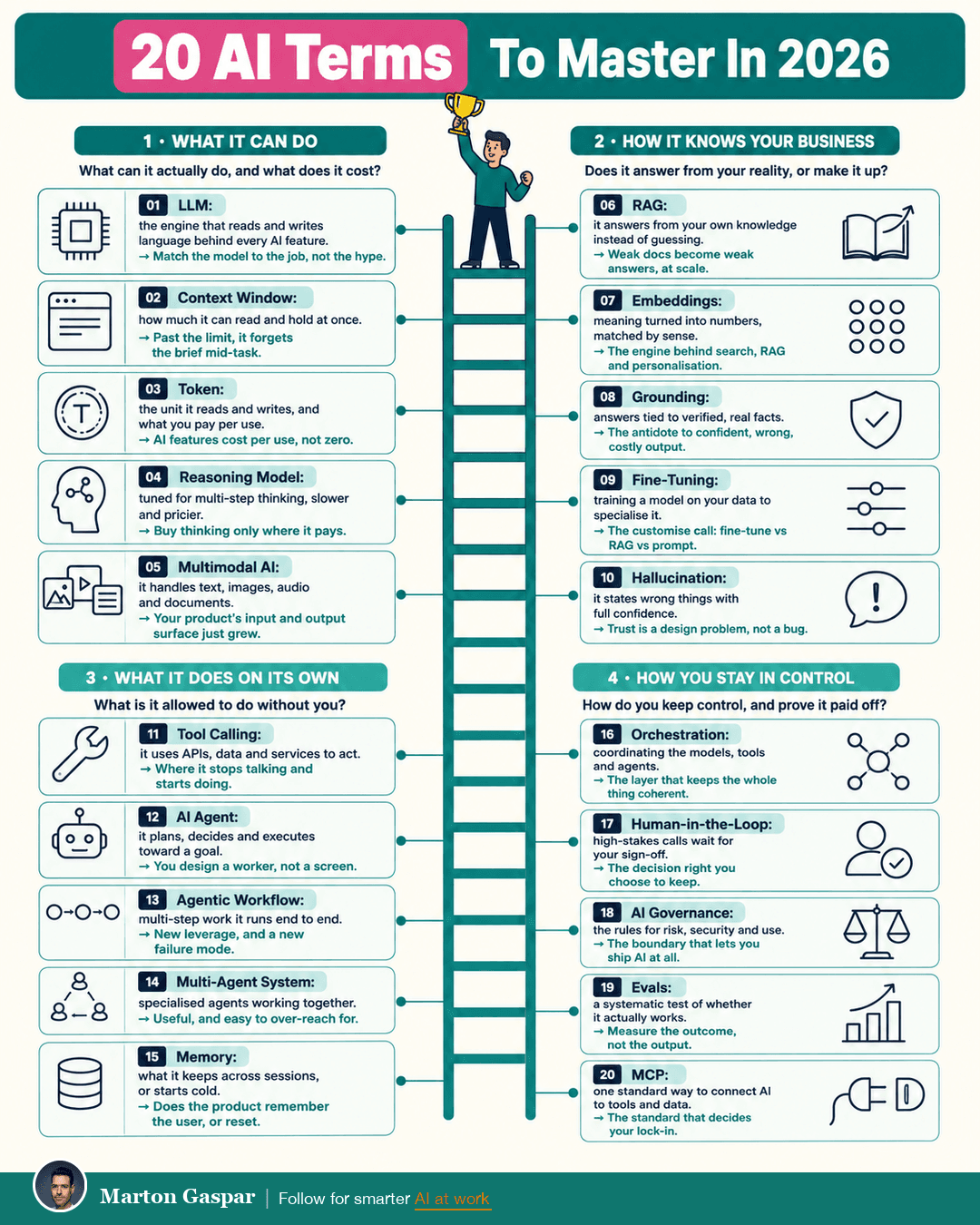
I watched product leaders become impossible to replace in a year. Not by learning more tools. By learning the language.
The day AI entered the roadmap, the job split in two. An engineer says "we'll just fine-tune it", or "the agent can own that flow". The leaders who can ask "why fine-tune and not RAG?" or "what's the eval before this ships?" set the direction. The rest defer to whoever sounds most technical. Same job, same team. One interrogates the words. The other nods.
That makes vocabulary a career question before it is a technical one. The words are how a product leader keeps their judgement in the room once the conversation turns to models and agents. And I'm not writing this from the outside. I've built with these myself: RAG, agents, evals, fine-tuning, MCP, memory. So when I say these 20 terms are the job now, they're mine too.
The 20 sort into four questions that sit behind every AI bet. Learn the questions first and each term has somewhere to live.
What can it do, and what does it cost us?
This group is about fit and running cost.
An LLM is the engine that reads and writes language behind every AI feature. Match the model to the job, not the hype. The context window is how much it can read and hold at once. Past the limit, it forgets the brief mid-task. A token is the unit it reads and writes, and what you pay per use. AI features cost per use, not zero.
A reasoning model is tuned for multi-step thinking, so it is slower and pricier. Buy thinking only where it pays. Multimodal AI handles text, images, audio and documents, which means your product's input and output surface just grew.
The question to ask in the room: is this the right engine for this job, and what does each use cost us?
Does it answer from our data, or make it up?
This group decides whether anyone can trust the output.
RAG (retrieval-augmented generation) answers from your own knowledge instead of guessing. Weak docs become weak answers, at scale. Embeddings are meaning turned into numbers and matched by sense. They are the engine behind search, RAG and personalisation. Grounding ties answers to verified, real facts. It is the antidote to confident, wrong, costly output. Fine-tuning trains a model on your data to specialise it, and it is the customise call: fine-tune vs RAG vs prompt. A hallucination is the model stating wrong things with full confidence.
The one that bites is grounding and hallucination. Not because the model is dumb. Because trust is a design problem, not a bug.
When I built a grounded RAG system over my own knowledge base, the architecture was the quick part. The slog was retrieval quality and keeping the docs current. The surprise was the citations. They showed me exactly when the model was reaching for a plausible neighbour instead of the right passage. That's the line between grounding and hallucination, and it's where the expensive AI bets go wrong.
What is it allowed to do on its own?
This group moves the product from talking to acting.
Tool calling is when it uses APIs, data and services to act. It is where it stops talking and starts doing. An AI agent plans, decides and executes toward a goal, so you design a worker, not a screen. An agentic workflow is multi-step work it runs end to end: more reach, and a new failure mode. A multi-agent system is specialised agents working together. Useful, and easy to over-reach for. Memory is what it keeps across sessions, or whether it starts cold. Does the product remember the user, or reset?
Every term here is a decision about autonomy. Someone has to draw the line on what the system may do without a person, and that line is a product decision.
How do we keep control, and prove it paid off?
This group is where product judgement does the most work.
Orchestration coordinates the models, tools and agents. It is the layer that keeps the whole thing coherent. Human-in-the-loop means high-stakes calls wait for your sign-off: the decision right you choose to keep. AI governance is the rules for risk, security and use, the boundary that lets you ship AI at all. Evals are a systematic test of whether it actually works. Measure the outcome, not the output. MCP (Model Context Protocol) is one standard way to connect AI to tools and data, and the standard you pick decides your lock-in.
"What's the eval before this ships?" is one of the questions that changes the conversation. It moves the debate from a demo that looks good to a test that proves something.
The 21st term
Twenty terms is a starting set, not the full list. The useful exercise is to find the gap in your own version of it.
If you added a 21st term to this list, what would it be? And which of these has already changed a decision on your roadmap? Most of us would miss at least one.