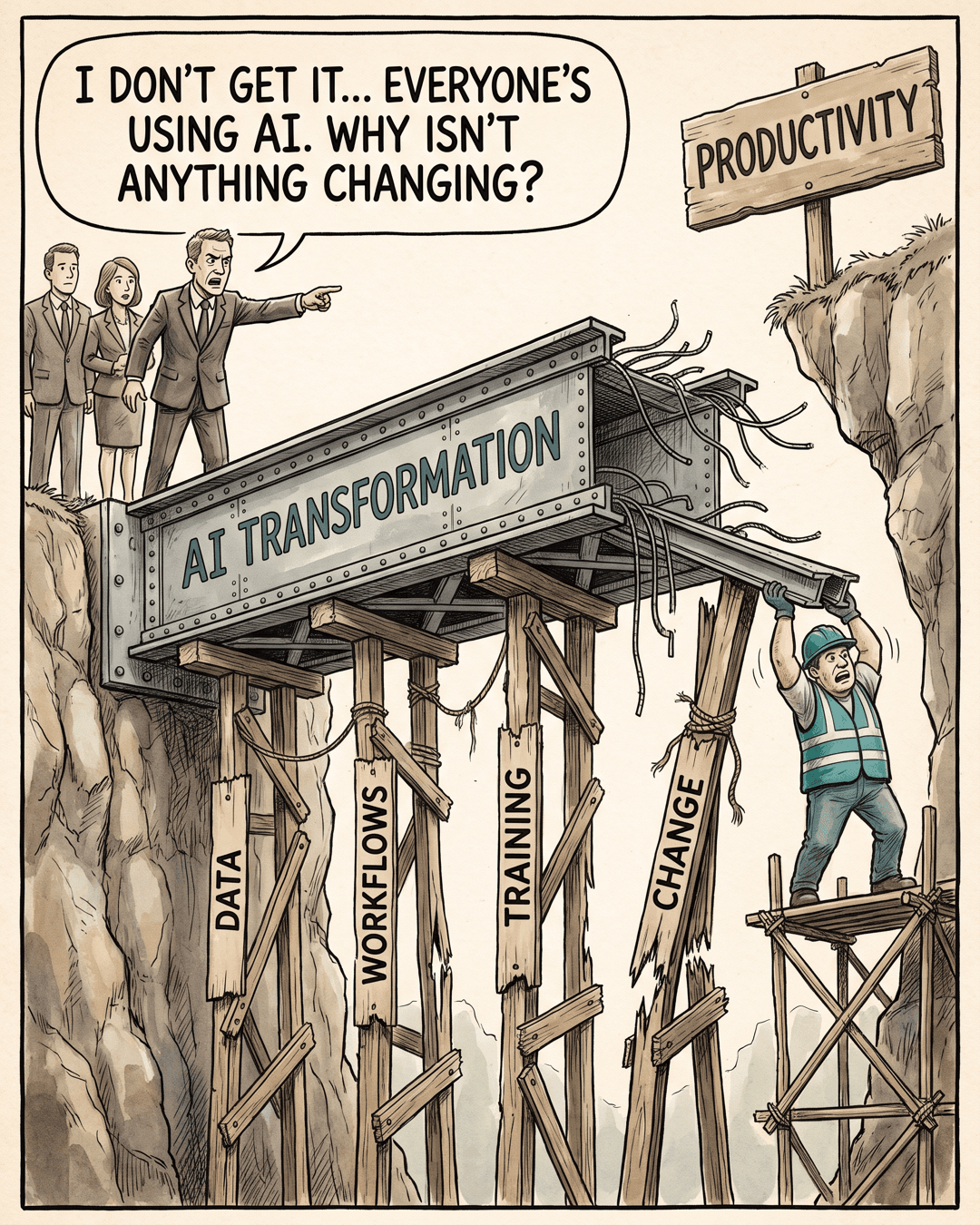
You called it an AI transformation. Your team calls it a flippin nightmare.
From where the leadership team stands, the output looks great. Reports arrive faster. Drafts appear in minutes. Everyone is using AI, so the obvious next move is to ask for more. And then someone asks the question in the cartoon: everyone is using AI, so why isn't anything changing?
The answer is usually standing under the bridge. Right now the AI isn't holding itself up. Your team is. This piece covers where that hidden work comes from, why nobody upstream sees it, and the four foundations the best product managers I see put in place so the AI starts holding its own weight.
Why the output looks fine from the top
The view from the top is the finished thing. A summary, a draft, a spec, a slide. It looks good, so the request is for more of it.
What the view leaves out is everything under the output. In most teams there is no memory, no checks and no loop. The AI forgets what it knew yesterday. It fills the gaps by inventing the rest. And somebody on the team picks up the slack. They redo the work by hand, fix the made-up parts, and paste back in the context the tool lost overnight.
None of that shows up in a dashboard. Nobody upstream sees the strain, so nobody fixes it. The extra effort is real, but it isn't counted anywhere, so on paper the transformation is working.
Hidden work has a nasty habit. It doesn't send a warning. It builds up in the people carrying it until one of them has had enough.
Then your best person quits, and nothing ever looked wrong. The numbers were fine. The output was fine. What changed was that the person holding the system together stopped holding it.
This is a system problem, not a people problem. The team is doing exactly what the setup asks of it: making the tool look good by covering for what it can't do yet. The fix is to change the setup.
Four foundations that make the AI hold itself up
The best PMs I see treat that hidden work as the actual job. They put four foundations in place.
First, put the foundations on the roadmap. It is the simplest move and the one most often skipped. Make the hidden work visible by giving it a place on the roadmap.
Data, workflows, training and change all need real time and real owners. While they live outside the plan, the work stays invisible and uncounted, and it keeps landing on whoever is closest. Once they are on the roadmap, they get sized, discussed and resourced like any other piece of product work.
If it isn't on the roadmap, someone is still doing it. They're just doing it on their own time.
Second, give the AI memory. Most AI setups start from zero every time. Every request needs the same background typed in again. Every new chat has forgotten the last one.
Giving the AI memory means one place for the context your team keeps re-explaining: the product, the customers, the decisions already made and why. When the tool can read that, it stops starting from scratch, and the person who used to supply the context by hand gets that time back.
Third, build in checks. An AI without checks will invent things and pass them off as real. That is the part your team is currently catching by eye, one output at a time.
Building in checks means the system has to show where a claim came from, or flag that it is guessing, before the output reaches a person. The goal is not perfection. The goal is that a made-up fact gets caught by the setup, not by the tired person at the end of the line.
Fourth, close the loop. The last foundation is what turns a tool into a system. When a person corrects the output, that correction should feed back in.
Without a loop, every fix is lost the moment the chat closes, and the team resets to zero on the next task. With a loop, the system improves itself instead. The same mistake stops coming back, because the last person to fix it taught the system not to make it.
The difference between announced and felt
Do all four and the AI starts holding itself up. The manual work disappears, and the strain your team was carrying by hand goes with it.
That's the difference between a transformation you announced and one your team actually feels. From where the boss stands, all they see is the AI. Not the people who were holding it up. A good product manager makes sure those people, and the work they were doing, are on the plan.
If you want a view of where your own setup stands, the scorecard at martongaspar.com/scorecard places you from AI-curious to AI-native and gives you a first step to close the gap. For the individual side of the same pattern, /vault/where-product-managers-stop-with-ai covers where product managers tend to stop with AI and what the level above looks like.