The best AI system cannot be bought.
It is built out of how you should work.
Fable 5, GPT 5.6, whatever drops next week. The model was never the thing that makes you a better product manager. The system around it is.
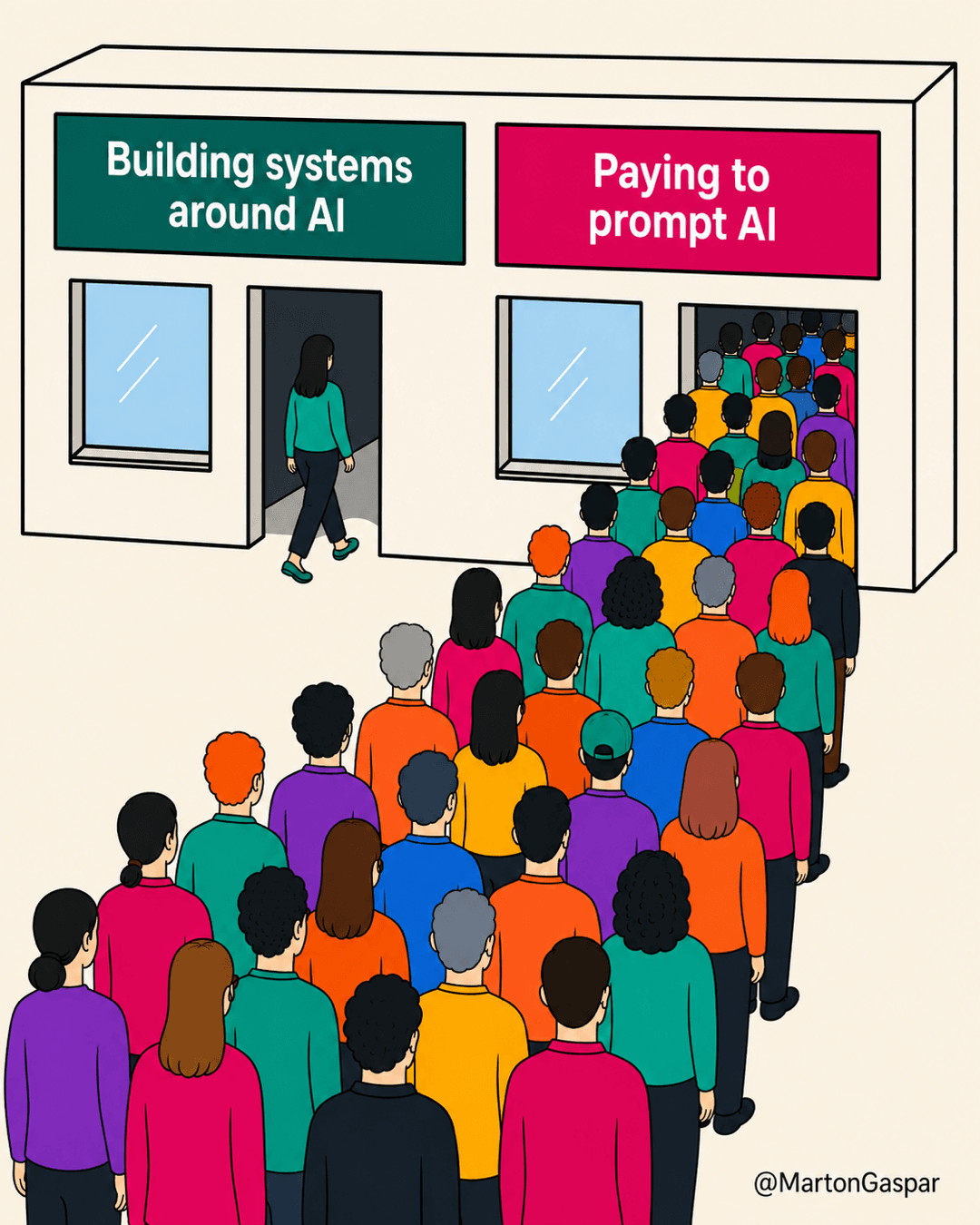
The picture that went with this post shows two doors. One says "Building systems around AI". The other says "Paying to prompt AI". One person walks through the first door. A long queue waits at the second.
The model knows nothing about your company
Every new model arrives with a wave of excitement, and every one of them starts from the same place with you: zero. The AI model knows nothing about your company. Not your roadmap. Not the problem you've been stuck on for a month. Not the customer who said the thing you keep coming back to.
That is why swapping models rarely changes much on its own. A better engine in an empty car still has nowhere to go. If each conversation starts from a blank chat box, you spend the first part of every task explaining your world again, and the model forgets it the moment you close the window.
Build a system around your role
Build a system around your role, and the chat box starts to work the way you do.
It writes your stakeholder update based on the actual meeting, not a generic template. It catches the insight a customer said that you'd have walked past. The difference is not the model's intelligence. It is the context, the habits and the problems you have built into the way it works with you.
Building my workflows was the whole shift for me. Not a better tool. A system built around how I actually work, and the problems I actually have.
You can build the same thing. That's how product managers should work now.
Why a system compounds and a tool doesn't
A tool you buy stays roughly the same. A system you build gets better the longer you use it. Three things follow.
The more you use it, the better it gets. Every correction and every piece of context makes the next answer closer to what you need.
When a new model lands, it just plugs in. The system holds your context and your way of working, so a better model makes the whole thing better instead of sending you back to the start.
You never start over. The work you put in this month is still paying off next month.
That is the real gap between the two doors in the picture. One queue keeps paying for the latest model and starting from scratch. The other keeps building something that gets more useful with every week. For a deeper look at what changes when you rebuild the job instead of speeding it up, see /vault/rebuild-the-product-job.
Where to start
You don't need to build the whole system at once. Start with one part of your week that repeats and costs you time: the stakeholder update, the meeting write-up, the customer call notes. Build the system around that one job, use it every week, and let it improve.
Then ask the same question again. Which part of your week would you automate next?
If you want to see where you stand today, the free scorecard at martongaspar.com/scorecard shows how AI-native your current way of working is.