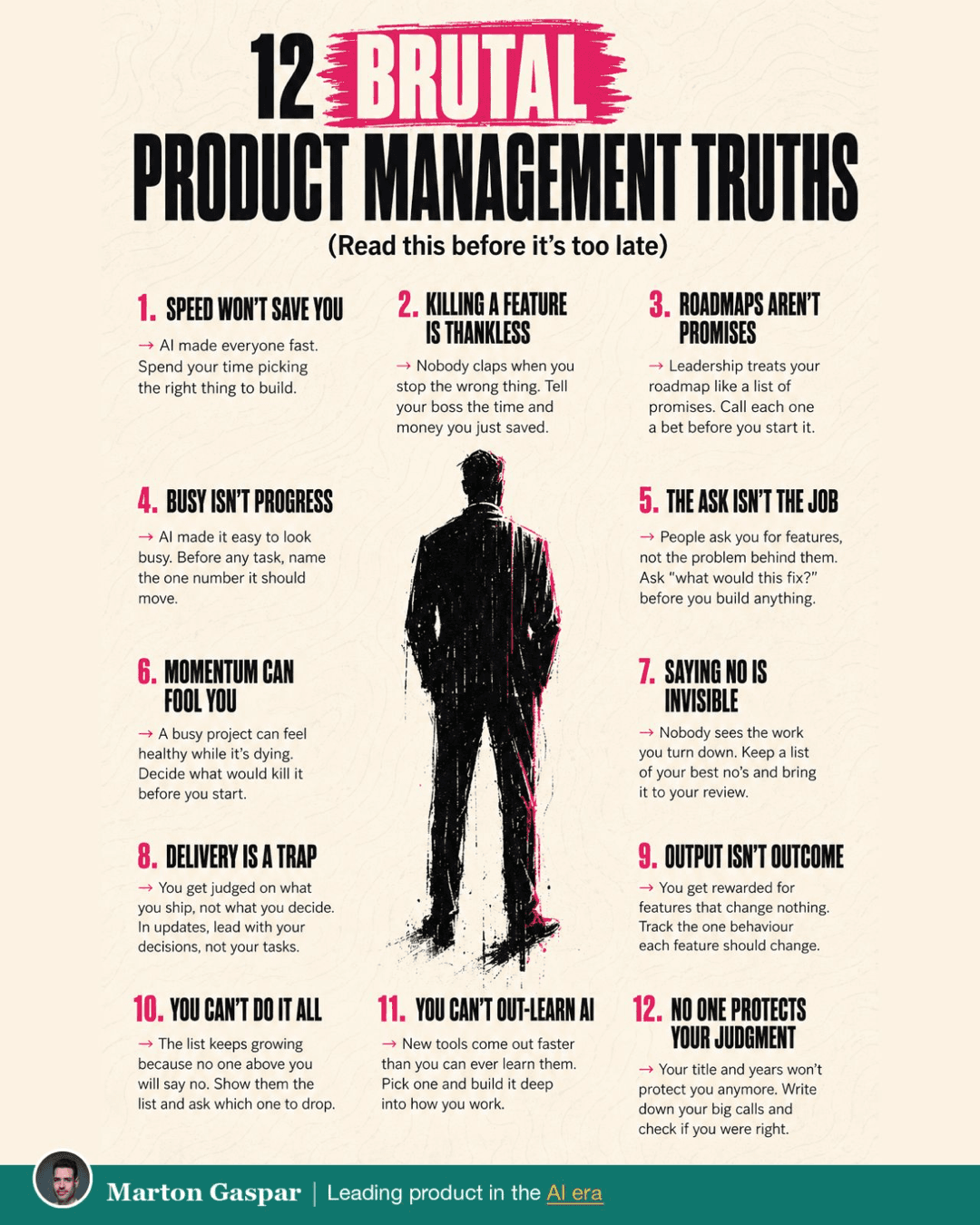
The faster AI makes you, the easier you are to replace.
Everyone around you got faster this year. It didn't change who gets kept. Speed is now cheap and widely available, which means it no longer sets anyone apart. The product managers who stay valuable stopped competing on speed. They compete on judgement: the quality of the calls they make about what to build, what to stop and what it should change.
Judgement isn't a personality trait. It's a set of habits, and most of them are small. Below are 12 truths about product management in the AI era, each paired with one move you can make this week. Master the same 12 calls and you can out-decide people with twice your experience.
1. Speed won't save you
AI made everyone fast. When everyone ships quickly, shipping quickly stops being an advantage. What's left is picking the right thing to build.
The move: before you build anything, write the problem it solves in one sentence. If you can't, it isn't ready, no matter how quickly you could build it.
2. Killing a feature is thankless
Nobody claps when you stop the wrong thing. A launch gets a celebration. A cancelled project gets silence, even when the cancellation saved more than the launch earned.
The move: when you kill something, put a number on what you saved, such as "that's three weeks back", and send it to your boss. Make the invisible win visible.
3. Roadmaps aren't promises
Leadership tends to read a roadmap as a list of commitments. You know it's a set of guesses about what will matter. That gap is where trust gets damaged every quarter.
The move: in your next review, say "this is our best bet", not "this is what we'll ship". Call each item a bet before you start it, and the conversation changes when one doesn't pay off.
4. Busy isn't progress
AI made it easy to look busy. Tickets close, documents appear and dashboards fill up, and none of it proves anything moved.
The move: add one line to every ticket, naming the number it should move. No number, don't start it.
5. The ask isn't the job
People ask you for features, not the problem behind them. A stakeholder who asks for an export button usually needs something else entirely: a report, an answer, a way to stop doing something by hand.
The move: when the next feature request comes in, reply with one question. "What would this let someone do that they can't do today?"
6. Momentum can fool you
A busy project can feel healthy while it's dying. Standups are full, demos look good, and the one result that matters hasn't moved in six weeks.
The move: at kickoff, write down the one result that means "stop". Check it every Friday, while stopping is still cheap.
7. Saying no is invisible
Nobody sees the work you turn down. Every bad idea you stopped, every distraction you kept off the team's plate, leaves no trace, and at review time it counts for nothing unless you can show it.
The move: start a "said no to" list today, one line each. Bring it to your review as evidence of judgement.
8. Delivery is a trap
You get judged on what you ship, not on what you decide. So it's tempting to report activity, because activity is easy to count.
The move: open your next update with the call you made, not the tasks you closed. Lead with decisions, and people start seeing you as the person who makes them.
9. Output isn't outcome
You can be rewarded for features that change nothing. The release notes look impressive and user behaviour stays exactly where it was.
The move: before you ship, name the one user behaviour that should change. After you ship, go back and check whether it moved.
10. You can't do it all
The list keeps growing because no one above you will say no. Every request is reasonable on its own, and together they're impossible.
The move: take the full list to your manager and ask one question: "Which of these do we drop?" That makes the trade-off a shared decision instead of your private failure.
11. You can't out-learn AI
New tools arrive faster than anyone can learn them. Sampling every one leaves you with shallow knowledge of many tools and real skill in none.
The move: stop sampling. Pick one tool and use it every day this week until it's muscle memory. Build it deep into how you work.
12. No one protects your judgement
Your title and years of experience won't protect you any more. The only protection is a record of good calls, and you need to be able to show it, including to yourself.
The move: keep a decision log. One line per big call, and why you made it. Revisit it monthly to see who was right.
The pattern behind all 12
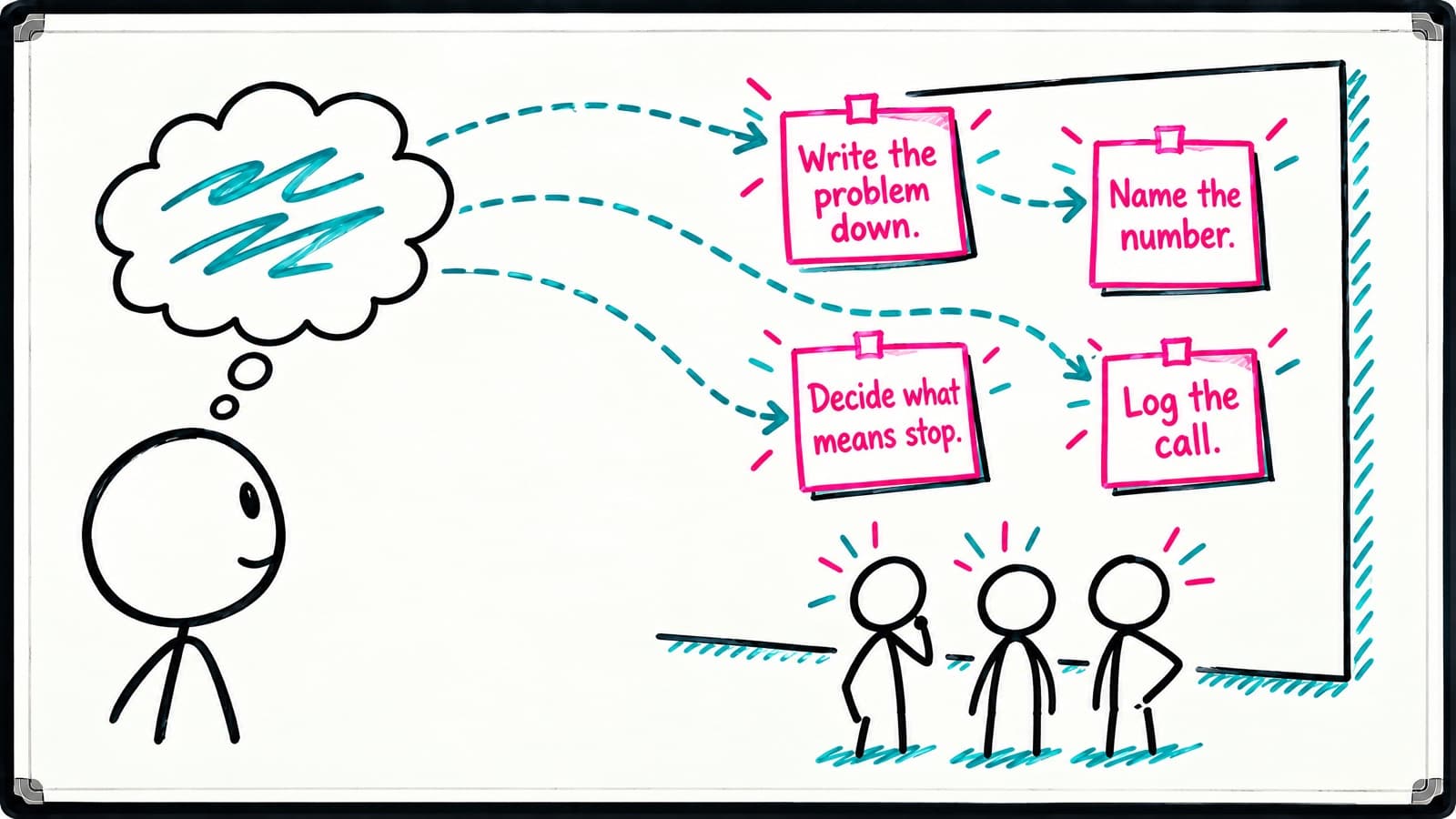
Read the moves again and the same thing keeps coming up. Write the problem down. Name the number. Decide what means stop. Log the call. Every one of them turns a judgement that lives in your head into something you and others can see and check.
That's the shift AI forces on product management. When execution is cheap, judgement is the job, and judgement only counts when it's visible. If you want the longer version, the companion piece, 24 Harsh Truths of Product Management I Learnt the Hard Way, covers the same ground in more depth.
Pick the one truth on this list you live by least, and make its move this week. The PDF keeps all 12 on one page, so you can bring it to your next planning session.