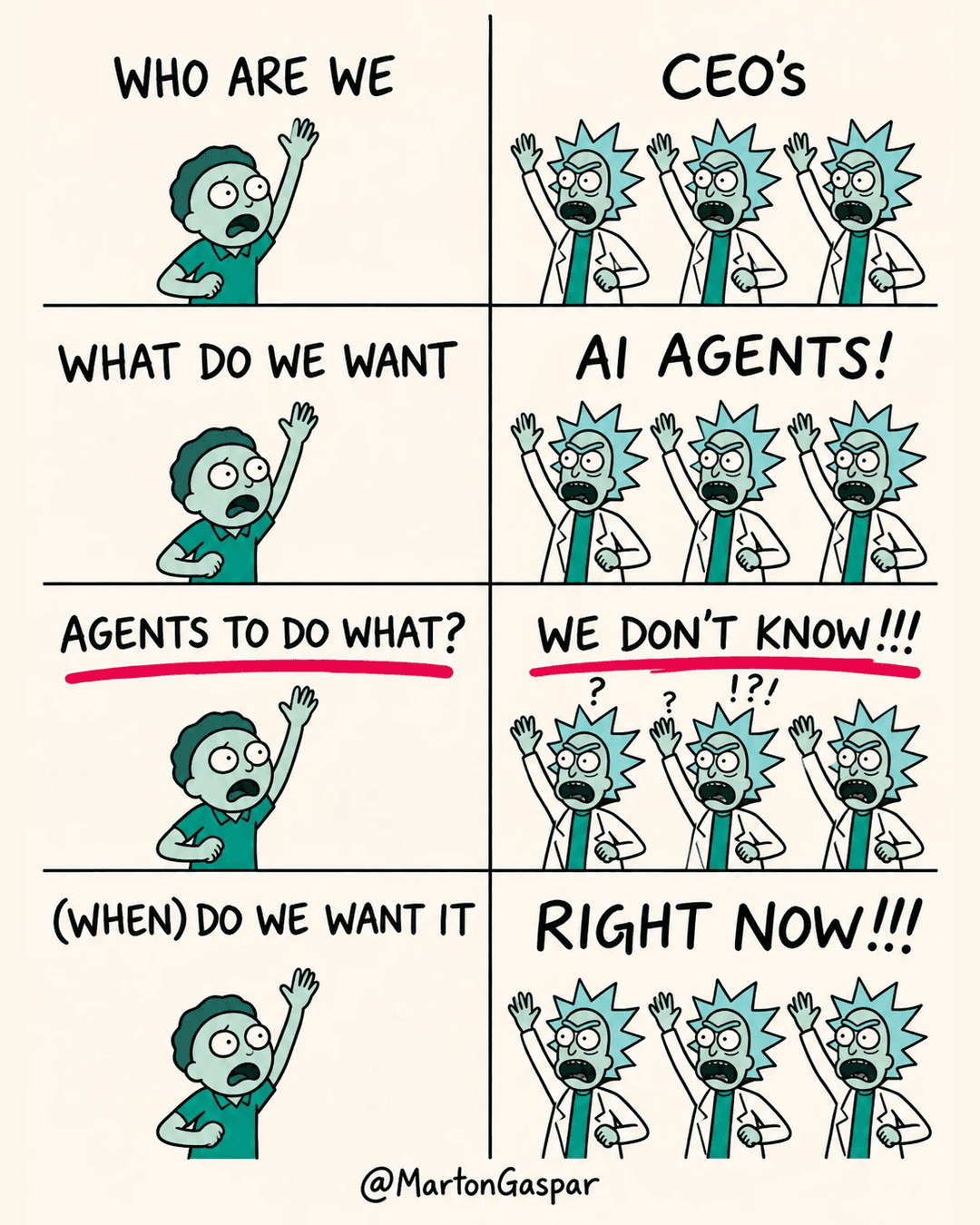
Who are we? CEOs. What do we want? AI agents. Agents to do what? We don't know. When do we want it? Right now.
That is the whole comic. Four rows. One nervous person asks the questions and a crowd shouts the answers back. It gets a laugh from product people because the third row is the one with the underline. The room knows what it wants and when it wants it. It just can't say what it is for.
That gap is not a joke for the product manager who gets handed the request on Monday. It is the job. This piece is about how to fill it before the build starts.
The missing answer is the spec
An agent is a worker. It takes steps on its own towards a goal. Like any worker, it needs a job before it can do anything useful.
"Agents to do what?" is not a side question. It is the spec. Which task does the agent take on? What does it start from? What does a good result look like, and who checks it? When should it stop and hand back to a person?
Without those answers you can still build something. It will run, and it may even demo well. But nobody will be able to say whether it worked, because nobody said what working meant. I wrote about the line most agent specs leave out in The Missing Line in Your Agent Spec (/vault/the-missing-line-in-your-agent-spec). This comic is the step before that line: there is no spec yet at all.
Why the deadline arrives before the use case
Look at the comic again. "Right now" comes with total confidence. "To do what" gets a shrug.
That order is not about anyone being careless. It is how the pressure works. A date is easy to say out loud in a meeting. A use case needs someone to look at the work, find the repeat tasks and decide which one is worth handing over. That takes time, and time is exactly what the room feels it doesn't have.
So the system rewards the fast answer. "We are doing agents" sounds like progress. "We are still working out what for" sounds like delay, even when it is the most useful sentence anyone could say.
This is the same trap as "add AI" in Product Strategy Starts With the Problem, Not the Tool (/vault/product-strategy-starts-with-the-problem). The tool shows up first, and the problem gets fitted to it afterwards.
Turn "right now" into a job description
The person asking the questions in the comic has the right instinct. The skill is asking them in a way the room can say yes to.
Don't argue with the deadline. Use it. "Great, if we want this soon, let's pick the one task it should take first." That keeps the energy and points it at a decision.
Then work through a short set of questions:
Which task, exactly? Pick one piece of work your team repeats often, with clear inputs and a clear output. Not "help with customers". Something you could hand to a new hire with a page of notes.
Which call stays with a person? An agent can draft, sort, check and chase. Decide in advance where a human signs off, so the agent does the task and you keep the call. Delegation for Product Managers (/vault/hand-over-the-task-not-the-call) goes deeper on that split.
What does done look like? Write down the result you expect and how you will tell a good output from a bad one.
How will we know it paid off? Name the one thing that should change once the agent is running, and how you will see it.
Four answers, and "AI agents right now" becomes a job description someone can build against. Leadership still gets something soon. It is just something that can be judged.
Asking "to do what?" is the senior part of the job
In the comic, the person asking the questions looks worried. In real life it can feel the same. Slowing down a room that has already decided feels like a risk to your standing.
It is the opposite. Anyone can repeat the demand back. The senior product manager is the one who turns a vague, urgent ask into a clear piece of work with a finish line. That is judgement, and it is the part of the job no agent takes off your plate.
If you want a fuller checklist for these requests, Just Add AI (/vault/just-add-ai) has 11 questions to answer before you build or ship an AI feature. And if the request feels wrong rather than vague, When Your CEO Has a Bad Idea (/vault/when-your-ceo-has-a-bad-idea) covers how to push back without closing the door.
Next time someone says "we need agents", ask the third-row question before anything else. Whatever comes back is where the real roadmap starts.