AI made every product manager faster this year.
Which is exactly why nobody feels ahead.
The promise sounded simple. More drafts, more prototypes, more research, in less time. And most PMs did get faster. But the feeling of being ahead never arrived. It is worth looking at why, because the answer changes what a good week of product work looks like.
What people think AI did for product managers
The common story has three parts. We get more done. We're ahead of the curve. We got hours back every week.
Each of those can be true at one person's desk. Your own to-do list moves faster, and first drafts arrive much faster than they used to.
Step back and look at the whole team, and the picture changes. Product work doesn't end when the PM finishes their part. It ends when someone decides what happens next, and then the user gets something better. Speed at the start of that chain only counts if the rest of the chain keeps up.
What it actually did: more work, same desk
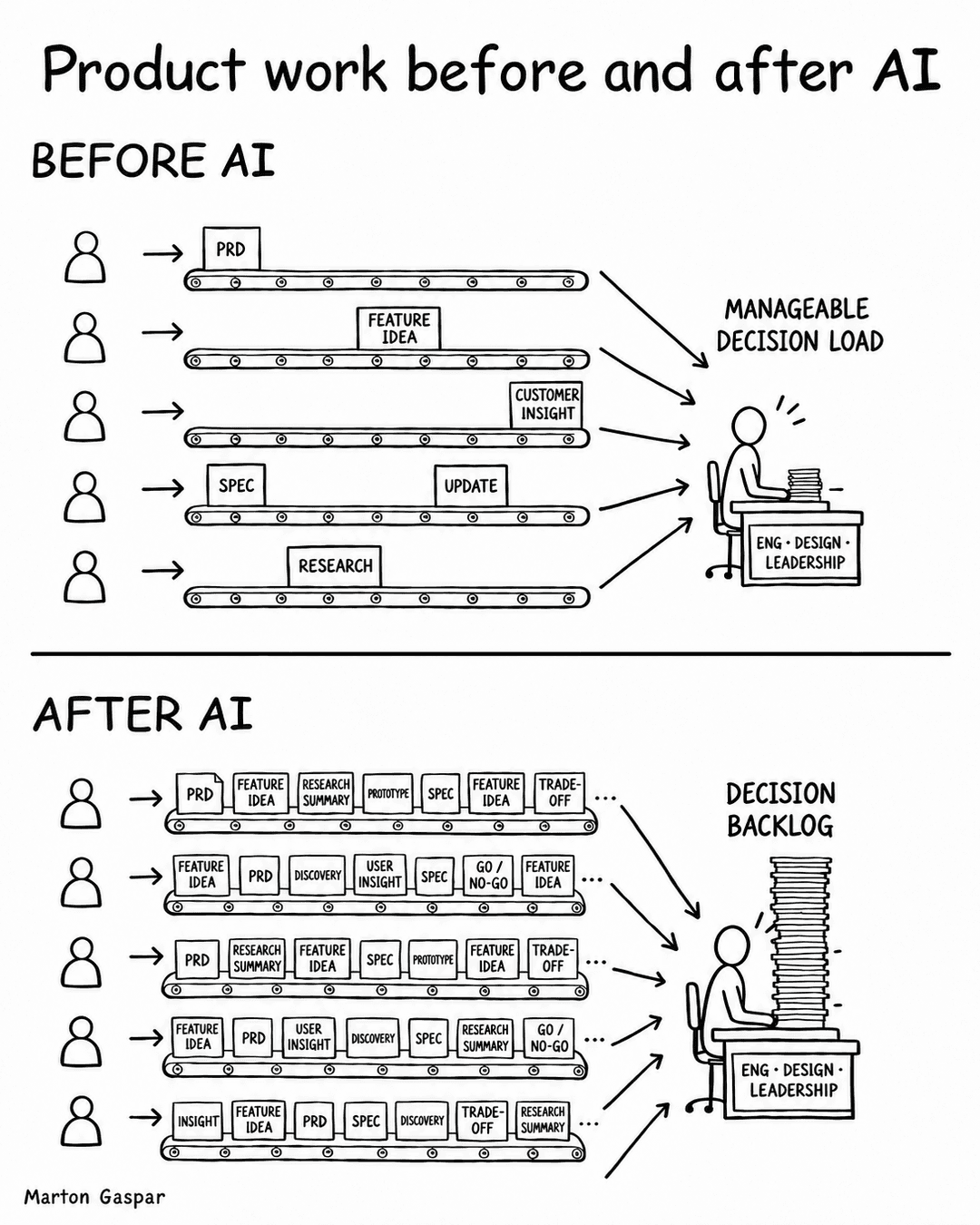
Every PM now produces more: PRDs, prototypes, research summaries.
It all lands on the same desk: engineering, design, leadership. That desk didn't get any bigger.
So the work waits. Review queues grow. Rework piles up. Decisions sit on hold. Your users didn't get more time for all those extra ideas either. And nobody feels ahead, because everyone sped up at once.
None of this is anyone's fault. It is what happens when the amount of work going in speeds up and the capacity to review it and decide on it stays the same. The extra output doesn't disappear. It turns into a decision backlog.
The bottleneck moved from making to deciding
AI didn't remove the bottleneck. It moved it, from making the work to deciding on it.
Making used to be the slow part. PRDs, prototypes and research summaries all took real time to produce. Now each of those takes far less. The slow part is the attention at the other end: someone has to read it, judge it and decide what happens next.
And the relief sits right there. Keeping up was never the game. Stopping the weak work is.
A PM's edge is no longer how much they produce. It is how much weak work they stop before it reaches anyone's desk. That is a judgement skill, not a speed skill, and it is one AI doesn't hand to you.
The same pattern shows up inside teams as effort nobody counts. AI Transformation That Nobody Feels (/vault/ai-transformation-hidden-work) covers that side of it.
Map one workflow from AI output to outcome
Pick one workflow you've sped up with AI. Map it in four steps:
AI output → who reviews it → the decision → the outcome.
Then look at where the numbers change. Where the output went up and the decisions didn't, stop that work before it starts. That might mean fewer drafts, fewer prototypes for ideas nobody has agreed to test, or fewer summaries that nobody acts on.
Doing the same job faster is one path. Changing what the job produces is another. Rebuild the Product Manager Job (/vault/rebuild-the-product-job) goes deeper on that difference.
Count the work you stopped, not the hours you saved
Hours saved tells you how fast you made things. It says nothing about whether those things should have been made.
So change what you count. Count the work you stopped, not the hours you saved.
A stopped piece of work frees review time, engineering time and a place in the decision queue. None of that shows up as hours saved on your side, but the team feels it.
Your AI gain isn't the work it does for you. It's the work your team no longer has to do.
What's one thing you stopped making, even though AI makes it cheap?
Every product manager has an AI profile. What's yours? Find out at martongaspar.com/scorecard.