Many leaders expect their team to perform like elite athletes, at AI speed.
But the training provided is amateur, at best.
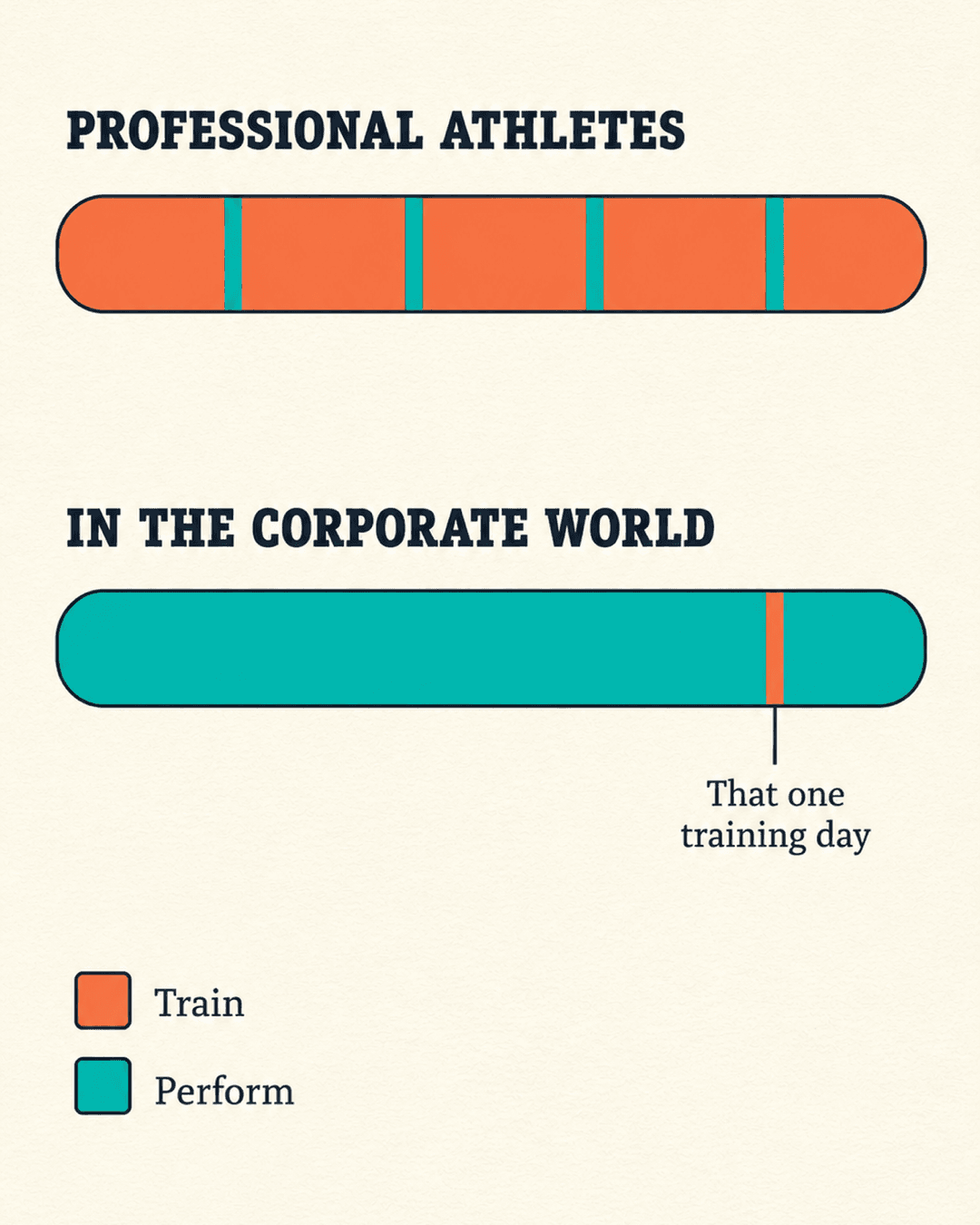
The picture says it in two bars. For professional athletes, the bar is almost all training, broken by thin slivers of performing. In the corporate world, the bar is almost all performing, with one thin sliver near the end labelled "that one training day". (Image credit: Kobi Omenaka.)
What sport gets right about performance
In sport, the pattern is obvious. Train far more than you perform. Recover on purpose. Review every result and adjust.
That is how performance becomes repeatable instead of accidental. A great result on match day is the visible end of weeks of work nobody watched. The training is where the skill gets built. The match is where it gets used.
At work, the ratio is upside down
At work it is the opposite. The team performs all day. The training barely happens.
Then AI made the performing instant. Now the team is expected to match the speed of the tool, learn a new system every week, produce more with the same heads, get it right with no time to think, and start every task from scratch, again. All while performing every single day.
There is no time to build a foundation. No memory. No learning loops. No system underneath. Just: "You have AI now. Go faster."
It is not a weak team. It is a missing foundation.
What the missing foundation costs
The faster you push without one, the more the gap costs you. Faster messes. Burnout. The same work, redone. Your best people leaving. Output up, results flat.
The burnout does not show up where you might expect. Upwork studied 2,500 people, and the ones burning out fastest were the strongest AI users, not the weakest. The people leaning in hardest were paying the highest price for a pace with nothing underneath it.
An athlete would never survive this. The team is expected to, every quarter.
Build the foundation into how the team works
The teams that pull ahead treat the foundation as the real work, not overhead. They build it into how they work, in four parts:
Context the AI can reuse, not re-explain. If every task starts with someone typing out the background again, the speed of the tool is spent on repetition.
Memory, so nothing is solved twice. A decision made once should be findable the next time the same question turns up.
Learning loops that catch a bad call early. This is the work equivalent of reviewing every result and adjusting. Without it, a mistake made at AI speed spreads at AI speed.
A clear decision on what is worth building. Speed only helps when it is pointed at the right thing.
When a team works this way, the speed compounds. Each piece of work makes the next one faster. People stop drowning. The business finally moves.
BCG found that the teams who build the foundation grow revenue twice as fast as the ones who just bolt AI on.
A good place to start is an inventory. Of those four parts, which does your team actually have under the pace AI now allows, and which is missing? The missing one is your training day.