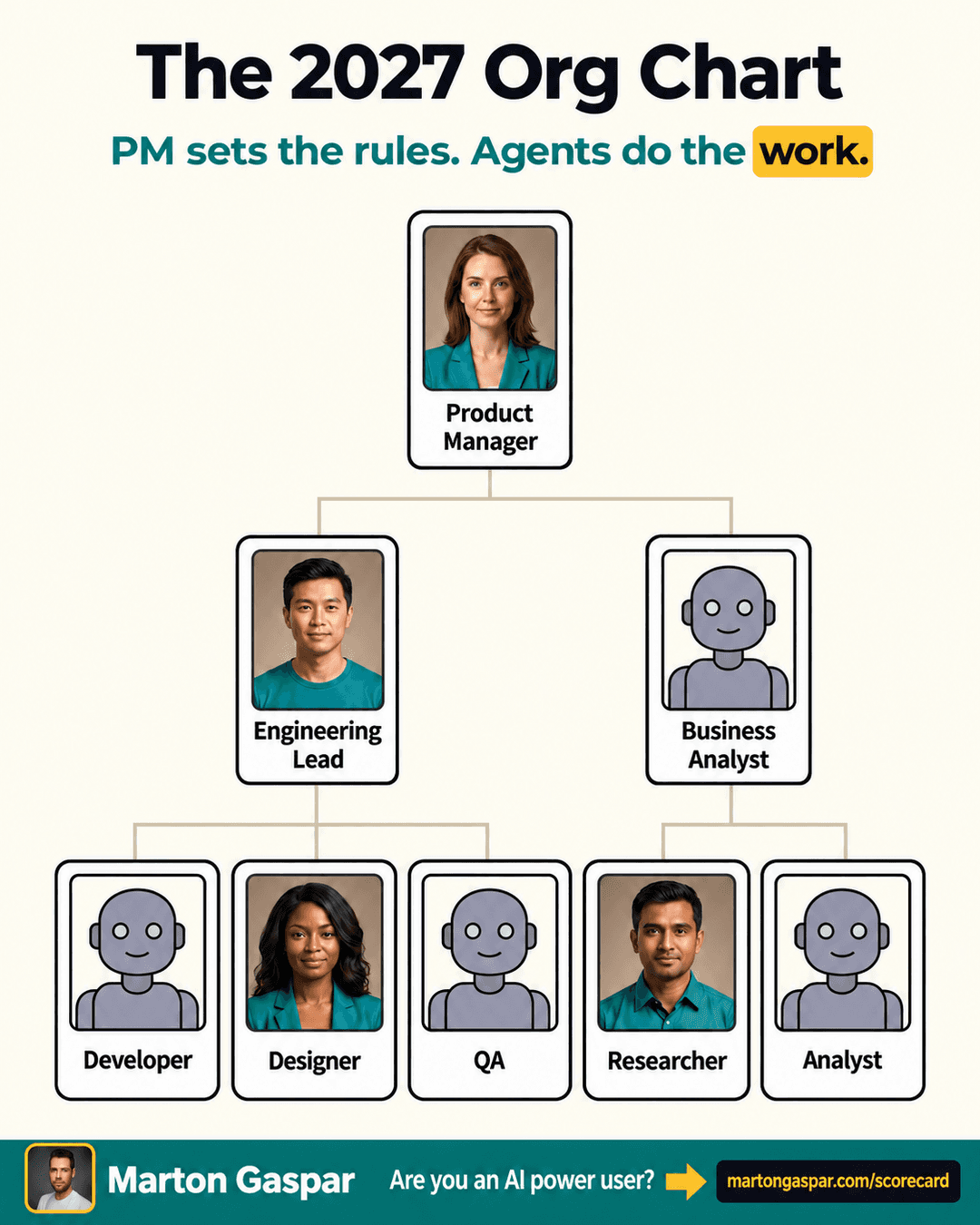
Google: 9 times out of 10 at work, AI doesn't finish the job. The PMs who fix that run the 2027 org chart.
Your value is the judgement that keeps working when you're not in the room.
The fix isn't a better model. It isn't a better prompt. You won't get ahead doing more with AI. You get ahead when the work gets done without you.
This piece walks through what that looks like in practice: why faster tools haven't shortened the queue at your desk, the two moves that change it, the setup I run, and the parts of the job that stay yours.
Why AI at work still runs like a very fast intern
Most AI at work still runs like a very fast intern. You open a chat. You explain the context, again. You check what comes back. Tomorrow you get asked the same thing.
The tool got faster. The queue at your desk didn't get shorter.
That is the gap. Every answer still routes through you, because the thing that makes an answer right for your product lives in your head. The model doesn't know which trade-offs you always make, which limits you never cross, or when you would stop and ask someone. So you supply it, one chat at a time.
The PMs I'd bet on build something else: their judgement, written down.
Move one: encode the judgement
The first move is to encode the judgement. A repeat call becomes a rule, a limit, or a point where the agent stops and asks.
Think about a call you make the same way every time. Written down, it turns into one of three things. A rule: when X happens, do Y. A limit: never go past this line. Or a stop point: when you reach this, check with me first.
That last one matters. Encoding your judgement doesn't mean handing over every call. It means being clear about which calls you are handing over and which ones still come back to you.
Move two: automate the output
The second move is to automate the output. Agents use those rules to produce the research, tickets, prototypes and code.
The order matters. If you automate the output without the rules, you get more work back that you still have to check, which is the fast intern again. With the rules in place, the output already reflects the calls you would have made.
Set it up once, and the repeat calls stop needing you.
What this looks like in my own setup
Here's mine. I'm not an engineer.
A written rulebook my agents check before they ask me. One board where every decision that does reach me lands. Coding agents that build overnight across my Macs.
When I correct something, the fix goes into the rulebook. I stop making that call.
No new habit. Nothing to remember. The correction is the habit, because each one becomes a rule that the next piece of work already follows.
If you want a list of specific setups to start from, Automate Repetitive Product Manager Tasks (/vault/automate-repetitive-product-manager-tasks) walks through ten of them.
Point it at any job you repeat
You don't need my setup to use the idea. Point the same idea at any job you repeat:
The weekly stakeholder update. Release notes. The competitor scan nobody has time for. The "is this a P1?" question you answer every week.
Each of those has a call inside it that you make the same way most weeks. Write that call down as a rule, a limit or a stop point, and the output can be produced without you starting from a blank chat.
What stays yours
Not everything should be encoded. What stays yours: new bets, messy evidence, calls you can't undo, and the rules themselves.
That last item is the important one. The rules are your judgement in written form. Keeping them, correcting them and deciding where the stop points sit is the senior part of the job. It is the work nobody else can do for you.
Whose rules will the 2027 org chart run on?
AI that helps you do more is a one-off advantage. Everyone gets it.
Written-down judgement keeps working without you.
By 2027, the org chart has agents on it. The question is whose rules they run on.
So keep it simple. Make the same call twice? Encode it. Make the same output twice? Automate it.
You're not stuck doing every repeat yourself. You're one rule away.
Not sure where you stand? See how you measure up against other PMs at martongaspar.com/scorecard.