Every question only you can answer is a KPI problem. Just not the kind that lives in your dashboard.
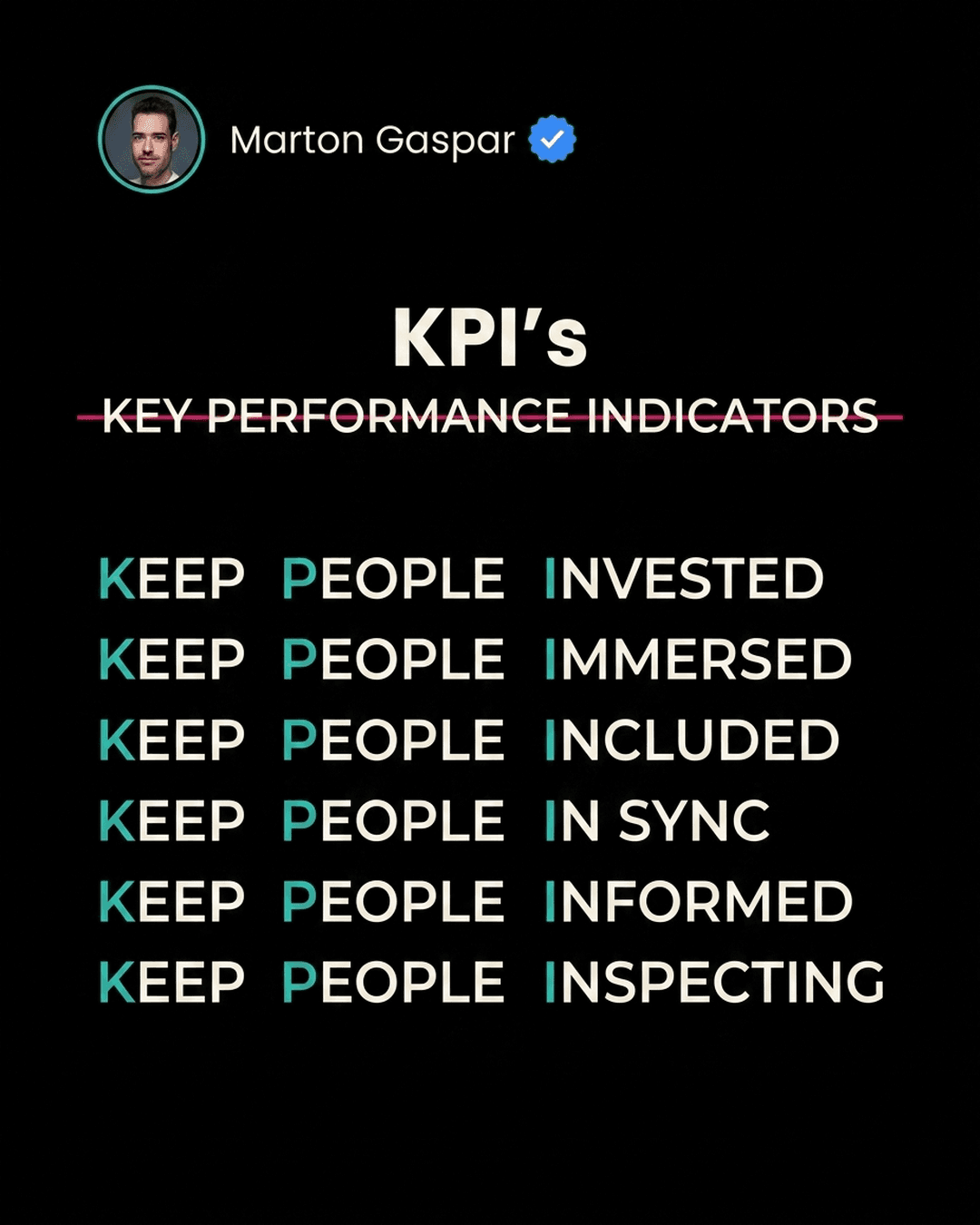
This KPI stands for Keep People. Keep People Invested, Immersed, Included, In Sync, Informed and Inspecting. Most KPIs measure what the team produced. These six measure something else: whether the team can decide without you. If you lead a product team, they change how decisions get made, and who has to be in the room for them.
The week I went skiing
Years back, a SaaS scaleup hired me to build a chatbot for each of their global clients.
I didn't build them one by one. I built one open process the whole team could run: marketing, brand, even the intern.
I wasn't sure it would hold without me. Then I went skiing.
I came back to 35 live. Nobody had waited.
That stung and felt like the best thing that had ever happened at work, both at once.
Why every decision ends up back with you
Being the only one who can answer a question feels powerful. It feels like being needed. It's also why every decision ends up back with you.
This isn't a people problem. It's a context problem. When the reasons behind the work live in one person's head, every decision has to route through that person, however capable the team is. The team waits, the queue grows, and the queue starts to look like proof of value.
The fix isn't doing more. It's keeping the context shared, not locked in your head. The six habits below are how.
Keep People Invested
The default is handing people a task to do. They do it, well, and then come back for the next one.
The better move is to give them the outcome metric to own. A task ends when it's done. An outcome keeps asking whether the work is actually moving the number, which means people start making calls you used to make.
It's working when they'll argue for the goal even when it kills their own idea.
Keep People Immersed
The default is the leader talking to customers and passing on a summary. It's efficient, and it turns you into the only source of truth about the user.
The better move is to put the team in front of the customer directly. Calls, support tickets, session replays. The raw thing, not your version of it.
It's working when they quote the user, not you.
Keep People Included
The default is bringing people in once the decision is made. You weigh the options, sign one off, and present it.
The better move is to bring them in while the options are still messy. Show them the draft, not the verdict. People can only improve a decision they can still change.
It's working when they change your mind.
Keep People In Sync
The default is that "what matters now" lives in your head, so the only way to find out is to ping you. Every ping is a small decision routed back to the leader.
The better move is one place people can check what matters now without asking. One page, kept current, that the whole team trusts.
It's working when they reprioritise on their own and you find out after.
Keep People Informed
The default is announcing the new plan. The plan changes, the team hears the new version, and the reason stays with whoever made the call.
The better move is to write down the evidence that moved it, not just the new plan. The reasoning is what lets people make the next call the same way without you.
It's working when nobody asks, "wait, why did we switch?"
Keep People Inspecting
The default is the leader privately judging what worked. Things ship, you look at the impact, and your judgement gets better while the team's stays where it was.
The better move is a standing look, together, at what shipped against what impact it had. Same data, same room, same conversation.
It's working when judgement updates across the team, not just in your head.
Write the answer where the team finds it
None of the six asks you to work harder. Each one moves a piece of context out of your head and into a place the team can reach. Put them together and they point at one idea. A team can only decide without you if it holds the same context you do: the outcome, the customer, the options, the priorities, the reasons and the results.
So next time a decision comes back to you, don't just answer it. The tricky part isn't the answer. It's writing it somewhere the team finds it without you.
Do that enough and the next 35 go live while you're on the slopes.
Download the one-page version and check which of the six your team already does well.