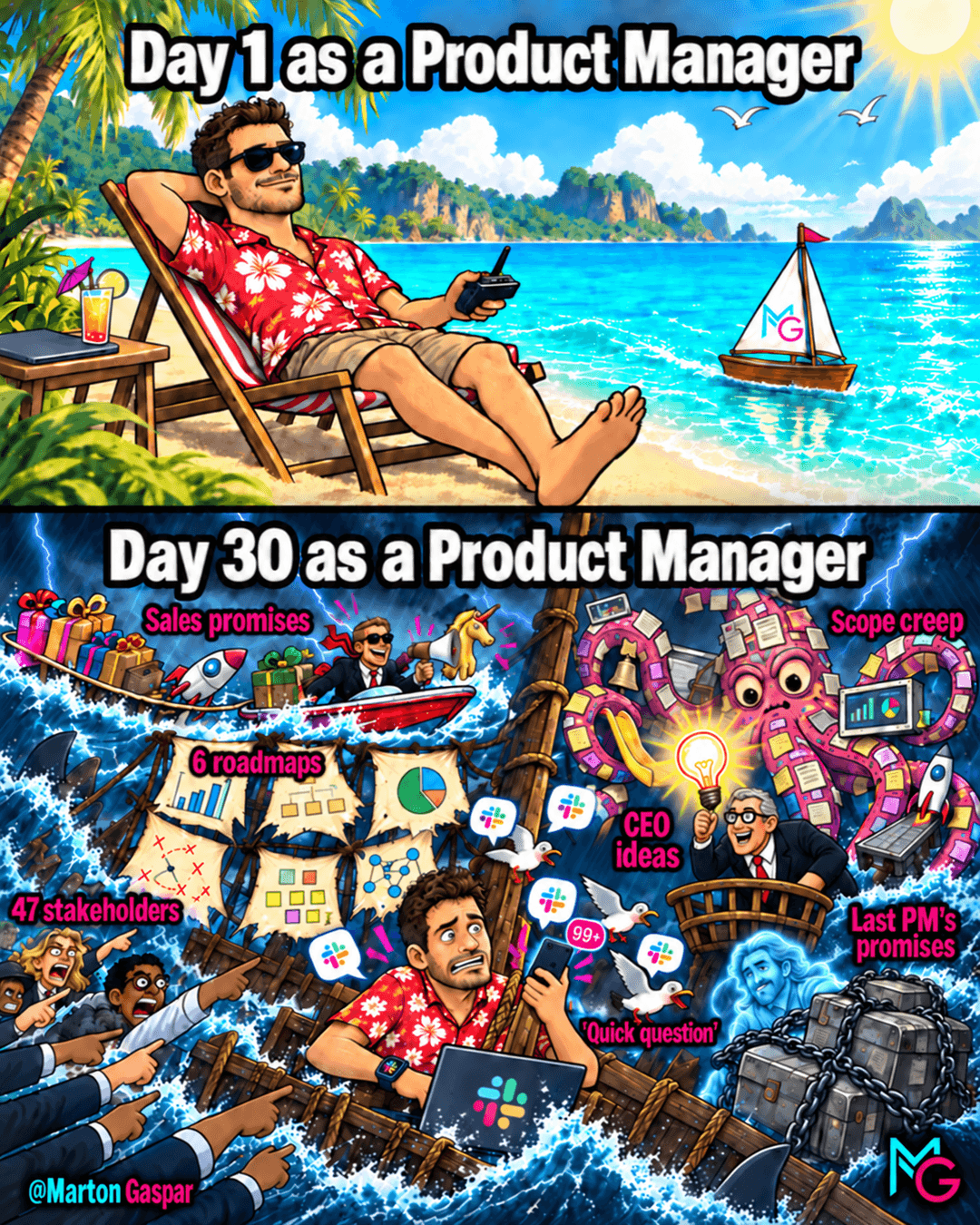
New PM role? Here's how the best ones start.
Most get week one wrong. You want to prove you belong before anyone questions it. So you show up with answers.
That's exactly the wrong move. Answers given in week one are built on whatever you picked up in the interview process, and they tell people you have already decided before you have listened.
Here's what I do instead. 10 years contracting. Dozens of first weeks. Same system every time. It's also the first thing I give every PM I coach.
Why the first week is the best time to ask
A new PM has something nobody else in the building has: permission to ask basic questions. "Who is our ideal customer?" sounds odd from someone who has been there two years. From someone in their first week, it sounds like doing the job properly.
That window closes fast. After a few weeks, people expect you to know. So the first week is the cheapest time to ask the questions that reveal how the place really works, and the system below makes the most of it.
Step 1: Get a list of your key stakeholders
Start with who matters. Ask your manager for the list of people whose priorities shape your product: the leaders, the teams you depend on, the people who will judge your work.
The list itself tells you something. Who is on it, and who your manager forgot until you asked, is an early read on how decisions actually get made.
Step 2: Ask each of them the same questions
The key word is same. Ask every stakeholder the same five questions:
What are your priorities right now?
Who do you think is our ideal customer?
How will your success be measured?
What do you expect from me and my team?
What else should I be asking you?
Asking the same questions is what makes the next step work. If every conversation goes in a different direction, you end up with a pile of interesting notes you can't compare. Identical questions give you answers you can line up.
The last question matters more than it looks. It hands the conversation back to the person who knows the place, and it often surfaces the thing you didn't know to ask about.
Step 3: Put the answers side by side
The insight comes from the comparison, not from any single conversation.
Lay the answers out next to each other, question by question. Then read across:
Where they agree, there's clarity. You can build on it.
Where they disagree, that's where I dig. A disagreement between stakeholders is a decision nobody has made yet, and it will land on the product team sooner or later.
The patterns that always show up
Some patterns show up almost every time:
Sales and the CEO have different customers in mind.
No two people agree on the biggest pain to solve.
Each team measures success differently.
There's always one "fact" that's actually just someone's bias.
None of these is a sign of a broken company. They are normal. The point is to find them in week one, on paper, rather than in month three when a roadmap built on one version of the customer runs into someone who believes in another.
Your first deliverable is one page, not a roadmap
My first real deliverable isn't a roadmap. It's one page: where my stakeholders agree, and where they don't. That's where I start.
The page does two jobs. It shows the people you'll work with that you listened before you decided. And it turns vague tension into a short list of specific questions the leadership team can answer, which gives your first roadmap something solid to stand on.
Learn what matters in a week, not a month
Most PMs spend their first month trying to learn what matters. This system tells you in a week.
It works because it swaps proving for listening, and listening for comparing. You don't need answers on day one. You need the right questions, asked the same way to everyone, and the patience to read across the answers.
The full version of the system has 15 questions, a template, and an AI skill to run the analysis. The five above are enough to start.
What's your go-to question when you start a new role?