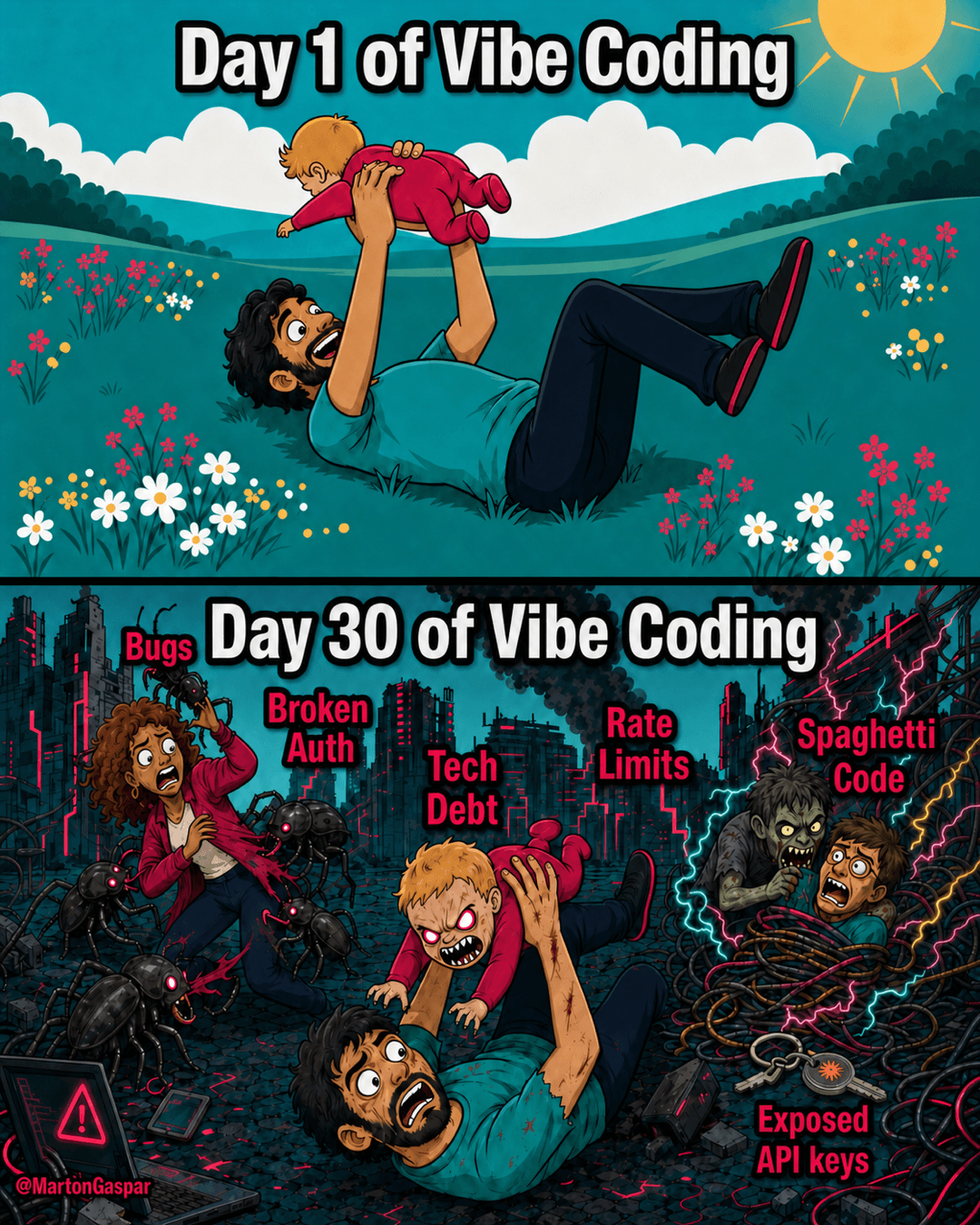
Nobody warns you about the nightmare after vibe coding. By day 30, it's already too late.
The picture tells the story in two panels. On day 1 of vibe coding, a dad lies in a sunny field, lifting his baby into the air. Everyone is happy. On day 30, the same dad is on his back in a ruined city, and the baby has turned into a monster. Around them: bugs, broken auth, tech debt, rate limits, spaghetti code, exposed API keys.
None of those showed up on day 1. All of them were there.
Judgement is built by getting burned
Every good product manager I know built their judgement the same way: by getting burned. The burn might be a launch that broke something nobody tested, or a shortcut that came back later with interest. Each one leaves a scar, and the scar is what makes the next call better.
Vibe coding is the first tool that skips the burn and delays the scar by 30 days. The thing works on day 1, so nothing hurts, so nothing gets learned. The cost is still coming. It's just late.
That's the gap you can't see from day 1. Nothing on the screen tells you the burn was skipped.
Day 1 runs on confidence, day 30 runs on competence
The day-30 nightmare isn't the tool failing. The tool did its job. It built what you asked for.
What it couldn't do was tell you what you didn't know to ask. Nobody asks for "no exposed keys" or "survives real traffic" in a prompt if they've never been burned by either. Those questions come from scars. On day 1 they don't matter. On day 30 they're the whole story.
Day 1 runs on confidence. Day 30 runs on competence.
Four levels separate generating from building
Generating something isn't building something. Four levels separate them, and vibe coding handed everyone the first one. The trouble is that the first level feels exactly like the fourth.
Level one: artifact
It looks like it works. It's day 1. So is every impressive demo you've ever seen.
The artifact is a real thing. You can click it, show it, put it in a deck. That's what makes it convincing. But looking like it works and working for real people are different claims, and the artifact only proves the first.
A demo answers "can it exist". It doesn't answer anything else.
Level two: consequence
At this level you know what it costs when real users touch it. The load, the edge cases, the data that arrives in a shape nobody planned for, the support queue the week after launch.
The move is to ask, before anything ships, what happens on the first bad day: what breaks first, and what it costs to fix. If nobody can answer, you're still at level one.
Consequence is where day 30 starts getting priced in on day 1.
Level three: ownership
Here you decide what the company keeps and what it kills. Everything generated becomes something someone has to maintain and explain. Ownership means choosing which of those things earn a place, and saying no to the rest.
The trap is keeping everything because it was cheap to make. Cheap to make is not the same as cheap to own.
What you keep is a decision. What you kill is too.
Level four: subtraction
At the top, you make the team more valuable by building less. The best call is sometimes the feature that never gets made, or the thing you talk someone out of before it starts.
This is the level vibe coding can't reach, because a generator only ever adds. Subtraction needs someone who knows what the product is for and what it isn't.
Building less, on purpose, is the most senior thing a builder does.
What to sort before you let it build
Picture two houses built with the same tools. One went up fast, on tyres and rubble. The other stands on a foundation. Same tools, same speed on paper. The difference is what they sorted before they let it build.
Start with the foundation: a clear owner. One person on the hook, not five. No owner, and everything above it sits on rubble.
Then four things on the wall. Take the last thing your team shipped and check it. Outcome: did everyone agree what done looked like? Context: did the AI, or the person, have what they needed to get it right? Decision right: did they know what they could decide on their own, and what had to come back to you? Review loop: was there a way to catch it when it went wrong?
Count how many you can answer. Miss one, and the work keeps bouncing back to you. Then the whole company only moves as fast as you do.
That's not a you problem. The AI got faster this year. The way calls get made didn't. A way of deciding that worked for a small team can't run the company you have now. Get the owner and the four right, for your people and your AI, and the speed you paid for finally shows up in the work.
What I keep when the agents build
I run agents that do the building now. What I keep is the calls, the hard nos, and whether the thing should exist at all.
Building got cheap. Judgement compounds. Tools reset. The gap between them doesn't.
The battle scars aren't obsolete. They're what day 30 is actually testing.
Knowing what day 30 costs
Too late for the build you shipped. Not too late for you.
You stop getting paid for the first version. Anyone can generate the first version now. You get paid for the one thing vibe coding can't generate: knowing what day 30 costs before day 1 starts.
Artifact, consequence, ownership, subtraction. A simple self-check: take the last thing you built or signed off, and ask which level it actually reached. That answer tells you where the next piece of judgement needs to come from.
Download the one-page version and keep the four levels next to whatever you build next.