Every product manager was taught the same thing. Delegation is the peak move. The more you hand off, the more senior you are.
That instinct served the job well for years. With AI in the mix, it needs a second look, because delegating to a machine carries as much risk as refusing to delegate at all. Refuse, and your days fill up with typing a tool could do. Hand over the wrong thing, and the role empties out without anyone noticing.
The difference comes down to one distinction. There are two things you can hand a machine: the task, and the call. From the inside, they are very hard to tell apart. This piece is about telling them apart, with a short test you can run on your own last three handoffs.
Delegation was taught as the senior move
The default says seniority is measured by how much you hand off. Junior people do the work, senior people route it. So when a tool arrives that can take almost anything, the instinct says hand it all over.
The better move is to ask what exactly you are handing over. Good delegation always had a hidden rule: give away the doing, keep the deciding. With a person on the other end, that rule mostly held by itself, because people come back with questions and push back when something looks wrong. A machine just carries on.
Delegation was never about handing off everything. It was about handing off the right part.
The old fence trick, in three panels
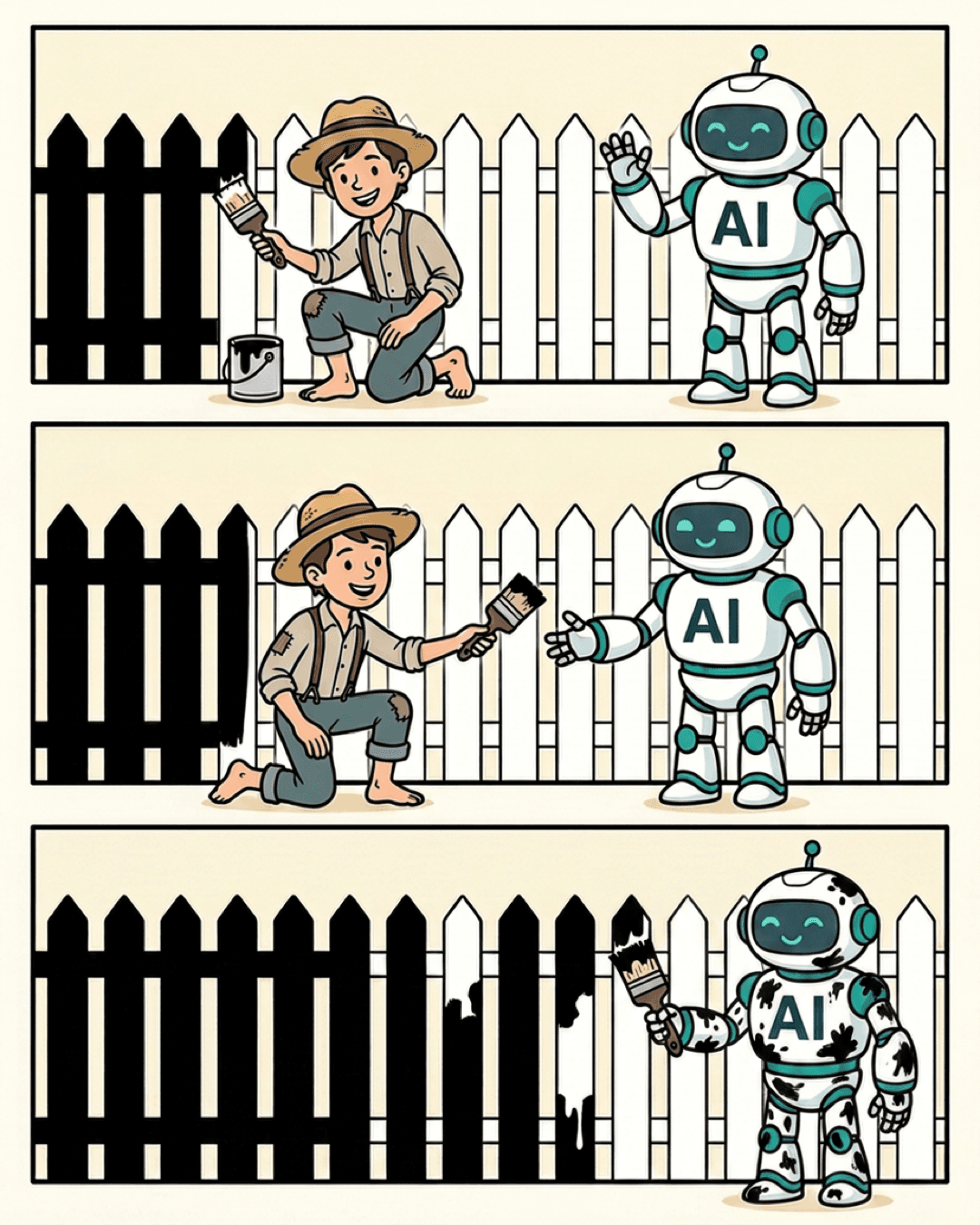
The comic that goes with this piece borrows the old fence trick. It worked for one reason. You gave away the brush and kept the idea. It stayed your fence.
The comic has three panels. In the first, the boy paints. He decides, and he does. In the second, he passes the brush to the robot. That's delegation working as it should. In the third, the robot paints alone. The fence gets finished, the paint goes on patchy, and the boy is nowhere in the frame.
Not because the robot got too good at painting. Because the boy handed over the one thing that made him the painter.
Hand over the task and you buy time to decide
The task is the typing. The first draft. The boilerplate.
Hand that over and you buy time. Time to decide more, and to decide better. The typing was never what made the work valuable, so clearing it gives you room for the part that is.
This is the good kind of handoff. You get better at the job, not just faster at it.
Hand over the call and nothing is left that was yours
The call is different. It's the what-to-build. The is-this-actually-right. The what-would-I-cut.
Hand those over too, and your plate looks just as clear. The output still arrives and the fence still gets painted. But the decisions inside it were made by something that never met your users, your team or your trade-offs. Now there's nothing left that was yours.
That isn't levelling up. It's leaving the frame.
Why the two handoffs feel exactly the same
Here's the part that catches people out. Handing over the typing and handing over the judgement feel exactly the same from the inside.
Both clear your plate. Both look like progress. Your week feels lighter either way. Only one keeps you in the work.
The sameness is what makes the second handoff so easy to miss. There's no moment where it feels like you gave something important away. The call slips out with the task, because the two travelled together in the same request.
A handoff that feels like progress isn't proof of progress.
The three-question test for your last three handoffs
Look back at your last three AI handoffs and ask three questions of each one.
First, did you hand over the work, or the decision about the work?
Second, did you come back with a better call, or just a faster one you never really made?
Third, could you still defend the choice in the room, or did the model do the choosing for you?
If you can answer all three cleanly, you're still the painter. If you can't remember making the calls, that is the signal worth acting on. The role has moved further from you than it looks from the inside. It's still early enough to step back in.
One more question to sit with: which panel did you wake up in this morning?
Delegate the work, keep the judgement
None of this is an argument for using the tools less. Refusing to delegate keeps you stuck doing work a machine could do, with less time for the decisions that count. The move is to hand over more, and to be precise about what you hand over.
Give away the brush. Keep the idea. The typing, the drafts and the boilerplate can go to the machine. What to build, whether it's right and what to cut stay with you. Those calls are what make it your fence, and what make you the product manager on it.
Keep the calls, and you're still the painter.
Download the one-page version and keep it next to your next handoff.