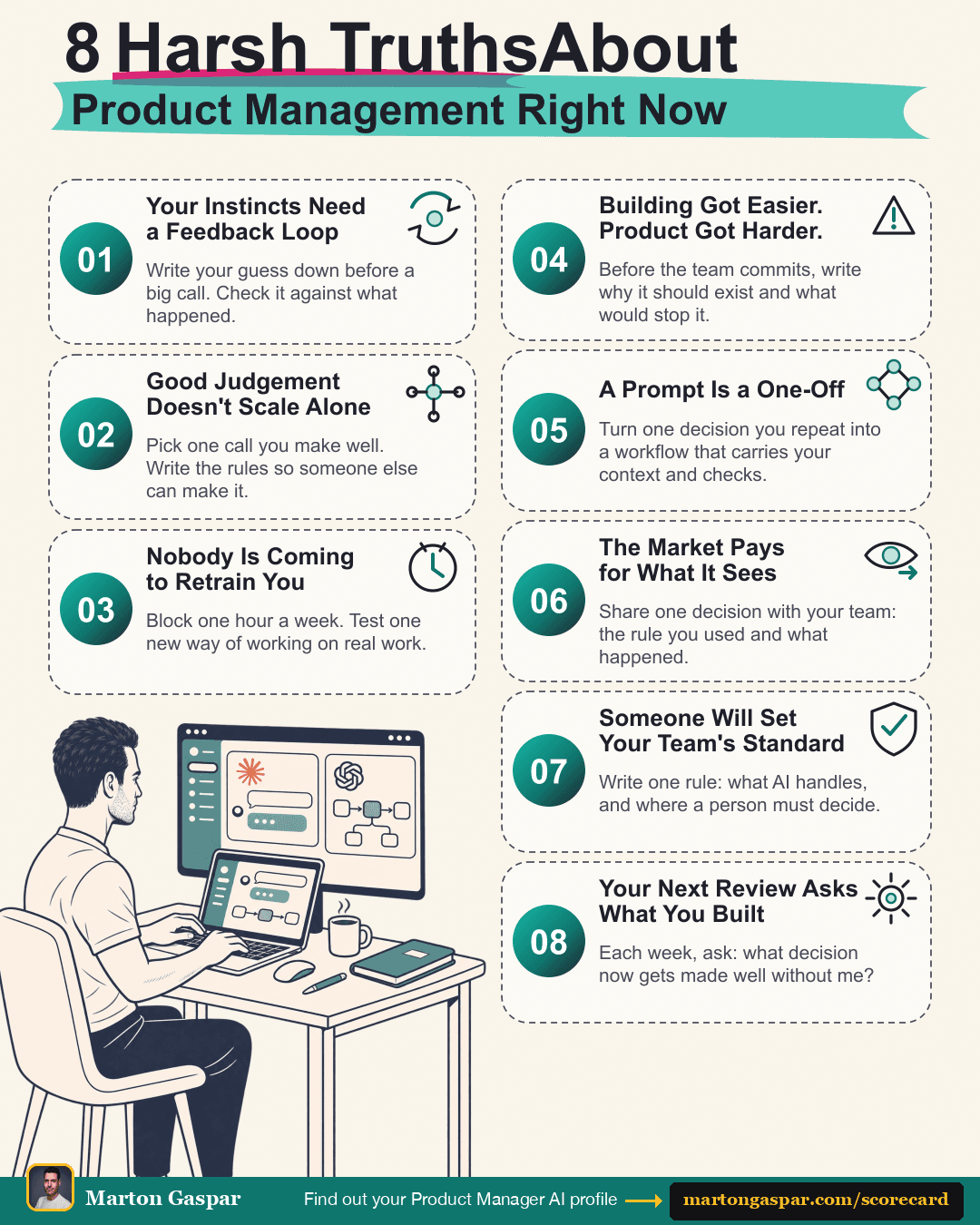
8 harsh truths about product management right now.
None of them are about the product. They are about how the job is changing underneath you, and what still gets rewarded when it does.
The tools got faster. Building a working thing now takes days, not quarters. That sounds like good news for product managers, and some of it is. But it also moves the hard part of the job somewhere else. When anyone can build, the question stops being "can we ship it?" and becomes "should it exist, and who decided?"
Each truth below comes with one move. Not a programme, not a course. One thing you can do this week that changes where you stand.
1. Your instincts need a feedback loop
Most product calls never get checked. You make the call, the work ships, the quarter moves on, and nobody goes back to ask whether the reasoning held. So your instincts stay exactly as good as they were, because nothing ever corrects them.
The move: before a big call, write down your guess. What you expect to happen, and roughly when. Then check the result against it.
It takes two minutes. Over a few months it tells you something no review ever will: where your gut is reliable, and where it is not.
2. Good judgement doesn't scale alone
Good judgement is valuable. Good judgement that lives only in your head is a bottleneck. It works when you are in the room and stops when you are not.
The move: pick one call you make well and write the rules behind it. When do you say yes? What makes you stop? What would change your mind?
Once it is written down, someone else can apply it, and so can an agent. Your judgement starts working in rooms you are not in. Encode Your Product Judgement (/vault/encode-your-product-judgement) goes deeper on writing your judgement down.
3. Nobody is coming to retrain you
Ways of working are changing faster than any company training plan. By the time a programme is designed, approved and rolled out, the tools it teaches have moved on.
That is not a failure of your employer. It is just the speed of it. Which means the learning is yours to run.
The move: test one new way of working each week. One workflow, one tool, one habit. Keep what helps. Drop what doesn't. Small, regular tests beat a big catch-up later.
4. Building got easier. Product got harder.
When building was slow and expensive, the cost itself filtered out weak ideas. Now a prototype is cheap, so more things get built, and more of them should not have been.
The hard part of product was never typing the code. It was deciding what deserves to exist.
The move: for the next thing on your roadmap, state why it should exist and what would stop it. If you can't name the condition that would kill it, you haven't decided to build it. You have just started.
5. A prompt is a one-off
A good prompt solves today's task. Tomorrow you open a blank chat and explain the context again. The work got faster, but it didn't get any easier to repeat.
The move: take a decision you make again and again, and turn it into a workflow. Give it the context it needs every time, and the checks you would run yourself. Then it runs the same way next week without you starting from scratch.
A workflow is the difference between using AI and building with it.
6. The market pays for what it sees
Good work that nobody can see is hard to reward. In a hiring process, a promotion round or a budget discussion, people back what they can point to.
Most product judgement is invisible by default. The feature you stopped, the risk you caught, the call that saved a quarter. None of it shows up on a release log.
The move: make one decision visible. Share the decision, the rule behind it, and the outcome. Not as a brag. As a record of how you think, so people can see it.
7. Someone will set your team's standard
Every team is going to settle on how it works with AI. What it hands over, what it checks, where a person stays in charge. If nobody sets that on purpose, it gets set by accident, one shortcut at a time.
The move: define it for your team. Write down what AI handles and where a person decides. Keep it short enough that people will read it.
Whoever writes that standard shapes how the team works for the next few years. It might as well be someone who understands the product.
8. Your next review asks what you built
Reviews are moving away from "what did you ship?" towards "what did you build that keeps working?" Output can be produced faster than ever, so output alone counts for less.
The move: before your next review, ask yourself one question. What decision now gets made well without you?
If you have an answer, you have something worth more than a list of shipped features. If you don't, that is the gap to work on next.
The thread through all eight
Read them together and one idea runs through every truth. The tools made building cheap. They did not make judgement cheap.
So the PMs who move ahead do the same few things. They check their calls. They write their judgement down. They turn repeat decisions into systems. And they make the thinking visible, so the market can see what it is paying for.
None of this needs a new title or a new company. It needs one move this week, then the next one.
If you want the full list of the harder lessons I learnt over the years, 24 Harsh Truths of Product Management (/vault/24-harsh-truths-of-product-management) groups them by where they bite.
Not sure where you stand? See how you measure up against other PMs at martongaspar.com/scorecard.