I once kept a brilliant know-it-all because they got results. They almost cost me my team's trust.
Good results, silent team
They were brilliant, and their work moved the product forward. But the rest of the team stopped pushing back. The risks they spotted stayed in their heads, and I found them after launch.
Then I asked in my 1:1s why the team had gone quiet. The answer was short: "We'll just always go with theirs."
I let good results excuse a silent team for too long. Now I measure myself by the calls the team makes without me. A product culture is healthy when good decisions keep getting made when you are not in the room, and when the people who see a risk say so before launch rather than after.
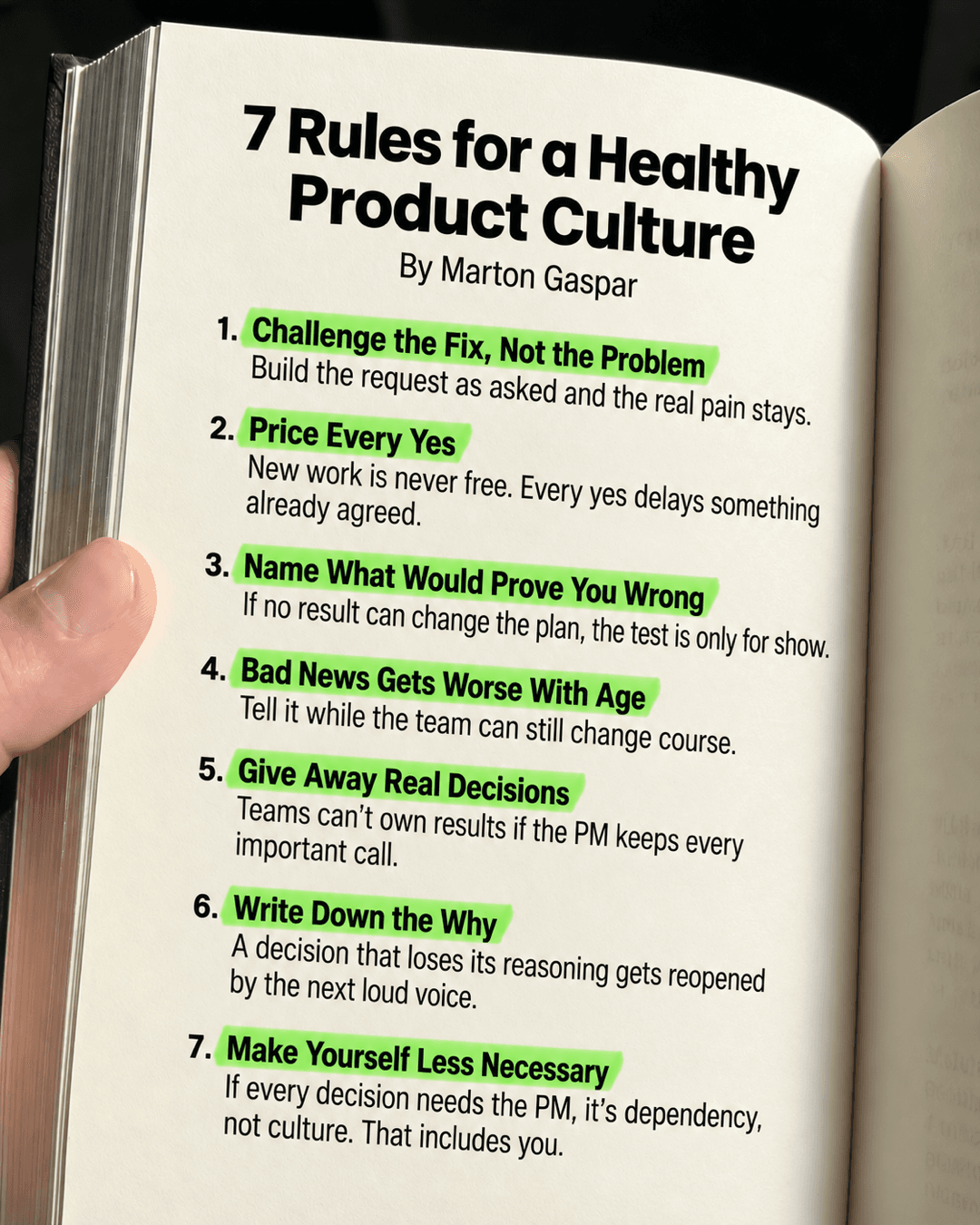
Seven rules for a healthy product culture
These are seven rules I believe product managers need to take seriously.
1. Challenge the fix, not the problem. Build the request exactly as asked and the real pain can stay. Ask, "If we never build this, what still hurts?"
2. Price every yes. New work is never free. Every yes delays something already agreed. Ask, "What stops if this starts?"
3. Name what would prove you wrong. If no result can change the plan, the test is only for show. Write "We were wrong if…" before anyone builds.
4. Bad news gets worse with age. Tell it while the team can still change course. Raise it before you have a fix ready.
5. Give away real decisions. A team can't own results if the PM keeps every important call. Sort each decision into one of three groups: the team decides, the team decides and tells you afterwards, or the team asks first.
6. Write down the why. A decision that loses its reasoning gets reopened by the next loud voice. Write four lines: the decision, the reason, the owner, and what would reopen it.
7. Make yourself less necessary. If every decision needs the PM, that is dependency, not culture, and that includes you. Hand over one weekly decision, plus the rule you use to make it.
Why rule 5 is the hardest
For me, rule 5 was the hardest. Backing the best idea felt like my job.
But every debate I handed to my star taught the team to stay quiet. Each time the strongest voice won by default, everyone else learnt that their view would not change the outcome. So they stopped offering it, and the risks they could see stopped reaching me.
Giving away real decisions feels like a loss of quality at first, because sometimes the team will make a call you would have made differently. The trade is worth it. A team that decides is a team that speaks up, and a team that speaks up catches more before launch.
I wish I'd learnt it sooner.
The habits do the work
Read the seven rules together and they share one aim. Each one moves a decision, or the reasoning behind it, out of one person's head and into the team's habits. Pricing a yes, naming what would prove you wrong, writing down the why: none of them depend on who is the smartest person in the room.
A PM's job isn't to make every good call. It's to build the habits that let the team make them without you.
If you want the leader's side of a healthy culture, /vault/traits-of-great-product-leaders covers fifteen small habits that stop a team waiting on its leader. For the conversation where most of this shows up, /vault/how-to-run-1-1s-that-build-decision-makers covers running 1:1s that build judgement.