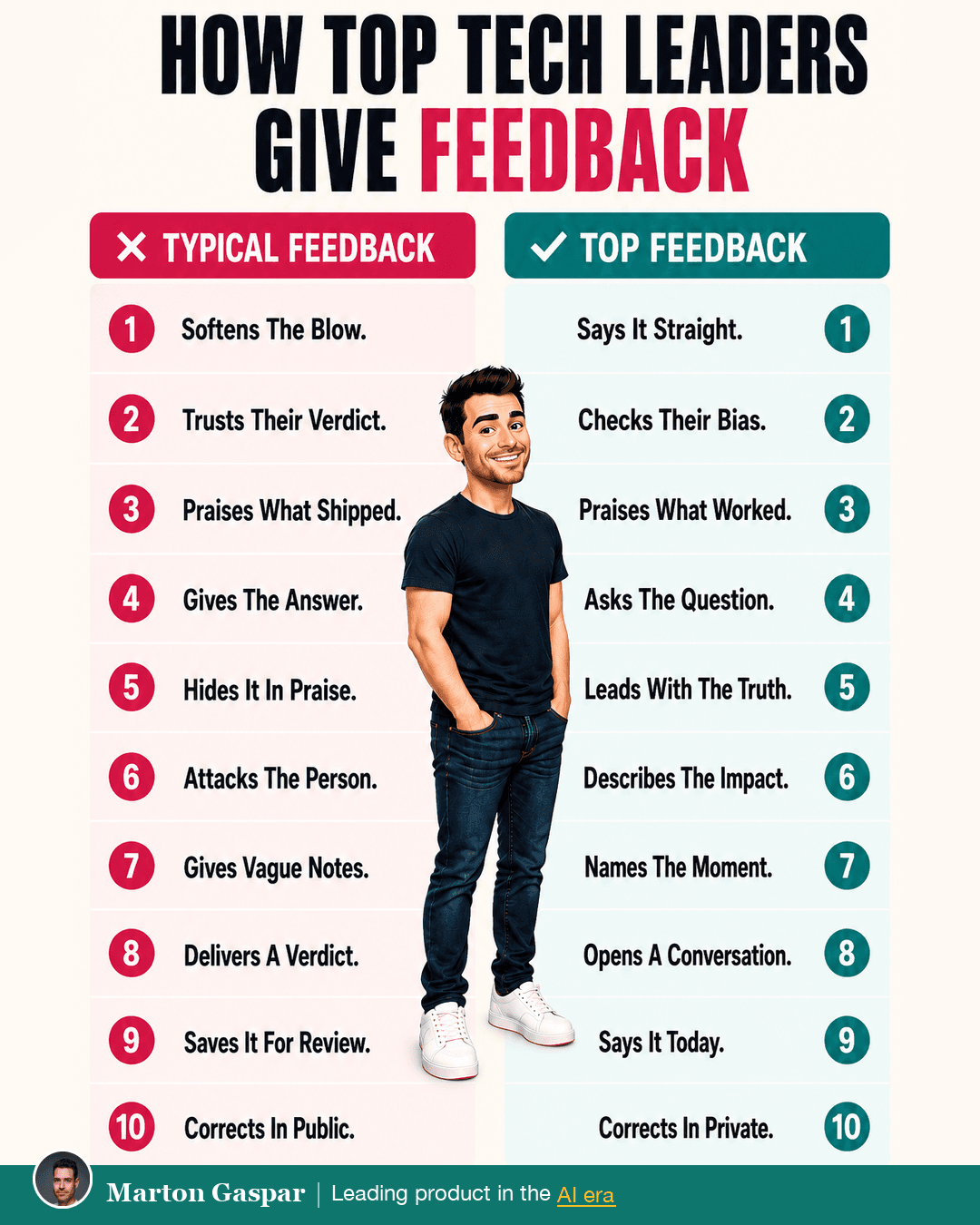
Great feedback can change your career. Few of us ever get it.
Giving great feedback is not a talent you are born with. It is a set of small swaps you can practise, one conversation at a time, and they all come down to one question.
Comfortable for me, or useful for them?
The average leader picks comfortable, without noticing. The top leader stops and makes it useful. Here are the ten swaps that separate typical feedback from top feedback, each one a choice you get to make in the moment.
Softens the blow, or says it straight
Typical feedback softens the blow until the point disappears. Top feedback says it straight. Clarity is the kind thing to do, because a message nobody understood can't help anyone improve. Softening feels generous in the moment. It mostly protects the person giving the feedback from an awkward few minutes.
Trusts their verdict, or checks their bias
Typical feedback trusts its own verdict. Top feedback checks its bias first. Before you tell someone what went wrong, ask whether you are reacting to the work or to your own preferences about how it should have been done. A different approach is not automatically a worse one. Checking first keeps the feedback about the outcome, which is the part they can actually act on.
Praises what shipped, or praises what worked
Typical feedback praises what shipped. Top feedback praises what worked. Shipping is the effort; what worked is the thing worth repeating. Naming it tells the person exactly what to do again.
Gives the answer, or asks the question
Typical feedback gives the answer. Top feedback asks the question. The answer solves today's problem. The question teaches them how to solve the next one. This is the swap that matters most, and the end of this article comes back to it.
Hides it in praise, or leads with the truth
Typical feedback hides the hard part between two compliments. Top feedback leads with the truth. When the important message is buried, people remember the praise and miss the point.
Attacks the person, or describes the impact
Typical feedback attacks the person. Top feedback describes the impact. Talk about the work and what it caused, not about who someone is. One gives them something to change. The other gives them something to defend.
Gives vague notes, or names the moment
Typical feedback gives vague notes. Top feedback names the moment. "Be more strategic" is hard to act on. A specific moment, in a specific meeting, is something they can picture and do differently.
Delivers a verdict, or opens a conversation
Typical feedback delivers a verdict and ends there. Top feedback opens a conversation. The person on the other side often knows something you don't, and you only hear it if you leave room for it. A verdict closes the topic. A conversation lets you both find out whether the feedback was right in the first place.
Saves it for review, or says it today
Typical feedback waits for the formal review. Top feedback says it today. Feedback is most useful while the moment is still fresh enough to learn from. Saved up for weeks, it arrives as a surprise about something the person can no longer change.
Corrects in public, or corrects in private
Typical feedback corrects in public. Top feedback corrects in private. A correction in front of others turns a learning moment into a question of face.
Five questions to make feedback useful
To make feedback useful, I ask myself five questions before I give it.
Am I saying what I actually mean? Am I talking about the work, or the person? Can I point to a specific moment? Am I opening a conversation, or just giving my verdict? Will it help them improve?
If any answer is no, the feedback is probably still in the comfortable version. Fix that one thing before the conversation.
The shift that matters most: build their judgement
There is one more shift, and it matters most.
The average manager hands over the answer. The best leader builds your judgement. One creates dependence. The other creates capability.
Building judgement is why the best feedback often sounds more like a question than an answer. A question asks the other person to see the problem for themselves, and that is what lets them handle the next one without you.
The hard part isn't knowing the questions. It is choosing them when the easy option is right there.
Don't try to fix everything at once. Pick the swap you avoid the most, and use it in your next one-to-one. One rep at a time.
Most feedback is forgotten by Friday. Great feedback leaves someone better than you found them.