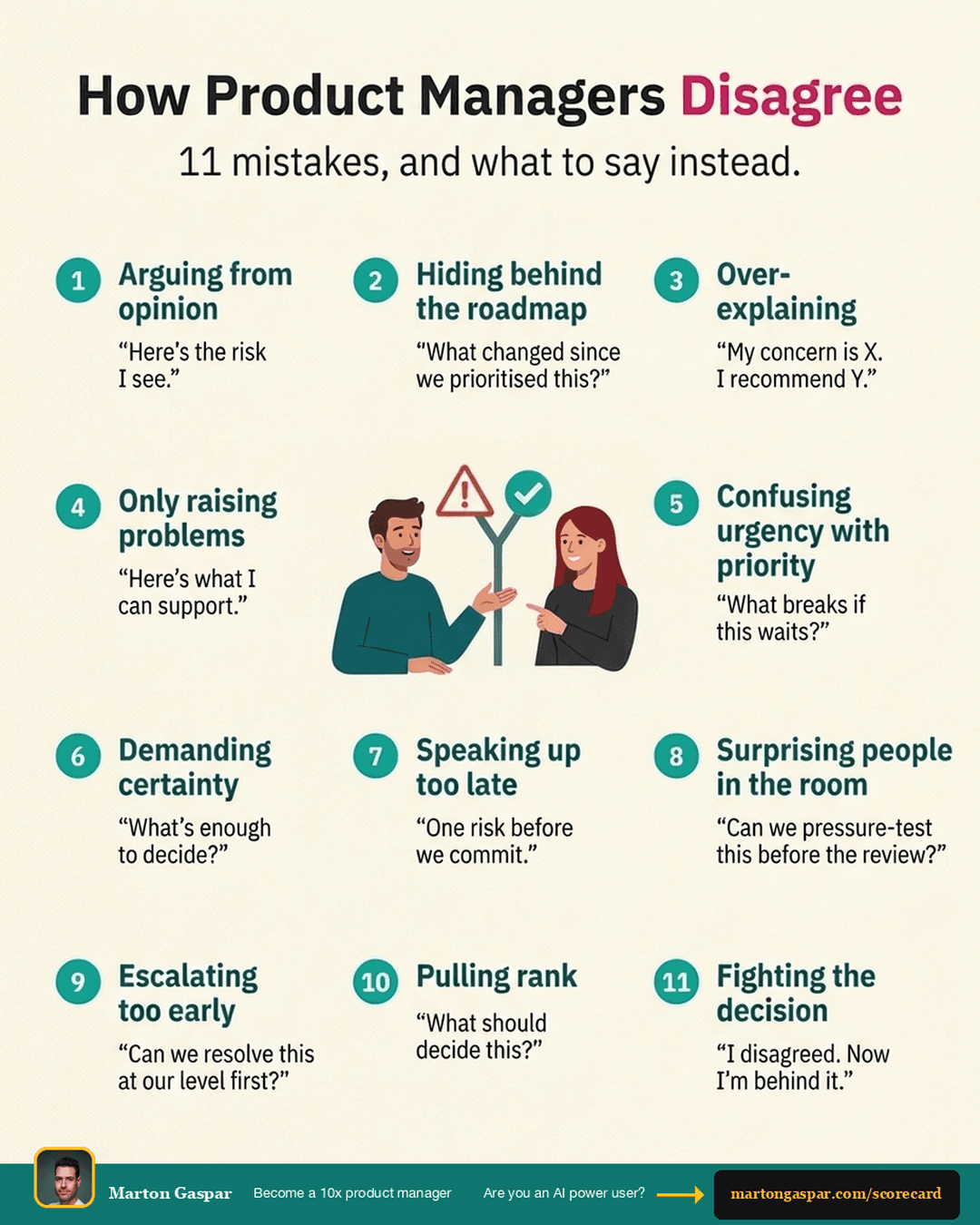
Bad disagreement is not a confidence problem. It makes you the issue, not the decision.
Every product manager disagrees for a living. With a roadmap, with a stakeholder's request, with a date someone already promised. The aim is to be the reason the decision got better, not the reason it took longer.
The mistakes below share one pattern. Each one turns the disagreement into something about you: your opinion, your certainty, your rank, your timing. The fixes all do the opposite. They make it about the decision: the risk, the trade-off, what breaks if it waits, what would change your mind.
None of these mistakes come from a lack of nerve. Most come from caring about the outcome and reaching for the quickest way to be heard. The trouble is that the quickest way usually puts your position in the spotlight, and once that happens the room starts judging you instead of the decision.
Here are 11 mistakes and what to say instead.
Arguing from opinion
"I think" invites a contest of opinions, and the most senior opinion usually wins it. Open with the risk instead.
Say: "Here's the risk I see." A risk can be looked at, sized and tested. An opinion can only be agreed with or overruled. Framing it as a risk also invites other people to add what they know, which is how a decision actually gets better.
Hiding behind the roadmap
"It's not on the roadmap" defends a past decision without checking whether it still holds. Ask what has changed since you decided it.
Say: "What changed since we prioritised this?" If nothing has changed, the roadmap stands on its merits. If something has, you are now discussing the right thing.
Over-explaining
The longer the case, the weaker it sounds, and the more openings it gives people to argue with a detail. Make your case in two sentences, then stop.
Say: "My concern is X. I recommend Y."
Only raising problems
A no on its own leaves the room with nowhere to go. Bring one option you'd back, not just a no.
Say: "Here's what I can support." It shows you want the outcome, and it gives the group something to build on.
Confusing urgency with priority
Something can be urgent without being important, and loud without being urgent. Ask what breaks if it waits a week.
Say: "What breaks if this waits?" A clear answer means the urgency is real. A vague one tells you something too.
Demanding certainty
Holding out for certainty can stall a decision indefinitely, because certainty rarely arrives. Ask what would be enough to decide.
Say: "What's enough to decide?" It turns an open-ended doubt into a bar the group can agree on and then meet.
Speaking up too late
A concern raised after the decision sounds like resistance, even when it is right. Say it before the decision, not after.
Say: "One risk before we commit." Timing is half of whether a disagreement helps or hurts.
Surprising people in the room
Nobody likes being challenged in front of their peers without warning. People defend what they are caught out on. Send a one-line heads-up before the meeting.
Say: "Can we pressure-test this before the review?" A one-line heads-up gives the other person time to think, and often the issue gets fixed before the meeting even starts.
Escalating too early
Going over someone's head before talking to them directly turns a disagreement into a conflict. Have the direct chat once before going up.
Say: "Can we resolve this at our level first?" If you can't, escalating afterwards is fair, and everyone knows you tried.
Pulling rank
Using your title or tenure to settle an argument might win the point and lose the room. Agree the criteria before you argue.
Say: "What should decide this?" Once the criteria are agreed, the options can be judged against them instead of against each other's status.
Fighting the decision
The hardest one is the last. Disagree. Lose. Back the decision anyway. Once it is called, say you're behind it.
Say: "I disagreed. Now I'm behind it." Reopening a decision you lost tells people your agreement is conditional. Backing it fully is what earns you the next ten rooms. It also means that when you do disagree next time, people know you are arguing for the decision, not against the people who made it.
Stop defending your position, start improving the decision
Read the 11 lines together and they move attention off people and onto the decision. Risk instead of opinion. Criteria instead of rank. Before the meeting instead of during it. Behind the call instead of against it.
The best disagreement I have seen did not win the room. It improved the decision.
If the hard part of your week is turning down requests rather than challenging decisions, How Product Managers Say No (/vault/how-product-managers-say-no) covers that side. For winning support before a decision is made, see Influence Without Authority (/vault/how-to-influence-without-authority).
Pick the one line from this list that would change the most meetings you're in, and use it this week.