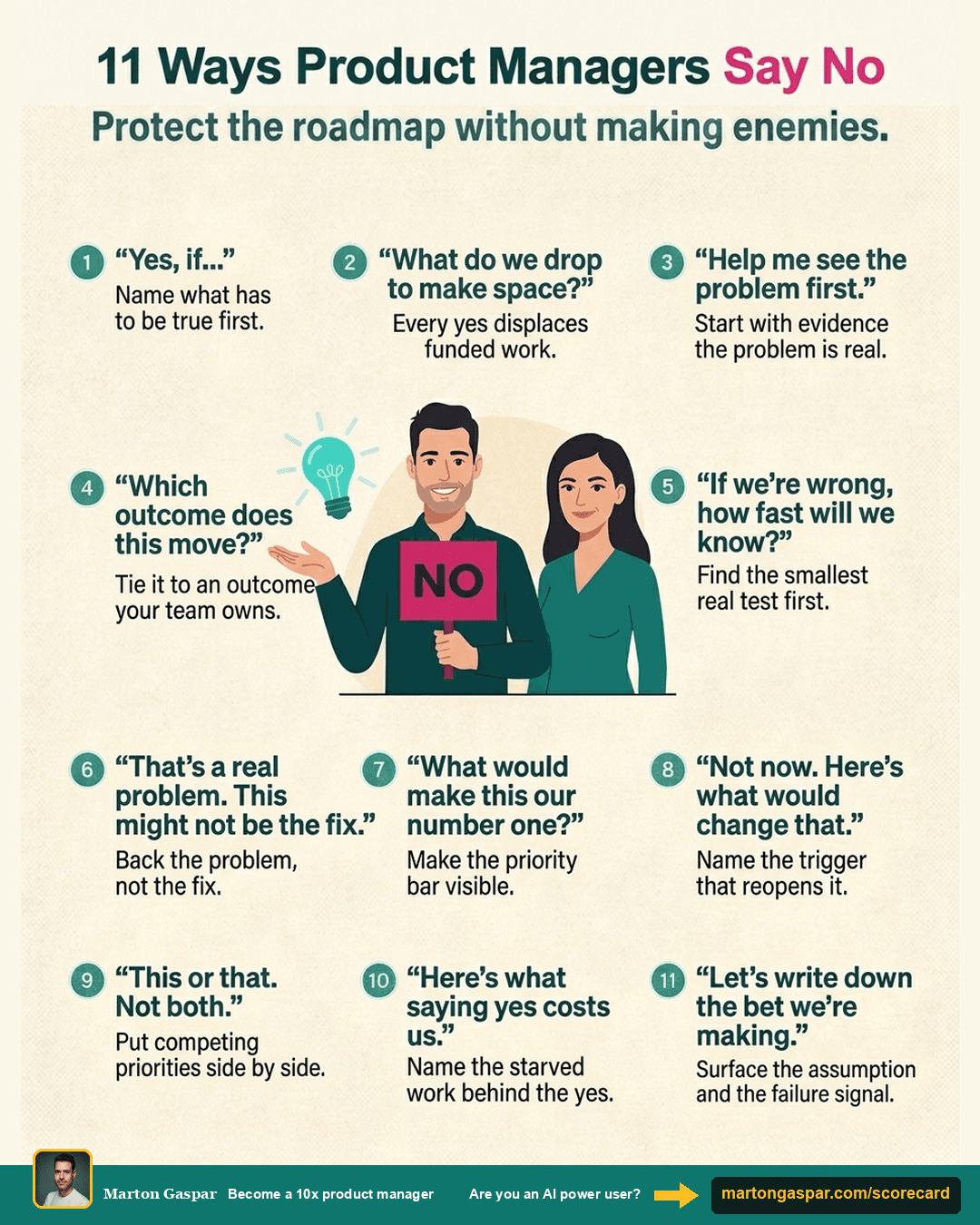
Here are 11 ways product managers say no. None of them are actually a no.
Somewhere along the way, "say no" became a product manager's whole personality. Protect the roadmap. Hold the line. Be the adult in the room. It's a miserable way to work, and it misreads what's in front of you.
People rarely arrive with an idea. They arrive with something they're trying to make happen, wearing the first solution they could think of. A flat no rejects both at once. A useful no pulls them apart, so you can take the problem seriously and still question the fix.
The phrases below pull the two apart. They're grouped by the job they do in the room, with a few extra ones for the hardest version of the conversation: saying no to your boss.
Start with a condition, not a wall
The default is to weigh the ask in your head and hand back a verdict: a closed door, with no idea what would open it.
The better move is "Yes, if...". Use it before you say anything else, and name one condition that would have to be true for you to say yes. If you can't name one, that's your answer, and you should give it plainly rather than hide behind the phrase.
Its cousin is "Yes. And here's what moves." Open with the yes, then name what slips and by how long. If nothing slips, you had spare capacity, so say that instead.
A condition gives them something to work with. A wall only gives them something to walk around.
Make the cost visible before anyone commits
The trap is treating a new ask as free. Every yes displaces funded work, but that cost stays invisible until a deadline slips and someone asks why.
So ask "What do we drop to make space?" the moment a new ask lands, and don't let the room move on until someone names what gets delayed. "Is this instead, or as well?" does the same job. Ask it before anyone scopes. If they say as well, ask what the team drops to cover it.
"Here's what saying yes costs us" names the starved work behind the yes before you say it, not after. Not to guilt anyone. So the cost is in the room before the decision is locked.
"This or that. Not both." puts competing priorities side by side: same team, same quarter, same capacity. When both costs are visible at once, people usually make the call themselves.
I coach PMs to show their plate so the other person can help pick. "Here's my top three. What would you change?" is how that sounds. Put your whole plate on one page, ranked, and bring it before they ask. Now the new thing has to push something off, and they pick what.
Find the problem under the ask
The default is to evaluate the solution you were handed, and end up arguing about a fix nobody has tied to a problem.
"Help me see the problem first" stops that. Ask for evidence the problem exists. You'll either find a cheaper path to the same goal, or find nothing underneath the ask. "What does this fix for you?" gets there from the other side. Write their answer down in their own words and don't scope until you have it. If they can't answer, the ask isn't ready, so book time for when it is.
"That's a real problem. This might not be the fix." Back the problem fully first, then question the solution separately. It's hard to accuse you of blocking when you've just agreed the problem is real.
"Which outcome does this move?" ties the ask to an outcome your team owns. Before the meeting, map it to your current OKRs yourself. If you can't find the link, ask them to make it.
Take the problem seriously and the solution becomes negotiable.
Test the timing, not just the idea
Some asks are good ideas at the wrong moment. Treating them as bad ideas starts a fight you don't need.
"What's driving the date?" Ask once, then wait for a real answer: a board date, a contract, a launch. "It would be good to have" goes in the backlog, not the plan.
"Not now. Here's what would change that." Never say not now without naming a trigger they can watch for: a metric, a milestone, a hire, a quarter. If you can't name one, it's a no, so give them the no.
"If we're wrong, how fast will we know?" pushes for the smallest real test. Not a fake MVP. The minimum that would actually change the decision.
Timing is a legitimate no. It just needs a door back in.
Put the bar and the bet in writing
When the bar for a yes lives in one person's head, nobody else can see it, so every no feels personal.
"What would make this our number one?" Write the bar down first: impact size, timing, confidence level. Now the conversation is about the bar, not your judgement.
"Let's write down the bet we're making." Open a doc in the meeting. Write the assumption, the expected outcome, and what failure looks like. Weak ideas rarely survive being written down. Strong ones get clearer.
"Can I write that up as the decision?" closes the loop: what we decided, who decided, what it costs. Send it before the day ends, or it's your word against theirs.
Written down, a no stops being your opinion and becomes a shared record.
When the ask comes from your boss
Saying no to your boss isn't the risk. Saying it badly is. An empty no gives your boss the problem back. A useful no gives them a better decision.
"That's your call. Here's my recommendation." Disagree and commit, out loud, in one sentence, then hand the decision back. If they go the other way, back it in public and mean it.
"I'm doing this unless you say otherwise." Say what you'll do and by when, in one message. Silence is now a yes, and you stopped waiting for one.
"Another team is closer. I'll bring them in." Say who, then book the conversation before you leave the room, and come back inside a week with it written down. A name alone is a dodge.
"No. And here's why." Answer in a day, not a month, with one reason short enough to repeat. A slow maybe traps people. A fast no frees them.
The pattern behind every useful no
Strip them back and the pattern is simple. Find the pressure behind the ask. Then challenge the solution, the timing, or the owner. Never hand back an empty no. Pair it with the price of yes, your recommendation, or a way forward.
This matters beyond one meeting. Every flat no teaches the person in front of you to bring you safer asks next time. Simpler ones. The ones you can't push back on. The real problems don't disappear. People just stop trusting you with them. Give them nothing useful and they stop asking you. They start telling you.
The wall doesn't keep bad ideas out. It keeps good ones from being shared at all.
Download the one-page version and keep it for your next stakeholder meeting.