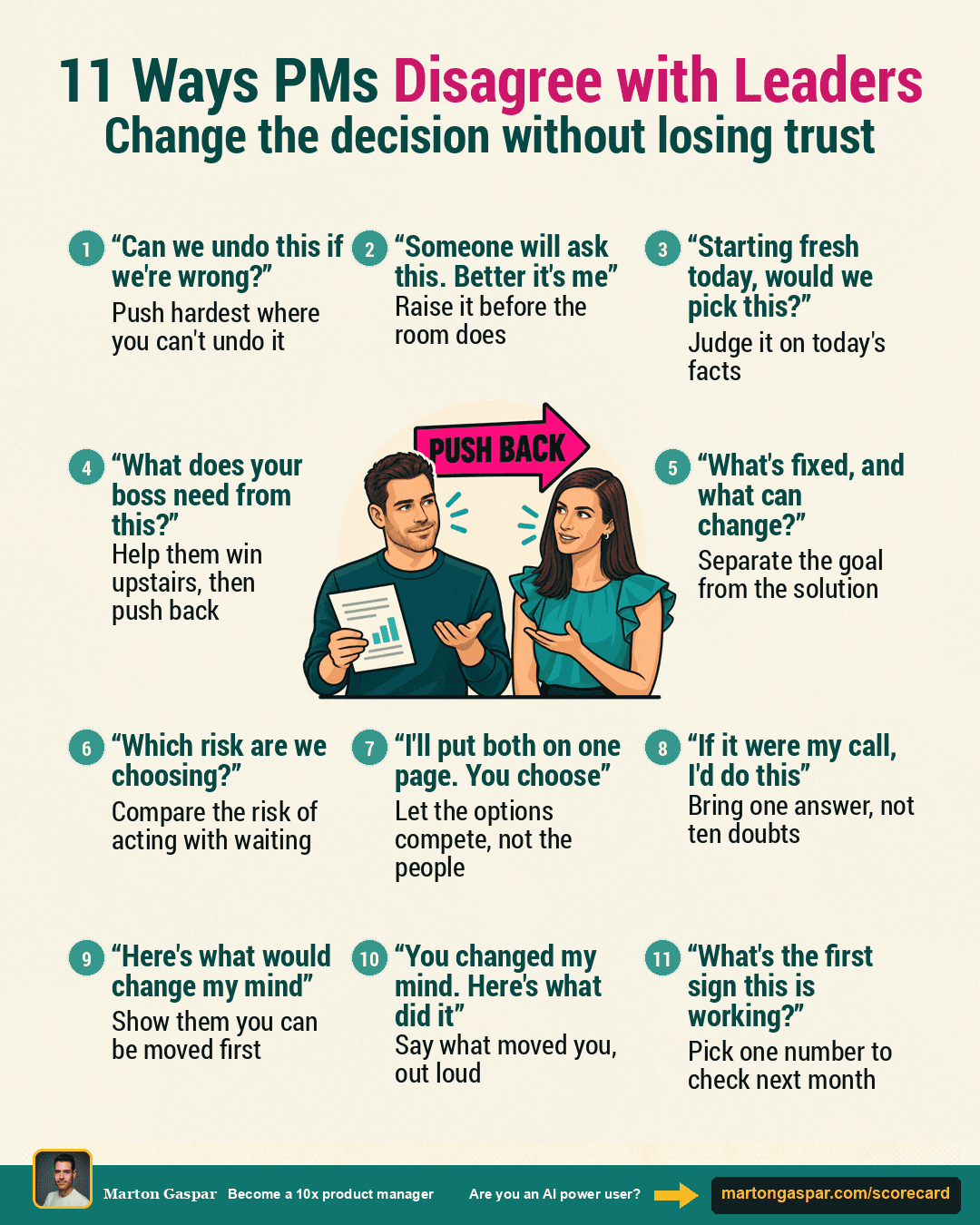
Here are 11 ways to disagree with your leadership without becoming "the difficult one."
Push back wrong and you're labelled. Push back right and they trust you more for it. The difference is rarely whether you disagree. It is when you raise it, how you frame it, and what you do once the call is made.
Each of the 11 below is a line you can say, with when to use it and what to do next.
"Can we undo this if we're wrong?"
Before you object at all, sort the call: easy to undo, or hard? A signed contract or a public promise is hard to undo. Push hardest there. If it's easy to undo, say your piece in one line and let it run. Saving your strongest pushback for the calls you can't reverse makes it count when you use it.
"Someone will ask this. Better it's me."
Raise it before the room does. Say it the day before the meeting, in a 1:1 or a two-line message. Name the exact question finance or their boss will ask. They walk in ready. Your doubt became their preparation, and you became the person who helped them, not the person who caught them out.
"Starting fresh today, would we pick this?"
Use it when the plan is older than a quarter, or half-built. List what has changed since: the market, the team, the numbers. Judge it on today's facts, not the facts from when it was agreed. If it's still a yes, drop your objection. You checked. Now commit.
"What does your boss need from this?"
Before you build your case, find the promise or number above them. Rewrite your objection as a risk to that number. Help them win upstairs, then push back. If you can't name the number, ask before you argue.
"What's fixed, and what can change?"
When the ask arrives as a finished solution, split it in three: the goal, the date and the how. Ask which are fixed. Often only one is, so push on the other two. That separates the goal from the solution. If all three are fixed, then it's not a discussion. Commit.
"Which risk are we choosing?"
When the debate is "do it" against "don't", write two lines. What goes wrong if we do it. What goes wrong if we wait. Now nobody is the blocker, because both options have a cost and the conversation is about which cost to carry.
"I'll put both on one page. You choose."
Send the page within a day of the meeting. Their option first, yours second, under the same headings: cost, time, risk. Let the options compete, not the people. A fair page earns trust in your pick. If yours loses on it, drop it.
"If it were my call, I'd do this."
Say it at the end of your case, never the start. Give the one reason that matters most, not all of them. Bring one answer, not ten doubts. If you don't have a recommendation yet, wait until you do.
"Here's what would change my mind."
Say it right after your recommendation. Name one fact or number that would flip you. Showing you can be moved first invites them to do the same, and they usually do. The debate becomes finding that fact instead of defending positions.
"You changed my mind. Here's what did it."
Say it the moment it happens, in front of the room. Name the exact argument or fact that moved you. Saying it out loud shows the room you argue for the best answer, not for your own. The next time you disagree, they listen.
"What's the first sign this is working?"
Ask it the moment the call is made, while everyone still agrees. Pick one number to check next month and book the check-in date in both calendars. Then the number decides, so nobody keeps score.
Raise it early, make your case once, back the call
Leaders don't stop trusting people who disagree. They stop trusting people who surprise them, or won't let it go.
Read the 11 lines together and they follow a pattern. Before the meeting, sort the call and raise the question early. During the debate, tie your case to what leadership needs, separate the goal from the solution and put the options side by side. At the end, give a clear recommendation, say what would change your mind and admit when it changed. After the call, agree how you'll know it worked.
Raise it early. Make your case once. Back the call either way.
These 11 lines are the moves to make. The mistakes to avoid when you push back, from arguing from opinion to fighting the decision after it's made, are covered in /vault/how-product-managers-disagree.
Which of these do you already use?