Don't follow 95% of the product advice out there. It comes from people who never worked in a top team.
It's the reason I create the content I do for product managers. I've coached over a hundred senior product leaders, and I've been building products at scale with top talent for over a decade.
It sounds simple written down like that. But when AI's pace picked up, I lost my confidence too. Most of what I thought would get me promoted didn't matter at all.
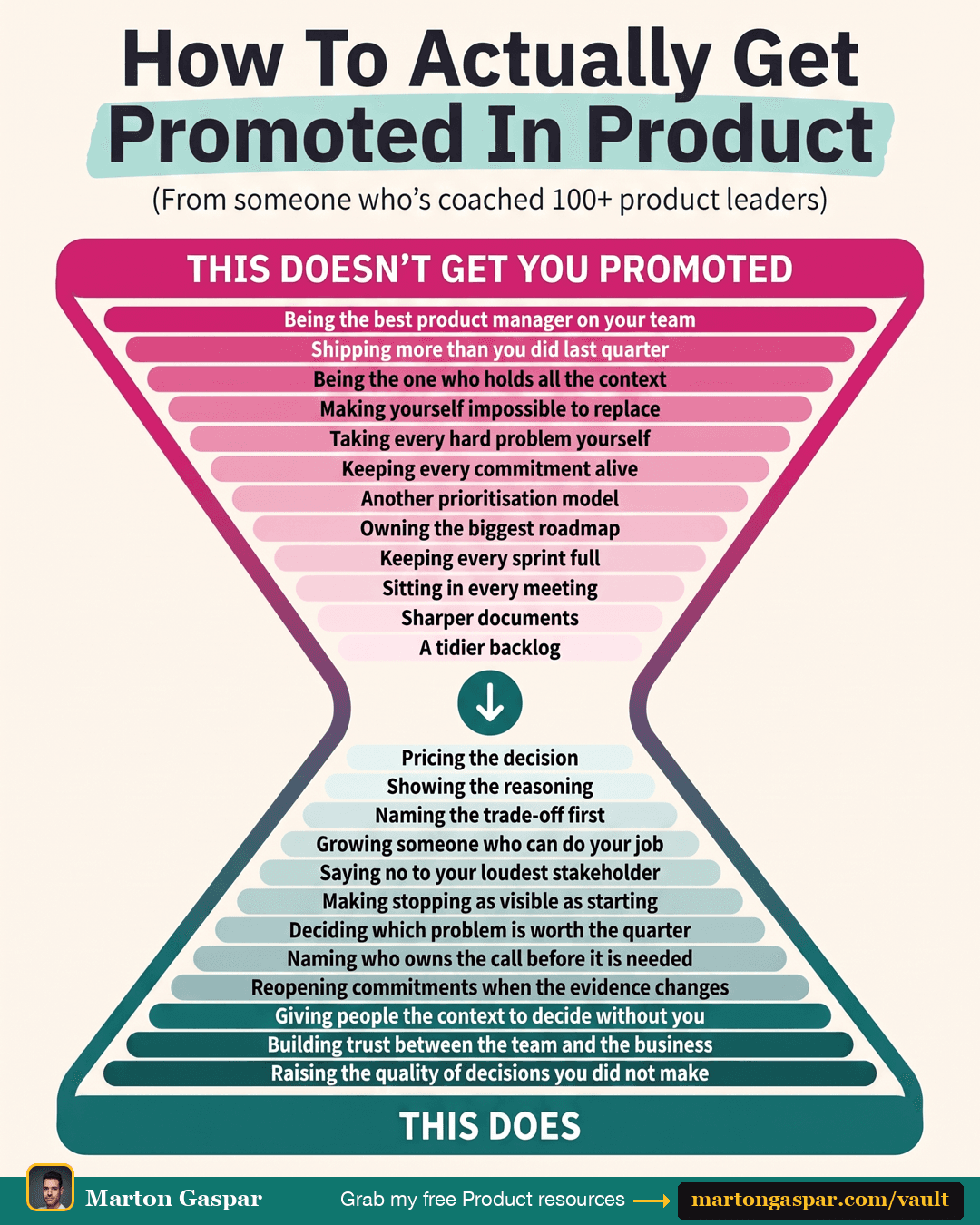
Here is the list I would work from if I were chasing a promotion in product today. Twelve things that feel like progress and don't move you up, and twelve that do.
What doesn't get you promoted
Most of the habits that stall a product career look like good work. Being the best product manager on your team. Shipping more than you did last quarter. Being the one who holds all the context. Making yourself impossible to replace. Taking every hard problem yourself.
Then the tidier versions. Keeping every commitment alive. Another prioritisation model. Owning the biggest roadmap. Keeping every sprint full. Sitting in every meeting. More polished documents. A tidier backlog.
Three of these deserve a closer look. The size of your roadmap won't get you noticed. Being the safest pair of hands is not the advantage you think. And a team that runs without you means you're ready, not replaceable.
Everything on this list makes you better at the job you already have. Promotion is about the next one.
Raise the quality of decisions you did not make
The default is to be the person every good decision goes through. It feels like impact, and it caps your impact at the number of hours you have.
The better move is to raise the quality of decisions made without you. At an HR SaaS I wrote the SOP to scale my delivery. An intern then launched sixty chatbots without me.
Your level shows in what happens when you are not in the room.
Give people the context to decide without you
The default is to stay in every meeting in case something comes up.
The better move is to give people the context to decide, then step out. Busy leaders name meetings where they added nothing. I challenge them to cut those. The notes and their team alert them anyway.
If the team has the context, they will come and find you when it matters.
Grow someone who can do your job
The default is to hold on to the work because it needs doing well.
Leaders who won't delegate don't trust it will be done their way. Your impact stops growing the moment your delegation does. The better move is to grow someone who can do your job, which is also how you show you are ready for the next one.
A successor is proof, not a threat.
Build trust between the team and the business
The default is to let friction between the team and the business turn personal.
The better move is to name the thing causing it. Bureaucracy made people angry at each other. We named it Kyle. Name the red tape and the team fights it, not each other.
Trust grows when both sides are pointed at the same problem.
Name who owns the call before it is needed
The default is to find out who owns a decision at the moment it is already urgent.
The better move is to ask early and keep asking. In government I asked the same question in every leadership meeting. Who owns this? I asked until they asked it first.
When the room asks the question without you, the habit has stuck.
Decide which problem is worth the quarter
The default is to take the brief as written and deliver it well.
The better move is to check the brief against what customers do. We were asked to fix a login page. The copy was fine, the step was wrong. Watch where customers stop before you take a brief.
Picking the right problem is worth more than solving the wrong one well.
Reopen commitments when the evidence changes
The default is to protect the plan because it was agreed.
The better move is to reopen it when the evidence moves. We turned a two-year roadmap into a live pilot in two months. Customers correct you faster than any plan does.
A plan is a starting point, not a promise to ignore what you learn.
Make stopping as visible as starting
Everyone announces what they start. Nobody announces what they stopped.
The better move is to say what you killed and what the team does instead. Stopping is a decision, and a decision nobody hears about gives you no credit and gives the team no direction.
What you stop says as much about your judgement as what you start.
Say no to your loudest stakeholder
The default is to either give the loudest stakeholder what they asked for or push back on the whole request.
The better move is more precise. Don't say no to the ask. Say no to their solution, then bring the one that fixes the pain underneath it.
You keep the relationship and you still get to the right answer.
Name the trade-off first, and price the decision
The default is to present options and hope someone picks. A leader was stuck between two good options for weeks.
The better move is to say what each one costs out loud, and the choice makes itself. Price it in plain terms: build this now and the other job waits three months. Now they can choose.
Once the cost is on the table, a stuck decision starts moving.
Show your reasoning
The default is to give the conclusion and keep the thinking in your head.
I told someone her idea sounded half formed. It wasn't. People judge the reasoning you show, not the reasoning you have. The better move is to put your reasoning where others can see it and check it.
Reasoning nobody can see does not count in the room.
The one decision to hand over this week
Read the two lists side by side and one pattern stands out. Everything that doesn't get you promoted makes you more needed. Everything that does lets your judgement work in rooms you are not in.
Being needed feels like value. It is also the thing that keeps you where you are.
So pick the one decision only you can make, and hand it over this week. Then check which of the twelve you are already doing, and which one to start next.
Download the one-page version and keep it where you plan your week.