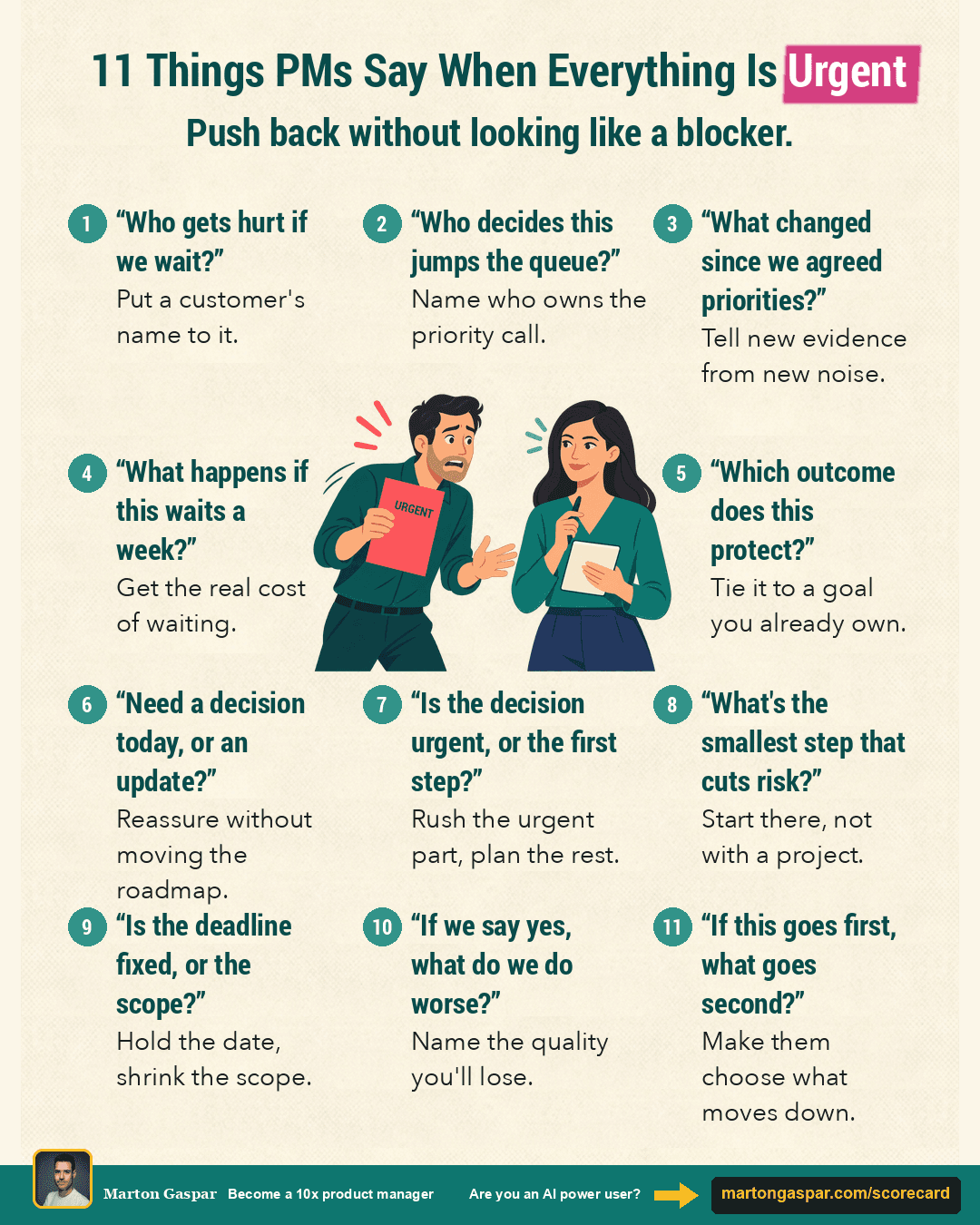
11 ways to handle urgent. None of them is to "drop everything."
When urgent becomes the default, every ask is a P1. The roadmap stops being a plan and turns into a queue that whoever shouts loudest gets to reorder. The team stays busy, but busy on whatever arrived last, while the work agreed last quarter slips a week at a time.
The pull is to treat pushing back as the risky move. Ask a question and you might look like the blocker. Say yes and you look helpful, at least until the rework shows up. The maths runs the other way. A question costs minutes. Building the wrong urgent thing costs weeks.
So the craft is sorting real urgency from false urgency fast, in a way that leaves the person asking feeling helped rather than stalled. It is also one of the clearest signals of seniority a product manager sends. The PM who can triage calmly under pressure gets trusted with the bigger calls.
Below are eleven questions that do the sorting. They're grouped by the job they do, and each one comes with when and how to use it.
Test whether it is urgent or just loud
"Who gets hurt if we wait?" Say it the moment the ask arrives, before anyone opens a ticket, and put a customer's name to it. If the urgency is real, they'll have a date in seconds. If it's a worry, they won't, and you've found that out before anyone has written a line of code.
"What happens if this waits a week?" goes one step further and gets the real cost of waiting. Ask for specifics before anyone estimates: revenue, a contract, a named customer. If the only cost is someone's patience, it can wait.
"What changed since we agreed priorities?" Bring last quarter's priorities and ask what happened just before this felt urgent. The point is to tell new evidence from new noise. A lost deal is a reason to re-plan. A loud meeting isn't.
All three ask for evidence rather than justification. Real urgency comes with a date, a cost and a cause. False urgency comes with a feeling.
Put a name to the priority call
Urgency often arrives with nobody's name on it. It came from "leadership", or "the client", or a thread nobody remembers starting. Two questions give it an owner.
"Who decides this jumps the queue?" names who owns the priority call. Reply in the thread it came in, so the answer is in writing. Once someone has to put their name to it, the urgency tends to drop.
"Which outcome does this protect?" ties the ask to a goal you already own. Have this quarter's goals open on screen when you ask it. If the ask fits none of them, it's a new goal, and a new goal needs a bigger conversation than a reply in a thread.
Neither question says no. They move the decision to where it belongs: with a named person, against an agreed outcome.
Separate the urgent part from the rest
Plenty of urgent asks hide a small piece that needs doing now inside a larger piece that doesn't. Treat the whole thing as a fire and a small problem turns into a whole project.
"Need a decision today, or an update?" Use it before you promise anything. Some people just need a line for their own boss. Reassure them without moving the roadmap: send a written update by 5pm, and the "urgent" ask usually stops there.
"Is the decision urgent, or the first step?" Split the ask in two on the whiteboard before the meeting ends. Rush the urgent part, plan the rest. They leave with today's call made, and the build gets a date instead of a panic.
"What's the smallest step that cuts risk?" Look for what you can do by tomorrow: a workaround, a config switch, a customer call. Not the fix. The thing that stops it getting worse while you build the fix. Start there, not with a project.
Each of these gives the person something today. That is what keeps you from looking like the blocker. They leave with movement, and the roadmap stays where it was.
Hand the trade-off to the person asking
When an ask does need to go now, something else has to give. These last three make sure the person asking sees what gives, and picks it themselves.
"Is the deadline fixed, or the scope?" Hold the date, shrink the scope. Lay the feature list next to the date and cross lines out together. If they say both are fixed, go straight to the next question.
"If we say yes, what do we do worse?" Name the quality you'll lose. Write the trade-off into the ticket: less testing, a known bug, a rough edge. Add the approver's name. People choose more carefully when their name is on it.
"If this goes first, what goes second?" Put the priority list on screen in the meeting and hand them the cursor. When they have to drag something down themselves, the urgent ask often gets smaller.
Nothing gets refused here. The price of yes becomes visible at the moment it gets paid, to the person who wants it.
These questions are for triage, when the ask might be right but the timing is in doubt. When the answer needs to be a plain no, How Product Managers Say No (11 Phrases That Keep the Conversation Open) covers that side of the conversation.
The blocker isn't the PM who asks
Every rushed yes teaches the company that urgent skips the why. The next ask arrives a little louder, with a little less reason attached, because loud worked last time. And more of the work gets built twice: once in a hurry, then again once someone works out what was needed.
That is the system worth pushing against. Urgency culture rewards whoever escalates fastest and leaves the rework with the team. A product manager who asks one good question isn't slowing anyone down. They're spending minutes to save weeks.
The blocker isn't the PM who asks. It's the rework nobody questioned.
Pick one question from the list and use it on the next urgent ask that arrives. Keep the rest for the next time everything feels urgent.