The best 1:1s build decision-makers. Here is a simple four-question guide that gets you there.
A 1:1 can be the most valuable 30 minutes in your week, or a status update an email could have sent. The difference isn't the time slot or the template. It's what the conversation is for. A great 1:1 turns problems into decisions, and decisions into judgement.
You're on both sides of this. You run 1:1s with your team, and you have them with your own boss. The same four questions work in both directions. When you're leading the conversation, you ask them. When you're the one being asked, you walk in with the answers ready.
The four spell GROW: Goals, Risks, Options, Way Forward.
Goals: what outcome are you going for?
Start with where they're headed, not the task list.
A 1:1 that opens with "what did you do this week?" turns into a progress report. The person lists tasks, you nod, and nobody learns anything about the decisions behind them. Asking about the outcome first changes the frame. It puts the work in the context of what it's meant to achieve, and it shows you quickly whether the two of you agree on what good looks like.
If the answer is vague, that's useful too. A fuzzy goal is usually the first thing worth working on together.
Risks: what's in the way?
Get the real blockers out before they bite.
People tend to bring the safe problems to a 1:1 and keep the uncomfortable ones for later. Asking directly what's in the way gives them permission to name the thing they're worried about while it's still small. A risk raised in week two is a conversation. The same risk found in week ten is a problem for everyone.
Surfacing risks is a habit you build into the meeting, not a separate review. Over time it becomes the part of the 1:1 that saves you the most.
Options: what are you weighing?
Make them bring options, not just problems.
This is the question that builds judgement. When someone brings you a problem and you hand back the answer, you've solved one problem and taught them to bring you the next one. When you ask what they're weighing, they have to do the thinking first. You see how they reason, and you can coach the reasoning instead of the result.
Ask "what would you do?" and then wait. The first answer is often better than they expect it to be.
Way forward: what's the call, and who owns it?
Leave with a decision and a name next to it.
A 1:1 that ends with "let's think about it" usually ends in another 1:1 on the same topic. Closing with a clear call and an owner turns the conversation into progress. It also tells the other person that the decision is theirs to carry, with you backing them, rather than yours to make for them.
For more on handing over the call rather than just the task, see /vault/hand-over-the-task-not-the-call.
When you're the one being asked
Walk into your own manager's 1:1 ready with the same four:
The call you're trying to make. The biggest risk you see. The options you're weighing. And what you'd do if nobody else could make the decision.
That last one matters most. It turns "what should I do?" into "here is what I'd do, and why". Your boss can then react to a recommendation instead of starting from a blank page, and you get to show your judgement rather than your workload.
Ten habits that separate a strong 1:1 from a typical one
The four questions give the meeting a shape. These ten habits decide what happens inside it.
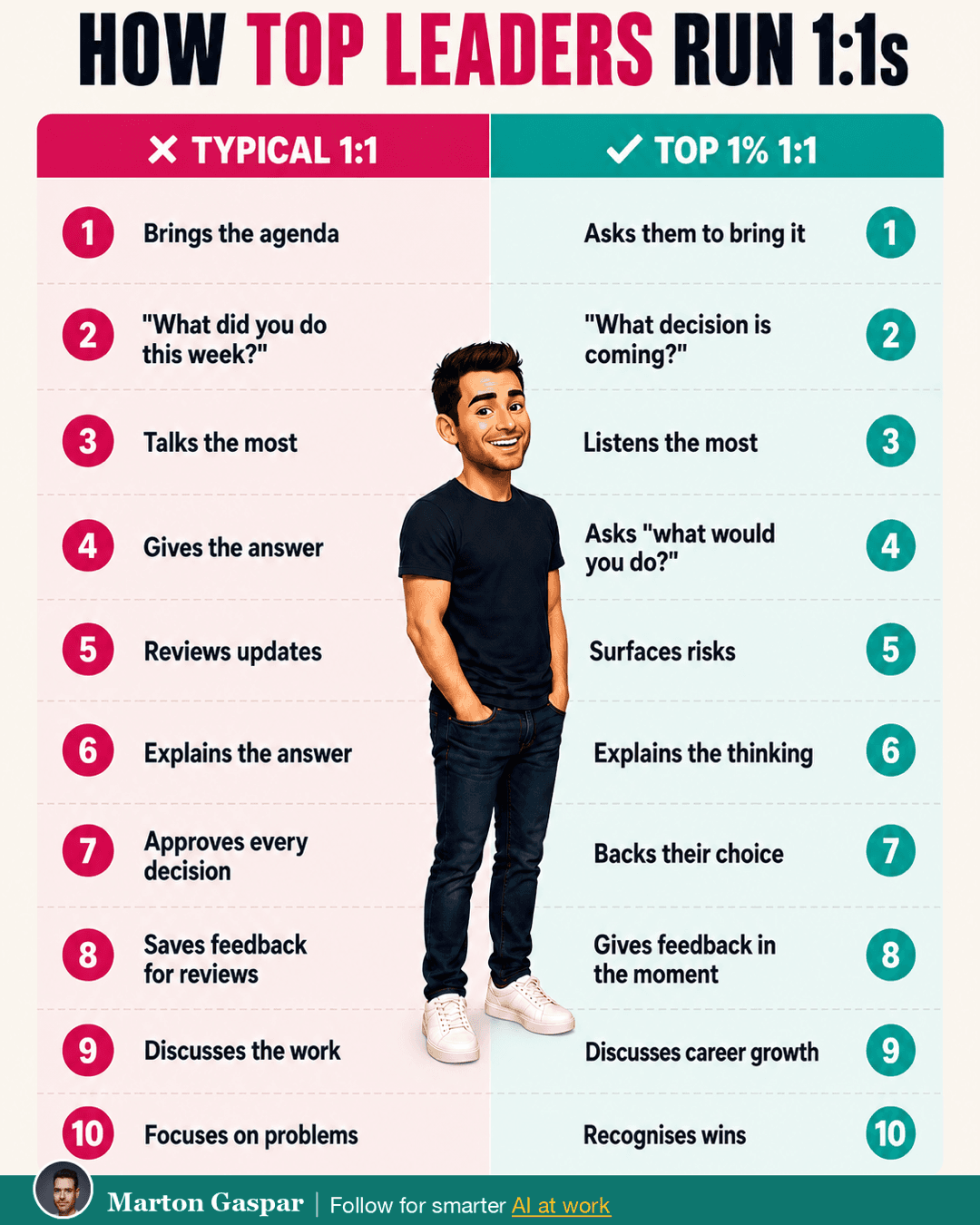
A typical 1:1 has the manager bringing the agenda. A strong one asks the other person to bring it. A typical one asks "what did you do this week?" A strong one asks "what decision is coming?"
In a typical 1:1 the manager talks the most and gives the answer. In a strong one they listen the most and ask "what would you do?"
A typical 1:1 reviews updates and explains the answer. A strong one surfaces risks and explains the thinking, so the next call can be made without the meeting.
A typical 1:1 approves every decision and saves feedback for the review cycle. A strong one backs the other person's choice and gives feedback in the moment, while it's still useful.
And a typical 1:1 discusses only the work and focuses on problems. A strong one makes room for career growth and recognises wins as well.
What changes after a few weeks
Run your 1:1s this way for a few weeks and the conversation shifts. Your team starts bringing recommendations instead of problems. You start doing the same with your own boss.
That's the real return on 30 minutes a week. Not a better status update, but two people who both get better at deciding. A good 1:1 makes you both better at it.