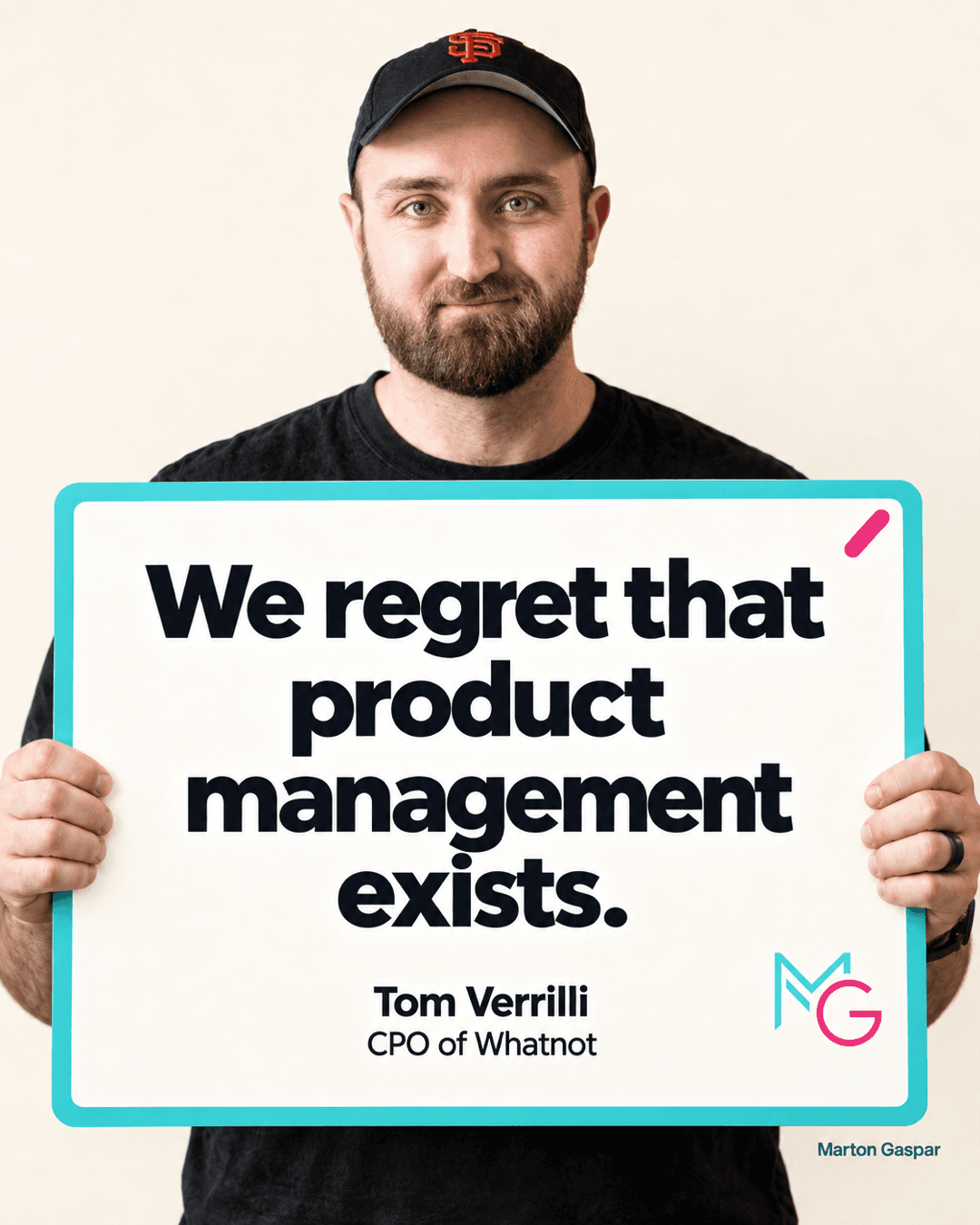
31,832 people applied to be a PM at Whatnot in two years.
They hired one, on purpose.
Tom Verrilli, Whatnot's CPO, told Lenny Rachitsky why. He puts senior PMs where there's a specific need, not on every team by default. His own line on it is blunter: "We regret that product management exists."
You don't have to agree with him to find the question useful. If a company can run with almost no PMs, what exactly is a PM's contribution where one is in place? And can you point to yours?
One PM per team is a habit, not a law
Most orgs put one PM on every team without thinking about it. It is a habit nobody questions, the way every team gets a standup.
Whatnot questioned it. Their answer was to place senior PMs where there is a specific need and leave capable teams to run themselves.
That is uncomfortable reading for anyone whose job title depends on the habit. It is also a fair challenge. A capable team doesn't need a PM to run itself. If the PM's main job is keeping the process moving, a good team can do that without one.
The job is changing decisions, not running the process around them
In a lot of teams I see, the PM doesn't change decisions. The role ends up managing the process around decisions the team already made: writing them up, scheduling them, tracking them.
That is a problem with how the role is set up, not with the people in it. But it explains why a CPO can look at the role and decide most teams don't need one.
I'd argue PM judgement matters most when the team already has an answer, and that answer is wrong. Not when there is no answer. When there is a confident one that nobody checked.
That is where to spend your judgement. On the call where the answer is something nobody checked.
The marketplace we didn't have to build
As product director at a home services scaleup, I led product across 50 engineers. I couldn't be across every team. So I focused on the decisions that actually needed me.
We wanted to build a marketplace, starting with a trial in Florida. The original plan was 13 engineers and a year to prove it worked.
Nobody had connected that plan to what we already had. Parts of our existing tech, stitched together with emergency routing by text, could simulate the whole marketplace.
I asked our engineers if we could pull it off. Four engineers. Two months. A live pilot testing insurer demand before a single line of marketplace code was written.
What changed was the order. First find out whether insurers wanted it. Then decide on the marketplace.
The wrong thing to do would have been to build. The contribution was spotting that existing tech and emergency routing by text could answer whether insurers would pay, without building the marketplace at all.
That is what a decision changed by a PM looks like. Nobody needed me to run the process. They needed someone to question the order.
Three things that make your contribution impossible to ignore
If your company ever asks whether your team needs a PM, these three answers make the case. They also make better promotion evidence than a list of features shipped.
The first is the problem you were brought in for. Name it plainly. Not "own the onboarding roadmap" but the problem behind it, such as new customers dropping out before they see any value. If you can't name the problem, nobody else can see why you're there.
The second is the decision you helped change. Not the decision you documented or the meeting you ran. The call that went a different way because you were in it. In the marketplace example, that was the order: test demand first, build second.
The third is what the team could do because of it. Time saved, money not spent, a risk avoided, an option kept open. In the marketplace example, a team of four answered in two months a question the plan had budgeted 13 engineers and a year for.
Put those three together and your contribution stops being a matter of opinion.
Your value is in the decisions that changed
Whatnot's numbers are extreme, and most companies won't copy them. But the logic behind them is worth taking seriously: put product judgement where it changes outcomes, not everywhere by default.
The protection for your career is the same either way. Be the person whose involvement made a decision better, and be able to say which decision.
For more on turning this into promotion evidence, see /vault/how-to-get-promoted-in-product.
Which decision from the last six months was better because you were involved?