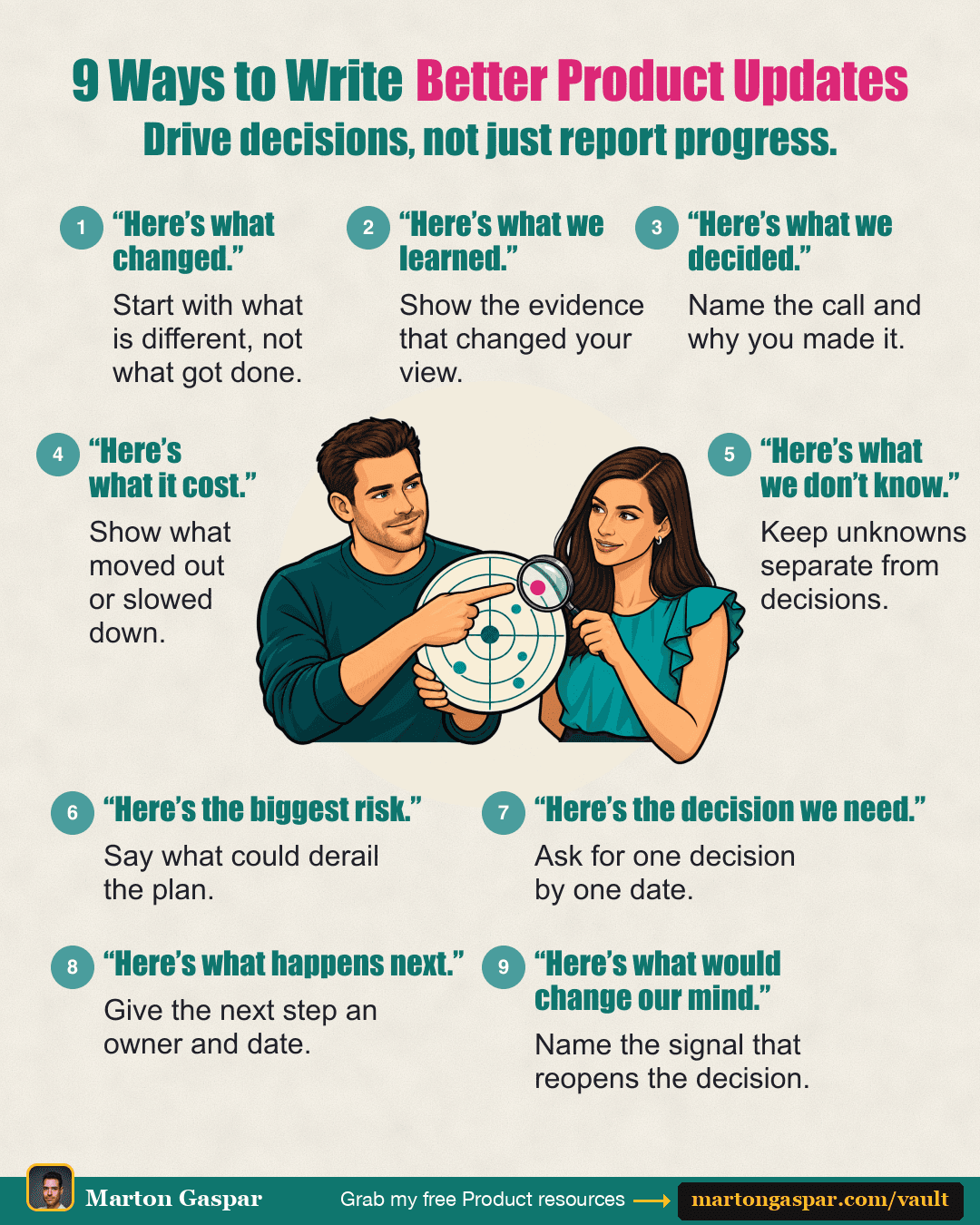
9 ways to excel at product updates. So nobody has to ask what happens next.
I often see PM updates turn into a list of tickets that nobody can act on or cares about. It's a miserable way to work, for the person writing it and for everyone reading it.
I think people read your update for two things. What they have to decide, and whether they should worry.
These 9 phrases are the difference between reporting the work and leading it. Each one comes with how to write it.
1. "Here's what changed."
Put what changed and why it matters in the first line. Start with what is different, not what got done.
If nothing changed this week, say so in one line and stop. A short update that says nothing moved is more useful than a long one that hides it.
2. "Here's what we learned."
Write it as one line: "We thought X. Now we think Y." Then show what Y changes in the plan.
Line two is where you show the evidence that changed your view. A lesson that changes nothing in the plan is a fact, not a learning.
3. "Here's what we decided."
Write it as a sentence someone could disagree with. Name the call and why you made it.
If nobody could argue with it, it wasn't a decision. "We're focusing on quality" is not a decision. A sentence that rules something out is.
4. "Here's what it cost."
Give what moved a new date, and say who it affects. Show what moved out or slowed down.
They hear it from you first, not in a review a month later. Bad news that arrives early is a plan. Bad news that arrives late is a surprise.
5. "Here's what we don't know."
Next to each unknown, write who answers it and by when. Keep unknowns separate from decisions.
This is not to hedge. It is so nobody mistakes a guess for a commitment.
6. "Here's the biggest risk."
Name one risk, its warning sign, and this week's fix. Say what could derail the plan.
If you can't pick one, the plan isn't clear enough yet. A list of ten risks tells the reader you haven't decided which one matters.
7. "Here's the decision we need."
List the decider, the deadline, two options and your pick. Ask for one decision by one date.
So the reply can be one word. The easier you make the decision, the faster it comes back.
8. "Here's what happens next."
Write who does what, by when, and what "done" looks like. Give every next step an owner and a date.
If one of those is blank, the step isn't real yet.
9. "Here's what would change our mind."
Write it early: "If X happens by Y, we look again." Name the signal that reopens the decision.
Then nobody argues the same decision again every week. The condition for reopening it is already agreed, so until it happens, the decision stands.
Updates that lead the work, not just report it
Every update that only lists finished work teaches people to come and find you for the rest.
The real decisions don't disappear. They just get made in rooms you're not in.
The way I see it, no surprises buys you room. People who are never surprised stop checking on you. That room is what lets you get on with the work instead of explaining it.
A list of finished tickets doesn't show your level. The decisions people can make without you do.
If the same idea applies to how you handle senior people more widely, Manage Confidence, Not Stakeholders (/vault/manage-confidence-not-stakeholders) goes further into it.
For free AI skills, templates and guides for PMs, visit martongaspar.com/vault.