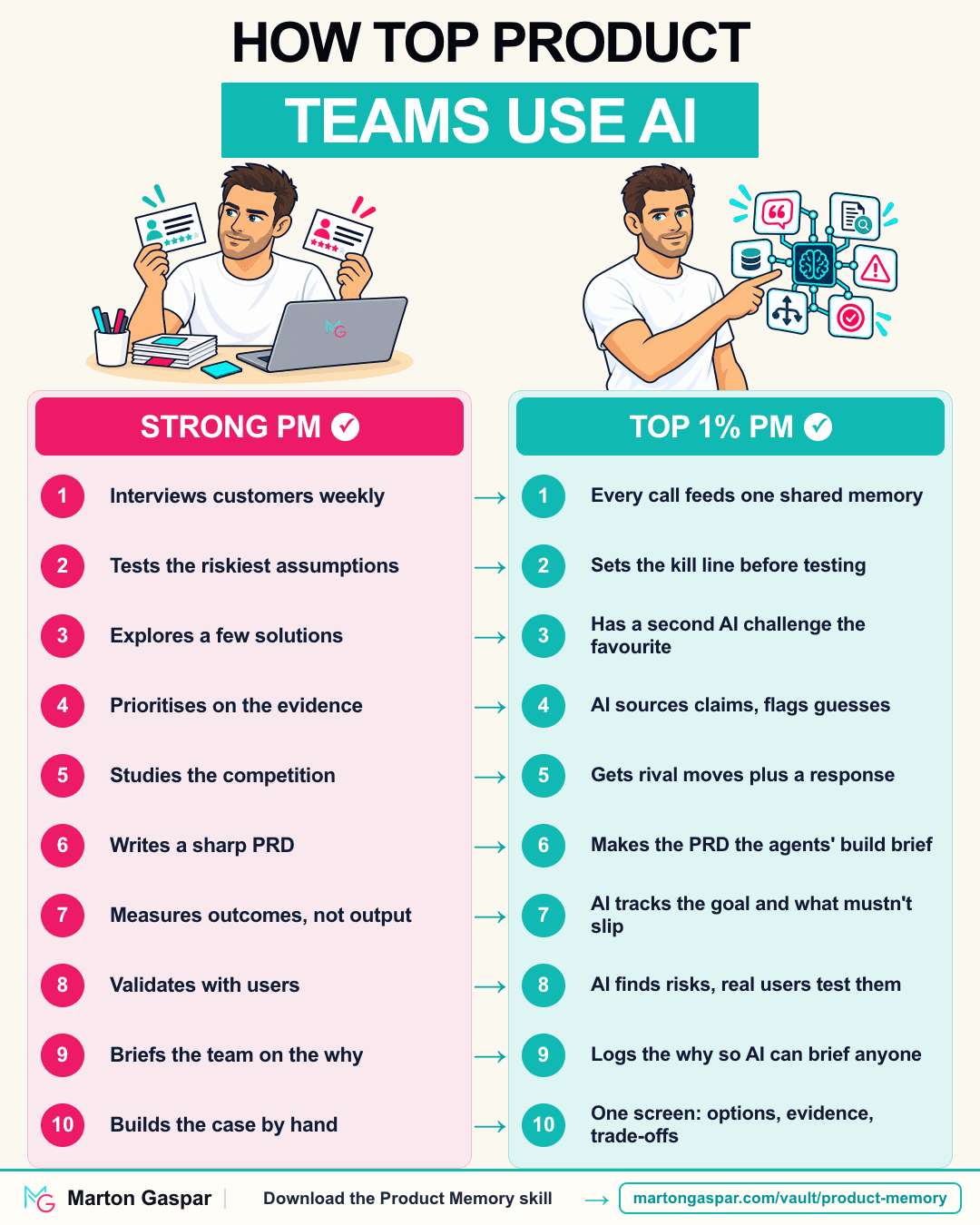
The best product teams changed how they decide.
Plenty of good teams run old systems on new engines. They bolt AI onto the same habits and get the same decisions, only faster. The top teams kept the habits and built a system underneath them.
Both ways of working are real product craft. Interviewing customers every week, testing the riskiest assumption, writing a clear PRD: strong product managers already run these habits, and none of them is wrong. What the top teams add is a layer that remembers, checks and pushes back. The decisions stay with the people.
Here are ten moves, each one pairing a strong PM habit with what the top team adds on top. Count how many you already run in a system, rather than in your head.
Customer interviews that feed one shared memory
A strong PM interviews customers weekly. The top team makes every call feed one shared memory.
First, the team maps the five bets behind the roadmap. After every call, AI tags each quote against them: it backs a bet, weakens a bet, or points to a new one. Over a few weeks the memory starts to show which bet is cracking.
Assumption tests with the kill line set first
A strong PM tests the riskiest assumptions. The top team writes the kill line before the test runs.
Before any test, they write two numbers: the one that kills the idea and the one that clears it. If both numbers would lead to the same plan, they skip the test, because it cannot change anything. A kill line only works before anyone sees the result. Set it afterwards and it bends to fit.
A second AI that challenges the favourite
A strong PM explores a few solutions. The top team has a second AI challenge the favourite.
The second AI gets the goal and the raw customer quotes, and never the team's preferred option. It ranks the options on its own. If it disagrees with the team, they write down why before going ahead. The reason is simple: an AI that knows the favourite tends to agree with it.
Priorities where every claim is sourced
A strong PM prioritises on the evidence. The top team has AI source every claim and flag the guesses.
Before a review, AI marks each claim in the doc as proof (with a link), a bet, or a guess. Guesses stay out of the decision. This matters most for the guesses that sound like facts, because those are the risky ones that slip through a normal review.
Competitor tracking that ends in a response
A strong PM studies the competition. The top team gets rival moves plus a response.
Each week, AI checks rivals' prices, changelogs and job ads. Each change is matched to one of the team's bets and given one reply: ignore, watch or act. What a rival removes hints at what they learned.
A PRD that doubles as the agents' build brief
A strong PM writes a clear PRD. The top team makes the PRD the agents' build brief.
The PRD is written for an agent to read. The agent plans the build and lists its assumptions. People fill gaps without saying so; agents list them. Once listed, each assumption becomes a bet the team can track and test, instead of something hidden in someone's head.
Outcome goals with a guard on what mustn't slip
A strong PM measures outcomes, not output. The top team has AI track the goal and the thing that mustn't slip.
They ask AI one question: "How could we hit this goal and make the product worse?" The answer names the metric they protect. AI then tracks that metric against where it started, so a slow slide has nowhere to hide while everyone watches the headline number.
User testing aimed at the risks AI finds
A strong PM validates with users. The top team has AI find the risks and real users test them.
AI checks the prototype against every past pushback in the memory and ranks the risks. Then real users try the top three alone while the team watches. The split is deliberate. AI can predict confusion. Only people show what they would actually do.
A decision log that lets AI brief anyone
A strong PM briefs the team on the why. The top team logs the why so AI can brief anyone.
Each decision gets four lines: the choice, what lost, why, and what would reopen it. When the losing idea comes back months later, AI checks whether the reopening condition has happened. If there is no new evidence, there is no new debate, and the team keeps moving.
The case for a decision, built on one screen
A strong PM builds the case by hand. The top team gets one screen with the options, the evidence and the trade-offs.
AI builds it from the memory: each option, the proof for and against, and the cost of being wrong. Each option ends with one line: "This wins only if ___ is true." Each blank becomes a new bet, and the next customer call tests it.
Build the memory first
Look at the ten moves together and one thing runs under all of them. Tagged quotes, kill lines, sourced claims, rival moves and decision logs all read from and write to the same shared memory. Without it, each move is a one-off trick someone has to remember to run. With it, each move feeds the next.
So the order matters. Build the memory first. The rest plugs in.
None of this hands the decision to a machine. The system keeps the record and checks the evidence, so the people can spend their judgement on the calls that need it. A PM's craft now sits in how the team decides, with AI as the system underneath. For the wider argument about redesigning the role itself, read "Rebuild the Product Manager Job, Don't Just Do It Faster".
Start by counting. How many of the ten are you already running in a system?