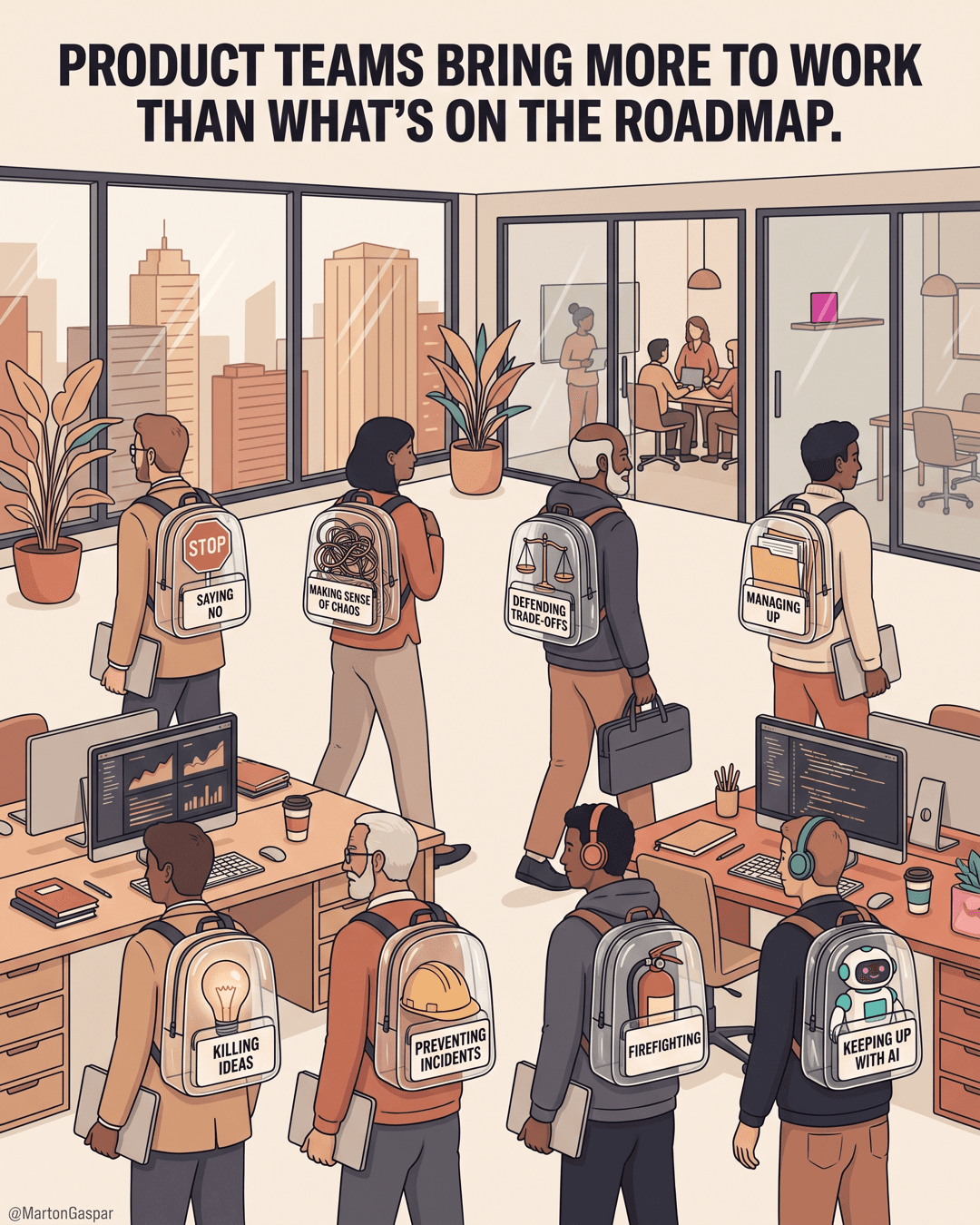
Product teams bring more to work than what you see. They carry work you may never see.
I have done this job, and coached the people who do it. The visible work was never the hard part.
Your roadmap shows what you shipped. It hides the work that keeps the product alive. Picture a product team walking into the office, each person with a clear backpack. Inside: a stop sign, a tangle of string, a set of scales, a stack of files, a light bulb, a hard hat, a fire extinguisher and a small robot. None of it is on the roadmap. All of it is the job.
Here is that work, and why it matters more now than ever.
Protecting the team's focus
Saying no. Say the no early, before it reaches the team. Every no you absorb is focus you buy them. A request turned down in a stakeholder conversation costs one conversation. The same request turned down after the team has started costs a sprint.
Making sense of chaos. Write the problem in one sentence before anyone opens a ticket. If it won't fit, the team isn't ready to build. That sentence is often the most valuable thing a product person writes all week, and nobody sees it.
Killing ideas. Kill the weak idea at the whiteboard. There it costs a conversation. Shipped wrong, it costs a quarter. Killing ideas feels negative, which is why it gets put off. Every idea that survives too long takes design time, engineering time and attention from the ideas that deserved them.
Keeping decisions in the open
Defending trade-offs. Name what every yes costs, out loud, before you commit. Unnamed trade-offs get made for you, usually by whoever shouts last or by the calendar.
Managing up. Brief your leader before they ask. Fewer surprises means fewer decisions pulled back up to them. Each surprise invites a leader to step in, and each step in takes a decision away from the team. A short note ahead of a review often does more for a team's autonomy than any argument about empowerment.
The work no metric captures
Preventing incidents. Report what you prevented, not just what you shipped. The disaster that never happened has no metric until you give it one. A count of risks caught before release, or a short note on what would have broken, turns invisible work into something a leader can see and value.
Firefighting. After each fire, find the upstream no you skipped, and make it next time. Fewer fires start there. Firefighting is visible and gets thanked. Preventing the next one is invisible, which is why it gets skipped.
Keeping up with AI. Stop collecting tools. Build one system that absorbs the next tool, so what you learn compounds instead of resetting.
AI can build your roadmap. It can't carry your backpack.
The best product work is the disaster that never happened. No one counts it, because no one saw it.
But that invisible work is the part getting more valuable, not less. As more of the visible work gets faster to produce, the calls behind it carry more of the weight: which no to say, which trade-off to accept, which idea to kill.
I run a product team of AI agents now. It ships my roadmap. The backpack is still all me: the no's, the trade-offs, the calls.
If saying no is the backpack you carry most, How Product Managers Say No at /vault/how-product-managers-say-no has 11 phrases that keep the conversation open. And if you want to see how far AI already sits in your own work, the two-minute scorecard is at martongaspar.com/scorecard.
Which of the eight is your team best at?