Your most expensive education is going to waste.
Every mistake already cost you something. Time. Confidence. Momentum. Opportunity. If you don't take the lesson, that cost buys you nothing.
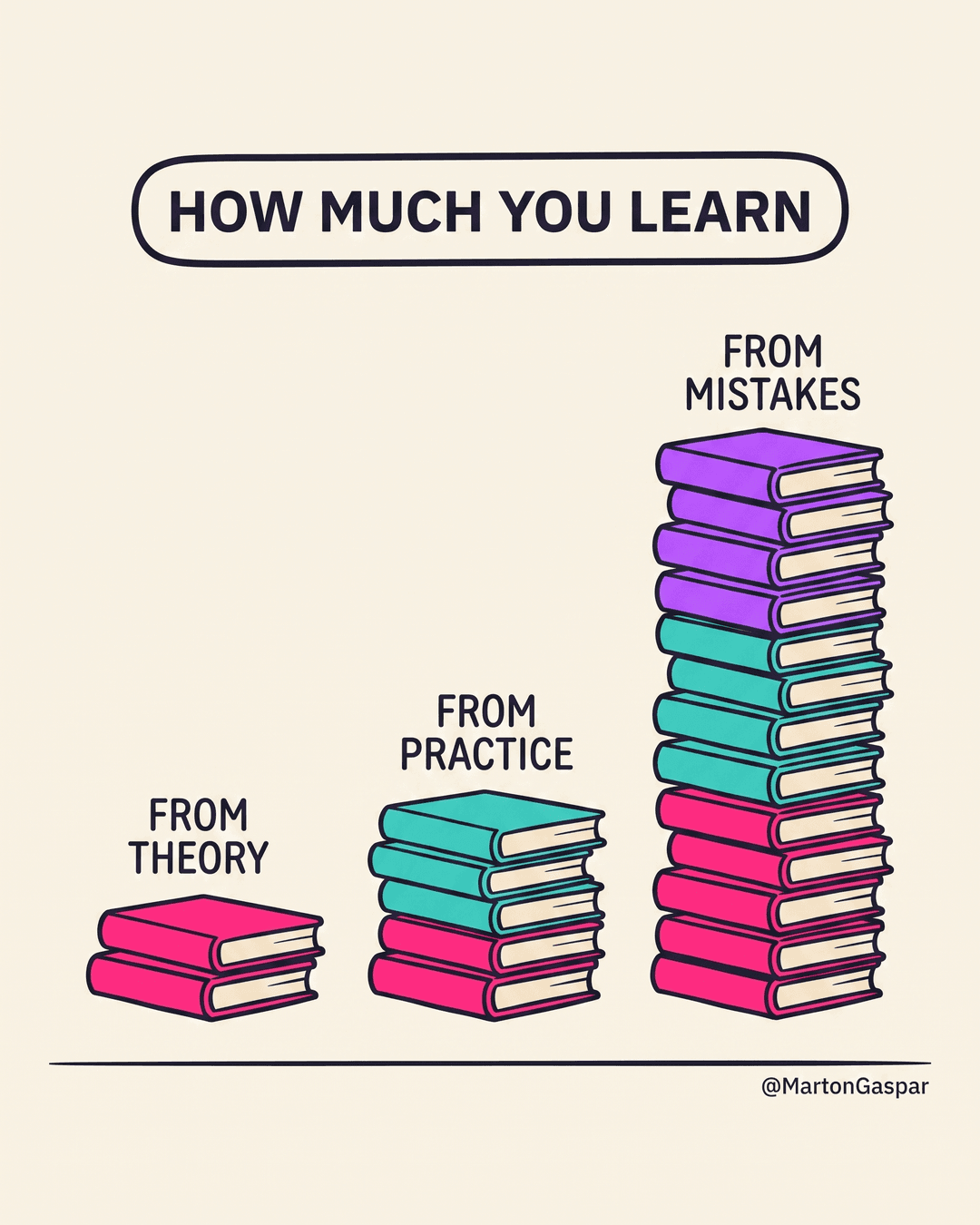
The picture makes the point with three stacks of books. How much you learn from theory: a thin pile. From practice: a bit more. From mistakes: the tallest stack by far. Theory tells you what should happen. Practice shows you what usually happens. A mistake shows you exactly where your own thinking broke, which is why that stack is the tallest.
The tuition has been paid either way. The question is whether you collect what you earned.
What usually happens to a mistake
Most professionals just bury the mistake and move on. The deadline you swore you'd hit. The feature nobody used. It gets a quick mention, maybe an awkward retro, and then everyone gets back to work.
Burying it feels like moving on. It isn't. The mistake comes with you, just without the lesson attached.
How shame takes over the next decision
What travels forward instead is the shame. And shame has a way of making the next decision for you:
You start playing it safe so it can't happen again.
You second-guess every decision after it.
You start to believe you're just not one of the good ones.
That's not learning from the mistake. That's letting it own you. Each of those moves feels like caution, but each one makes the next call worse, because it is driven by the old miss rather than the new evidence.
Treat the setback as data
The alternative is to treat the setback as data. Four questions do most of the work:
What did you assume that turned out wrong?
What signal did you ignore?
Who did you not talk to?
What would you do differently next time?
None of these ask who is to blame. They ask what the miss can teach. The first finds the belief that failed. The second finds the warning you had and didn't act on. The third finds the perspective missing from the room. The fourth turns the whole thing into a rule you can carry into the next decision.
Those answers are product judgement you can't buy. No course or book gives you the specific assumption that broke on your product, with your team, in your market. Only the mistake does.
Three things the fastest learners do differently
The people who learn fastest from setbacks do three things differently.
They treat every miss as reusable experience. A mistake is not a one-off event to get past. It is a lesson that applies again, the next time a similar call comes round.
They see a bad call as evidence, not a sentence. A wrong decision tells you something about the situation and the information you had. It is not a verdict on whether you belong.
They tell the truth about what happened, so they can move on. A clear account of what happened is what lets you put the mistake down. Burying it is what keeps you carrying it.
Collect what you already paid for
The tuition's already paid. Go collect what you earned.
Pick one mistake you have been carrying. Run the four questions on it. Write down the answer to the last one, and keep it where you make decisions.
What's the mistake that taught you the most?
Image credit: @ferraroroberto (Instagram).