You can't rip the humans out and keep the value. The value sits in their judgement.
There is a comedy sketch every product manager should watch. Greg ran billing. The company cut him to save money. Then the bot changed the code Greg had warned them never to touch. Customers got charged twice, and nobody left could fix it.
They saved Greg's salary. They lost the judgement they were actually paying for.
What the company was really paying for
On paper, Greg was a cost line. In practice, he was the person who knew which part of the billing system was fragile, which fixes were safe, and which changes would hurt customers. Knowledge like that often lives in one person's head. When they go, it goes with them.
That is the trap with cutting people to make room for AI. The tasks a person does are easy to list. The judgement behind those tasks is not, so it is easy to miss until something breaks.
AI multiplies what is already there
AI multiplies whatever is already there. Point it at Greg and you get a faster Greg. He spots billing problems sooner, and he knows which fixes are safe.
Point it at an empty seat and you get speed with nobody steering. The bot in the sketch was fast. It just had no one who knew where the danger was.
This is the case a product manager can take to leadership. Keep the people who know the system, and give them AI to go faster. The saving from cutting them is visible on day one. The cost can turn up later, in front of customers.
The catch: judgement only pays when people use it
There is a catch. Keeping the experts is not enough on its own.
When every AI output gets "looks good to me", the judgement is switched off. The expert is still on the payroll, but the review has become a habit rather than a check. You are paying for an expert and getting a rubber stamp.
Three checks for real judgement
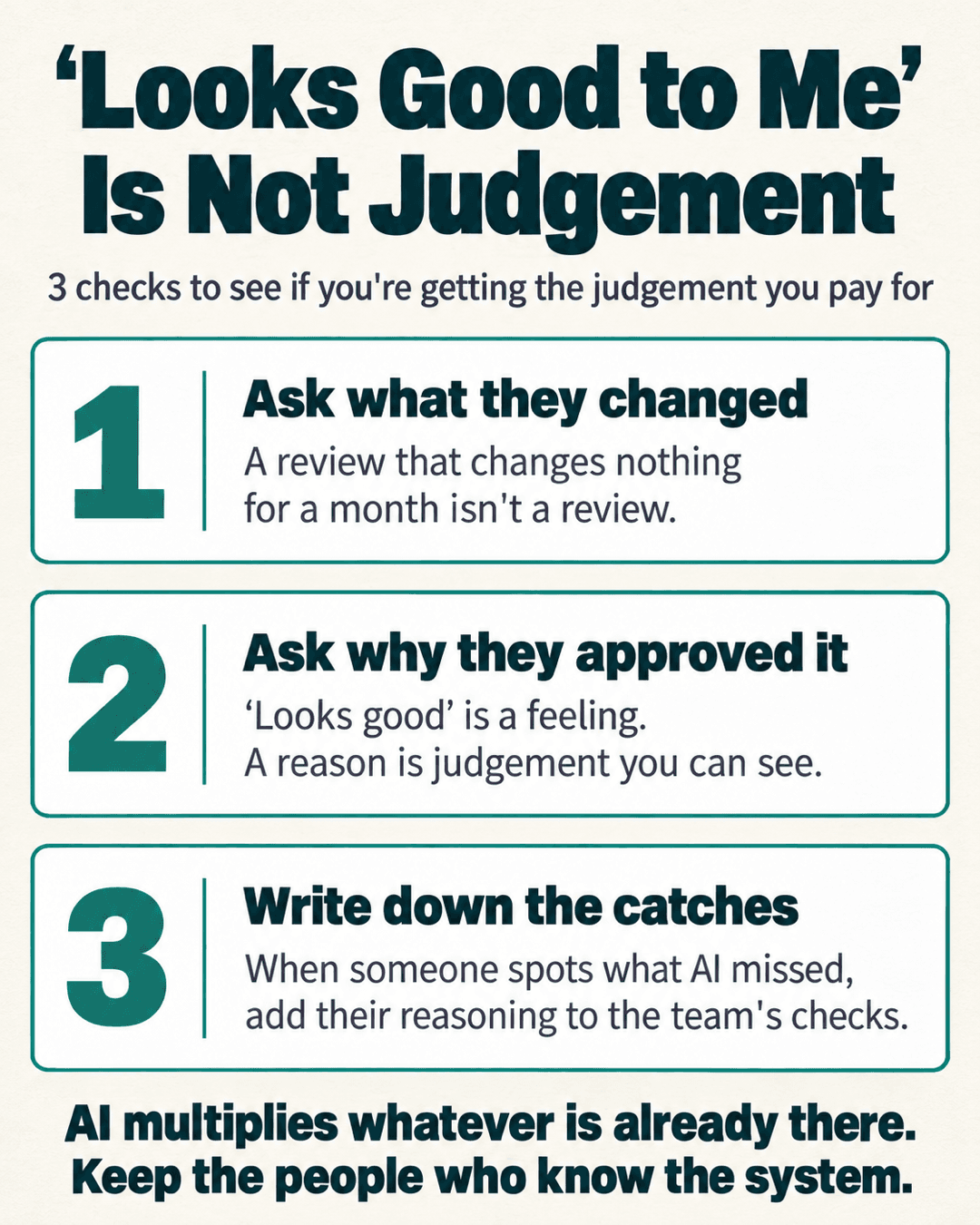
Here are three checks to see if you are getting the judgement you pay for.
1. Ask what they changed. A review that changes nothing for a month isn't a review. If nothing ever changes, it is worth asking how closely anyone is looking.
2. Ask why they approved it. "Looks good" is a feeling. A reason is judgement you can see. If the reviewer can say why the output is safe, the review happened.
3. Write down the catches. When someone spots what the AI missed, add their reasoning to the team's checks. Now the judgement grows every time it gets used, instead of living only in one person's head, the way Greg's did.
The third check is the one that changes the economics. Each written catch makes the next review easier. The team stops depending on a single expert remembering everything, without losing the expert.
A comment is not judgement
"Looks good to me" is a comment. It isn't judgement.
The question for any team using AI is not whether a human is in the loop. It is whether that human is still deciding anything. A name on the approval is easy to add to a process. A reason behind the approval is what tells you the judgement is still switched on. For a related list of the calls a product manager should keep rather than hand to AI, see /vault/outsourcing-judgment-to-ai.
If you want to see where you stand against other product managers, the scorecard at martongaspar.com/scorecard asks whether you are AI naive or AI native.