The PM who made Head of Product had one edge. Executives never had to think about them.
Most PMs I see earn confidence on effort alone. More updates, more meetings, more face time, more visibility. It works, right up until you leave the room. Then the confidence leaves with you.
That is not a talent problem. It is a method problem. Outcomes are the only real proof, and the roadmap is how you show the right work is in motion. Between now and those outcomes, what you are delivering is confidence. Confidence is not a mood you manage. It is an output you can build on purpose, and a system is what builds it. A system creates predictability, and predictability creates confidence. Effort resets every Monday. Confidence built on a system doesn't.
Here is that system, piece by piece.
Informed, aligned, confident: the three levels
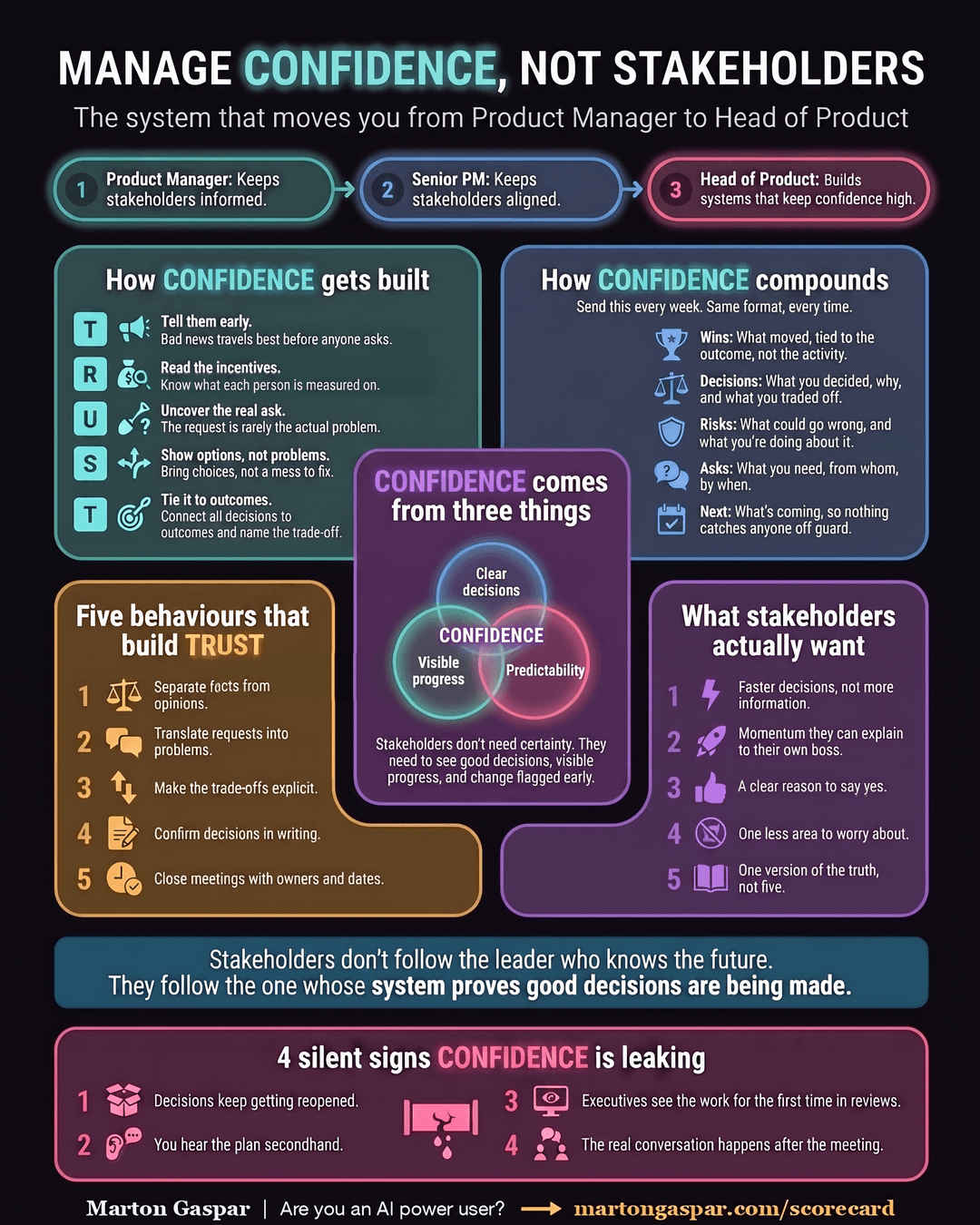
A product manager keeps stakeholders informed. A senior PM keeps stakeholders aligned. A Head of Product builds systems that keep confidence high.
The first two are about what you communicate. The third is about what holds when you are not in the room. That is the step up. It is not a bigger title. The room stops worrying when you leave it.
How confidence gets built: TRUST
Five moves, and they spell TRUST.
Tell them early. Bad news travels best before anyone asks. Raised early, it comes with time to act on it.
Read the incentives. Know what each person is measured on. A proposal lands differently when it speaks to the number someone is judged by.
Uncover the real ask. The request is rarely the actual problem. Find what sits underneath it before you start solving.
Show options, not problems. Bring choices, not a mess to fix. A stakeholder handed options can make a decision. One handed a problem has to do your job too.
Tie it to outcomes. Connect all decisions to outcomes and name the trade-off. Every call should point back to what it is meant to move, and say what it costs.
Confidence comes from three things
Clear decisions, visible progress and predictability. Where all three overlap, you get confidence.
Stakeholders don't need certainty. Nobody can give them that. They need to see good decisions, visible progress and change flagged early. Once they have that, they are with you, not checking on you.
How confidence compounds: the weekly update
Send this every week. Same format, every time.
Wins: what moved, tied to the outcome, not the activity.
Decisions: what you decided, why, and what you traded off.
Risks: what could go wrong, and what you are doing about it.
Asks: what you need, from whom, by when.
Next: what is coming, so nothing catches anyone off guard.
The format matters as much as the content. When it arrives the same way every week, people learn where to look and stop needing to ask. That is predictability, built one update at a time.
Five behaviours that build trust
Separate facts from opinions. Translate requests into problems. Make the trade-offs explicit. Confirm decisions in writing. Close meetings with owners and dates.
None of these is dramatic. Each one removes a small reason for someone to doubt the process, and together they make your decisions easy to follow and hard to reopen.
What stakeholders actually want
Faster decisions, not more information. Momentum they can explain to their own boss. A clear reason to say yes. One less area to worry about. One version of the truth, not five.
Read that list again and notice what is missing. Nobody is asking for more meetings or longer decks. They want something they can rely on and repeat upwards. Stakeholders don't follow the leader who knows the future. They follow the one whose system proves good decisions are being made.
Four silent signs confidence is leaking
Decisions keep getting reopened. You hear the plan secondhand. Executives see the work for the first time in reviews. The real conversation happens after the meeting.
Each one is a signal that the system has a gap, not a verdict on you. Hearing the plan secondhand and watching decisions get reopened are two I have coached PMs through. The fix is the same in both cases: go back to the system and find which part stopped running.
From effort to system
Every stakeholder wants certainty. Nobody can give them that. What you can give them is confidence that the right calls are being made. Once they have it, they are with you.
That is the shift from senior PM to Head of Product. The work does not get louder. It gets more predictable, and the confidence stops depending on you being in the room.
If you want the moves for getting people you don't manage to back a decision in the first place, Influence Without Authority (/vault/how-to-influence-without-authority) covers that side of the work.