At senior level, your boss stops grading your work.
They start grading your judgement.
Your work got you here. Then the feedback goes vague. "Be more strategic." "Show more ownership." Nobody tells you the rules changed. They just start expecting more.
As you go higher, you get fewer instructions and need more judgement. And your judgement has to be visible, or it doesn't count. A good call your boss never sees looks the same, from where they sit, as no call at all.
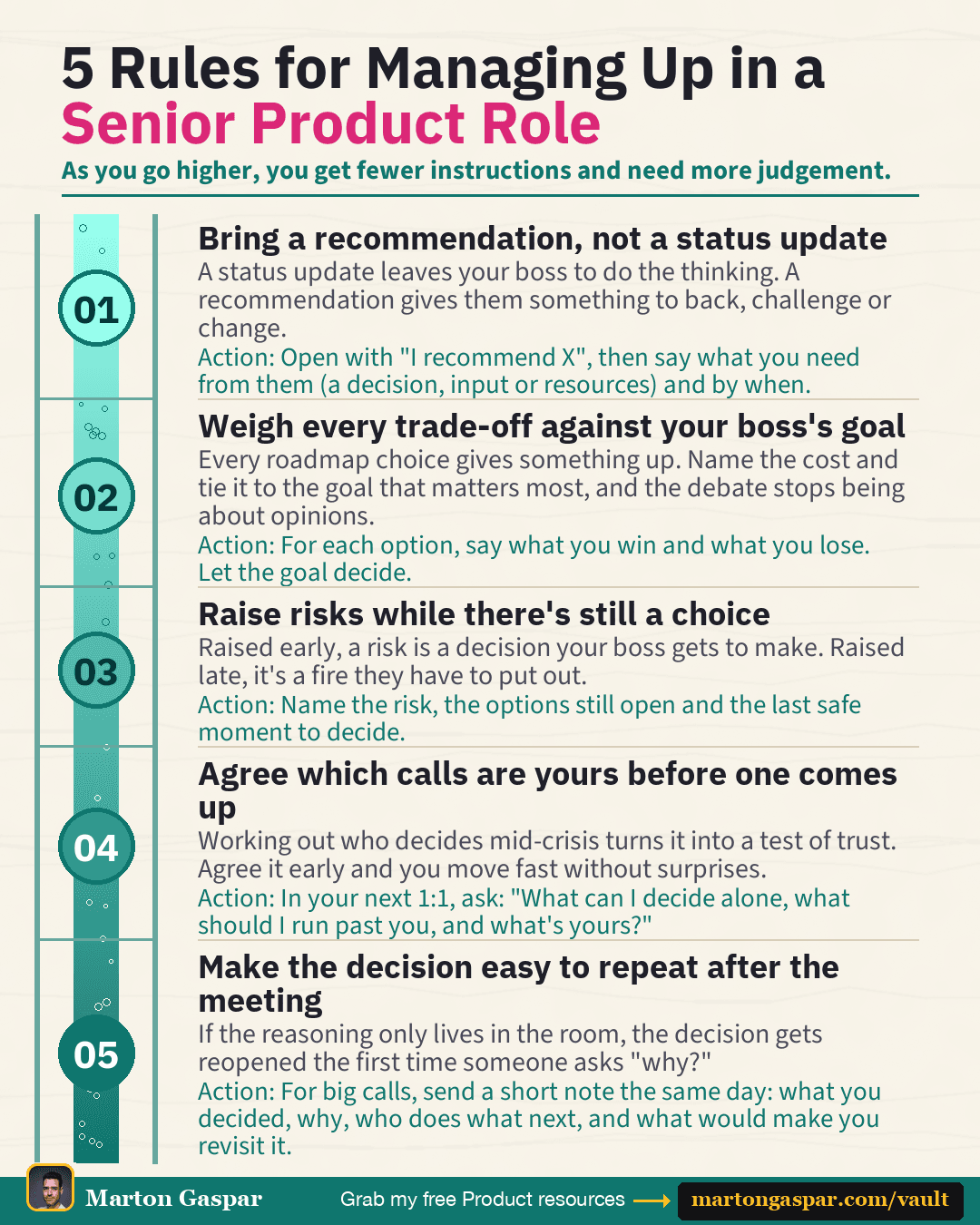
Here are five rules for managing up as a senior product manager. Each one answers the same question: did your boss see your judgement, or just the answer?
Rule 1: Turn updates into recommendations
A status update leaves your boss to do the thinking. A recommendation gives them something to back, challenge or change.
Write the answer before the meeting:
"I recommend X because Y. I need Z from you by [date]."
Z might be a decision, some input or resources. Name which one, and when you need it.
If you can't finish that sentence, the item isn't ready for a decision. That is useful to know before the meeting, not halfway through it.
A recommendation also shows your boss how you think. They can see what you weighed, what you chose and what you need from them. That is the judgement they are trying to grade, put where they can see it.
Rule 2: Make the trade-off explicit
Every roadmap choice gives something up. Name the cost and tie it to the goal that matters most, and the debate stops being about opinions.
Start by asking your boss: "When these goals conflict, which one wins?" You need that answer before the conflict happens, not during it.
Then frame every option the same way: "This protects X, but costs us Y."
Senior judgement is deciding which cost is worth paying. When you lay out the cost of each option against the goal your boss already chose, you show that you weighed it, rather than asking them to weigh it for you.
Rule 3: Turn risk into choice
Never raise a risk on its own.
Raised early, a risk is a decision your boss gets to make. Raised late, it's a fire they have to put out.
So bring three things with every risk: the options still open, what each one costs, and the last safe decision date.
After that date, you're reporting a problem rather than managing a risk. The same information, raised a week earlier, makes you look like someone who sees around corners.
Rule 4: Agree decision rights by type
Don't ask "Can I decide this?" every time.
Ask once, for a whole type of decision: "For decisions like this, should I decide, tell you afterwards or bring it to you first?"
Working out who decides in the middle of a crisis turns it into a test of trust. Most autonomy is lost mid-crisis because nobody agreed this upfront. Agree it early and you move fast without surprises.
A good time to ask is your next 1:1, when nothing is on fire. Go through the decisions that come up most often and sort each type into one of the three.
Rule 5: Stop decisions being reopened
If the reasoning only lives in the room, the decision gets reopened the first time someone asks "why?"
Send a four-line note within 24 hours:
What we decided. Why. Who owns the next step. "We'll revisit this if..."
The note takes ten minutes. The reopened debate takes a week.
The last line matters most. Naming the condition that would reopen the decision tells everyone it was made on purpose, with its limits known. Anyone who wants to reopen it has to show that the condition has been met.
The same habit is one of the moves in /vault/how-to-influence-without-authority, because a written decision is what holds alignment together after the meeting.
Autonomy is earned upfront
Read the five rules together and they all move the work earlier. The recommendation is written before the meeting. The trade-off is agreed before the conflict. The risk is raised before the deadline. Decision rights are settled before the crisis. The reasons are written down before anyone forgets them.
Senior PMs earn autonomy by doing the judgement work upfront.
Fewer surprises for your boss means more calls left to you. And when the feedback says "be more strategic", these five rules are a concrete answer to what that means.
For the wider picture of what moves a product career forward, see /vault/how-to-get-promoted-in-product.
Which rule would change the most in your next 1:1?