Most product leaders are excellent at one thing. That strength is exactly what holds them back.
Most leaders can't see their own style either. Their teams can, clearly.
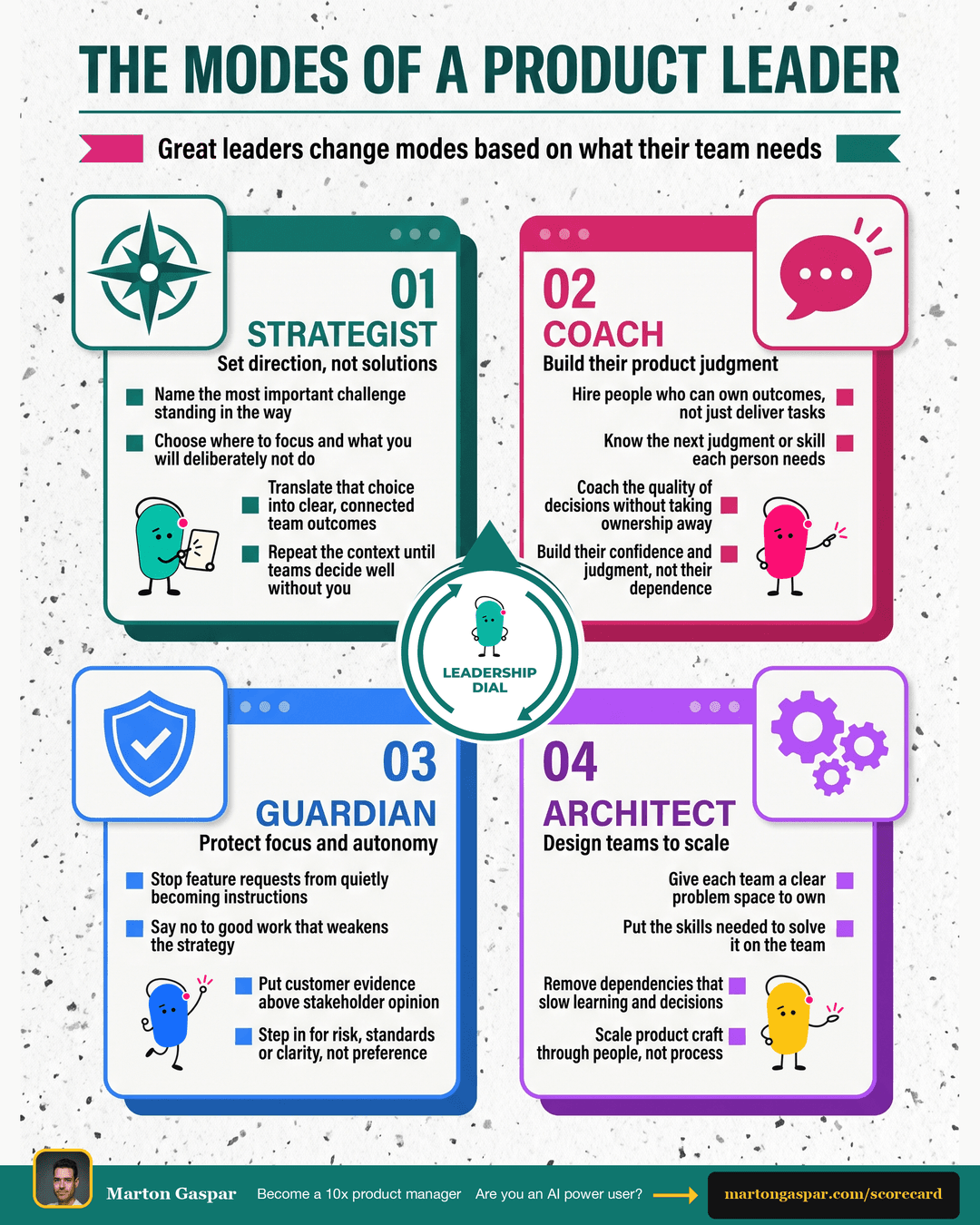
That one thing a leader is excellent at is a mode. The problem is never which mode it is. It's having only one. Great leaders change modes based on what their team needs, and the team's needs change from one meeting to the next.
The prize moved
For ten years, output was the prize. The leader who shipped, won.
Tim Cook is a good example of a leader who knew his style. When Steve Jobs died, Cook didn't try to become him. No grand reveals, no pretending to be the genius. He knew what he was: an operator, a steady hand. In my view, that was what Apple needed for the next decade, and it is why he won.
Then the job changed. AI made output cheap, and anyone can ship now. So the prize moved, from how much can we build to what is worth building. A different prize calls for a different leader.
Here is the tell that your style has gone stale. Your team is busier than ever, and the business has barely moved. Plenty of shipping, nothing that changes the numbers. Your team feels that before you do. You can't see it, because you are the one still doing it.
Below are four modes, what each one looks like, when to use it, and the sign that you have stayed in it too long.
Strategist: set the direction
The Strategist sets direction, not solutions.
Start by naming the one challenge in the way, so the team stops guessing what matters most. Then say what you are not doing this quarter, and mean it. A direction that excludes nothing gives nobody a reason to choose.
Next, turn that choice into outcomes people can act on by Monday. A strategy that can't be translated into team outcomes stays a slide. Finally, repeat the context until the team makes the call without you. The test of this mode is how many good decisions get made while you're not in the room.
Use it when the team is busy but pulling in different directions, or when a new quarter starts and nobody can say what the one thing is.
It breaks when the signs turn red and you keep selling the direction. Watch for bad news that always arrives with an excuse. The question to ask yourself: will this matter, or does it just sound good?
Coach: build their judgement
The Coach builds the team's product judgement instead of supplying it.
It starts with hiring people who own outcomes, not people who clear tickets. Then know the next call each person is not ready for yet, or the next skill they need, so you can grow them towards it on purpose.
In the moment, ask what they would do, then wait ten seconds longer than feels comfortable. Coach the quality of the decision without taking ownership away. The aim is to build their confidence and their judgement, not their habit of asking you.
Use it when the same questions keep arriving at your desk, or when someone is close to being ready for a bigger call.
It breaks when the team needs an answer and you keep coaching. Watch for every decision still needing your approval. The question: am I growing the team, or avoiding the decision?
Guardian: protect the focus
The Guardian protects the team's focus and autonomy.
Catch the request that arrives dressed as a decision, before a feature request turns into an instruction nobody agreed to. Turn down strong work that pulls the strategy in two. Good work in the wrong direction still costs you the quarter.
Before anything touches the roadmap, ask which customer problem it solves, and put customer evidence above stakeholder opinion. And step in for risk, standards or clarity, never for taste. A leader who overrules on preference teaches the team to wait for preference.
Use it when priorities start multiplying, or when senior requests begin to skip the process the team relies on.
Architect: design for scale
The Architect designs teams to scale, and decides what is worth building at all.
Give every team a problem to own, not a backlog to clear. Put the skills needed to solve it inside the team, so they don't depend on borrowing people. Cut the dependency that makes them wait to learn or to decide.
When something stops working, redraw who owns what instead of adding another process. Scale product craft through people, not through more process.
Use it when teams are waiting on each other, when the same handoff keeps breaking, or when the market shifts and the old playbook fails.
It breaks when the direction is clear and you keep redesigning. Watch for a plan that changes every week. The question: what used to be true, but isn't any more?
The mode many leaders get stuck in: the Executor
There is a fifth default, and it is the one the last decade rewarded. The Executor ships the plan, fast and reliably.
It works when the goal is clear and the job is to deliver. It breaks when the goal has moved on and you keep driving the plan. Watch for activity going up while results don't. The question: is this worth doing, or just easy to do?
Being the best Executor in the building used to be enough. Reliable, visible, easy to measure. It is not what the next decade rewards. The four modes above are where the work moved to.
Knowing which mode the room needs
Anyone can learn all four modes. The harder skill is knowing which one the room is asking for before you open your mouth.
A team stuck between two good options needs the Strategist. A person who keeps escalating calls they could make needs the Coach. A roadmap filling up with urgent asks needs the Guardian. Teams blocked on each other need the Architect. Reading the situation comes first. The mode follows.
Sometimes the right mode is the one that feels like doing nothing. I once coached a leader into a much bigger role. Every instinct, his and the room's, said move, decide, fix something in week one. I told him to do the opposite. Sit. Listen. Ask curious questions until you understand the real problem.
Choosing to sit while everyone wanted action was the biggest decision he made. It felt like failing in public. He did it anyway. Two weeks in, he was pulled into rooms two and three levels above him. Not because he moved fast, but because he asked the questions that got to the real problem. A year in, he had doubled the ambitious goal he set, and leadership tripled his remit.
My own default is to reach for the Coach, or to sell the vision. The Architect is the one I am still working at.
What one mode costs you
Stay in one mode long enough and the team stops bringing you the work that needs the other three.
They won't say that's what is happening. They call it not wanting to bother you. A leader who always strategises stops hearing about the person who is struggling. A leader who always coaches stops hearing about the scope creeping in. The work that needs the missing modes doesn't disappear. It just stops reaching you.
One question before any big call
Before any big call, ask one thing: what does the business actually need from me now?
The mode you default to is a habit. The one you choose before you speak is the skill. Start by naming your strongest mode right now. Then pick the one you use least, and look for one moment this week where the room is asking for it.
If you want the same idea from the individual PM side, /vault/pm-archetypes covers four default modes for product managers. For the small habits that stop a team waiting on its leader, see /vault/traits-of-great-product-leaders.