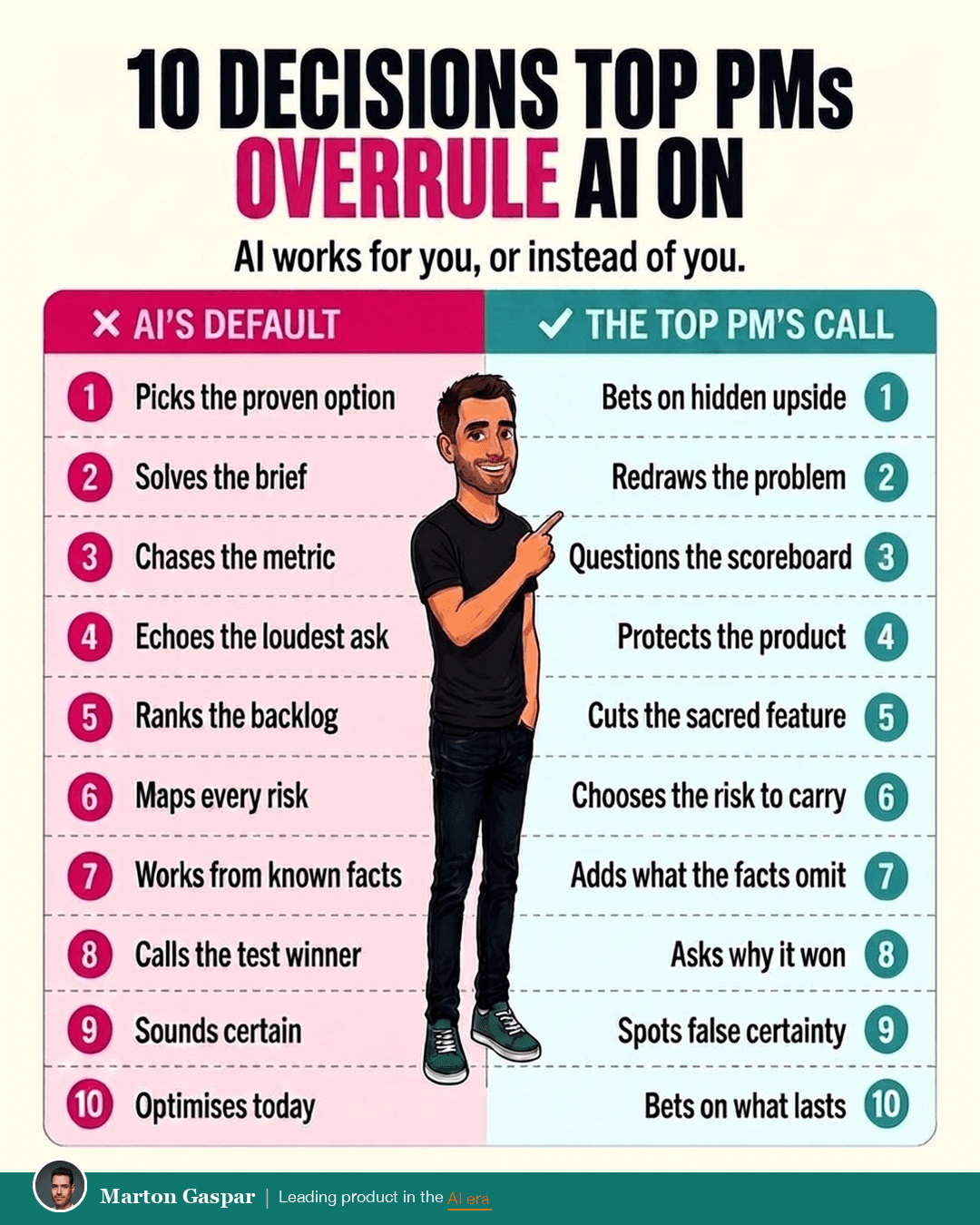
AI will never get you fired. Outsourcing your judgement to it will.
The product managers AI replaces aren't the slow ones. They're the ones who stopped deciding.
AI has a default answer for almost every product call. It picks the proven option, solves the brief it was handed, chases the metric and echoes the loudest request. Each default is reasonable on its own. That is the trouble. A reasonable default that nobody overrules becomes your decision without you ever making it.
Below are the 10 calls where AI's default and a strong product manager's call part ways, and where to overrule the default before its answer becomes yours. AI works for you, or instead of you. The difference is which of these calls you keep.
Before you build: redraw the problem
Call 1: Put a bolder bet beside every safe recommendation. AI picks the proven option. Add a second option next to it: small downside, big upside. Then pick the one you'd actually take. Sometimes that is still the safe one. The point is that you chose it.
Call 2: Rewrite the brief in one sentence before AI solves it. AI solves the brief it is given, weak or not. Write the problem, the outcome and the real constraint in a single sentence. If the sentence comes out weak, you're not ready to build, and faster output won't fix that.
Call 3: Turn every metric into the customer behaviour it stands for. AI chases whatever number you point it at. Name the behaviour behind the number. Then name how the number could climb while the product gets worse. That second question is how you question the scoreboard instead of serving it.
Deciding what gets built
Call 4: Trace the loudest request back to the real need. AI echoes the loudest ask, because loud asks fill the input. Find the need underneath it, and weigh how often it truly comes up before urgency or seniority sets the roadmap. This is the call that protects the product.
Call 5: Let AI rank the backlog, then go after what's protected. Ranking is a fine job to hand over. What a ranking won't do is question the features everyone treats as untouchable. Make every "sacred" feature earn its place again. Or cut it.
Call 6: Turn the risk list into a decision. AI can map every risk. A list of risks is not a decision. Name the one you'll accept and who owns it, then what would make you change course. Choosing the risk to carry is the part that stays with you.
Reading the evidence
Call 7: Add the context no document holds. AI works from known facts. Your product sits inside history, politics and constraints nobody wrote down. Add them. Then mark what is fact, what is a guess, and what is really just politics.
Call 8: Before you scale a winning test, explain why it won. AI will happily call the winner. Ask why it won. Check that the lift wasn't just novelty, or one odd segment hiding a trade-off. A result you can't explain is a result you can't repeat.
Call 9: Treat confident output as a claim, not a conclusion. AI sounds certain whether it is right or wrong. Ask what would disprove it, and what missing fact would flip the answer. Spotting false certainty matters more as the output gets more fluent.
Judging past this quarter
Call 10: Judge the call past this quarter. AI optimises for today. Ask what wins now, what compounds in a year, and what today's win costs you later. Betting on what lasts is the call that shapes a product over years rather than sprints.
The version of you that keeps deciding
AI won't replace you. The version of you that stopped deciding will.
Same AI, two product managers. One keeps the call and gets better at it every time. One hands it over and gets replaced.
None of these ten calls means refusing the work AI does well. Let it draft, rank, map and summarise. Keep the moment where its default turns into your decision. For more on where that line sits, /vault/hand-over-the-task-not-the-call covers the difference between handing over a task and handing over a call, and /vault/product-manager-judgement-ai has five questions to check your work before it reaches the team.
Pick the one call from this list you guard hardest, and the one you've let slip. If you want to see how AI-native your own way of working is, the free scorecard at martongaspar.com/scorecard shows where you stand.