Your instincts got you promoted. Now they're getting in your way.
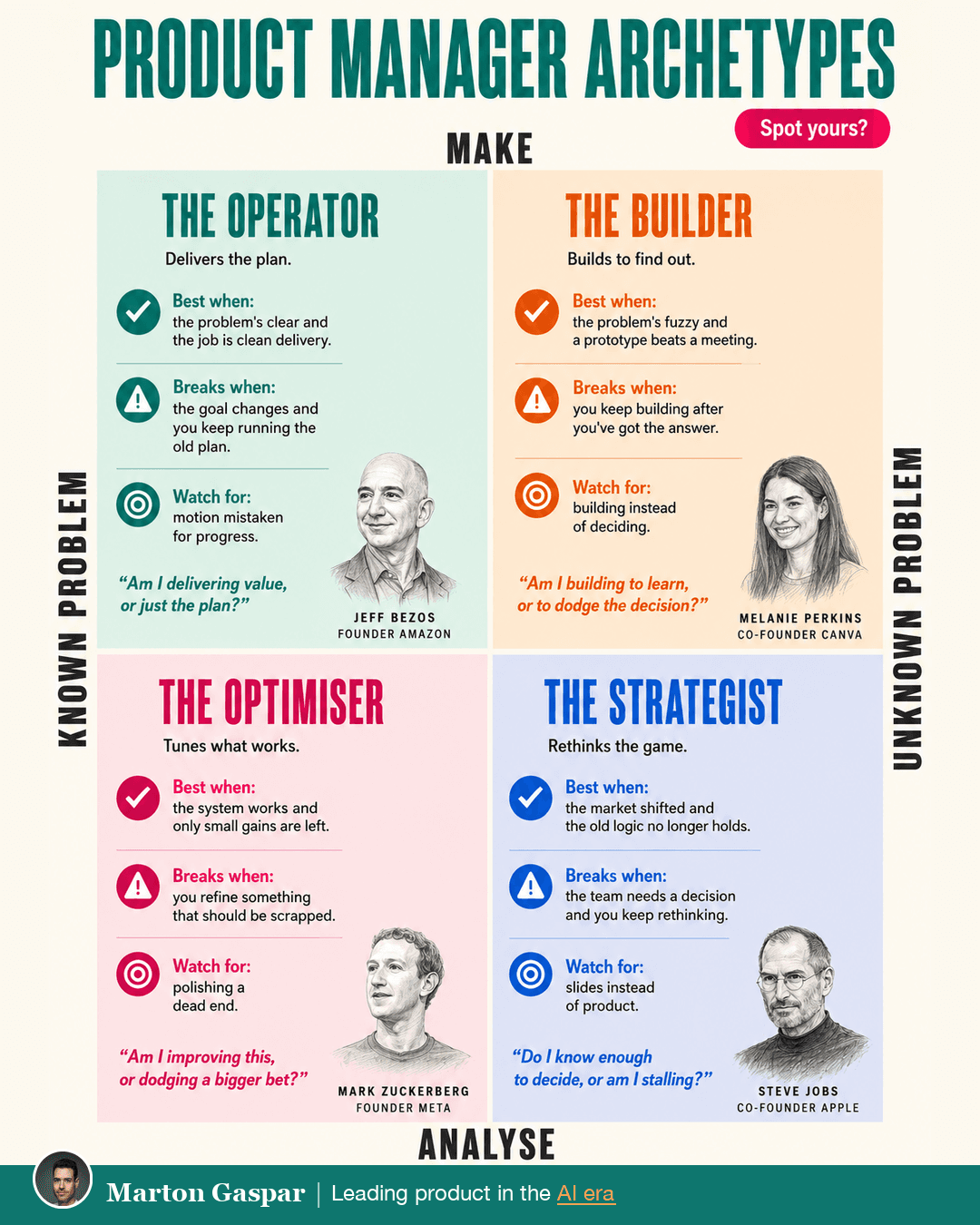
Every product manager has one default mode they run without thinking. Deliver the plan. Tune what works. Build to find out. Rethink the game. Yours is the one that made you good, and it made you good because it fit the problems you used to get.
Then AI made building cheap, and the problems changed. The job is less about saving build time and more about learning and deciding faster. There are fewer problems with a known answer and more with no answer yet. You reach for the same mode, the problem has moved, and the mode that used to win now backfires. This page maps the four archetypes, when each one is right, when it breaks, and how to catch yourself using the wrong one.
The map: known or unknown, make or analyse
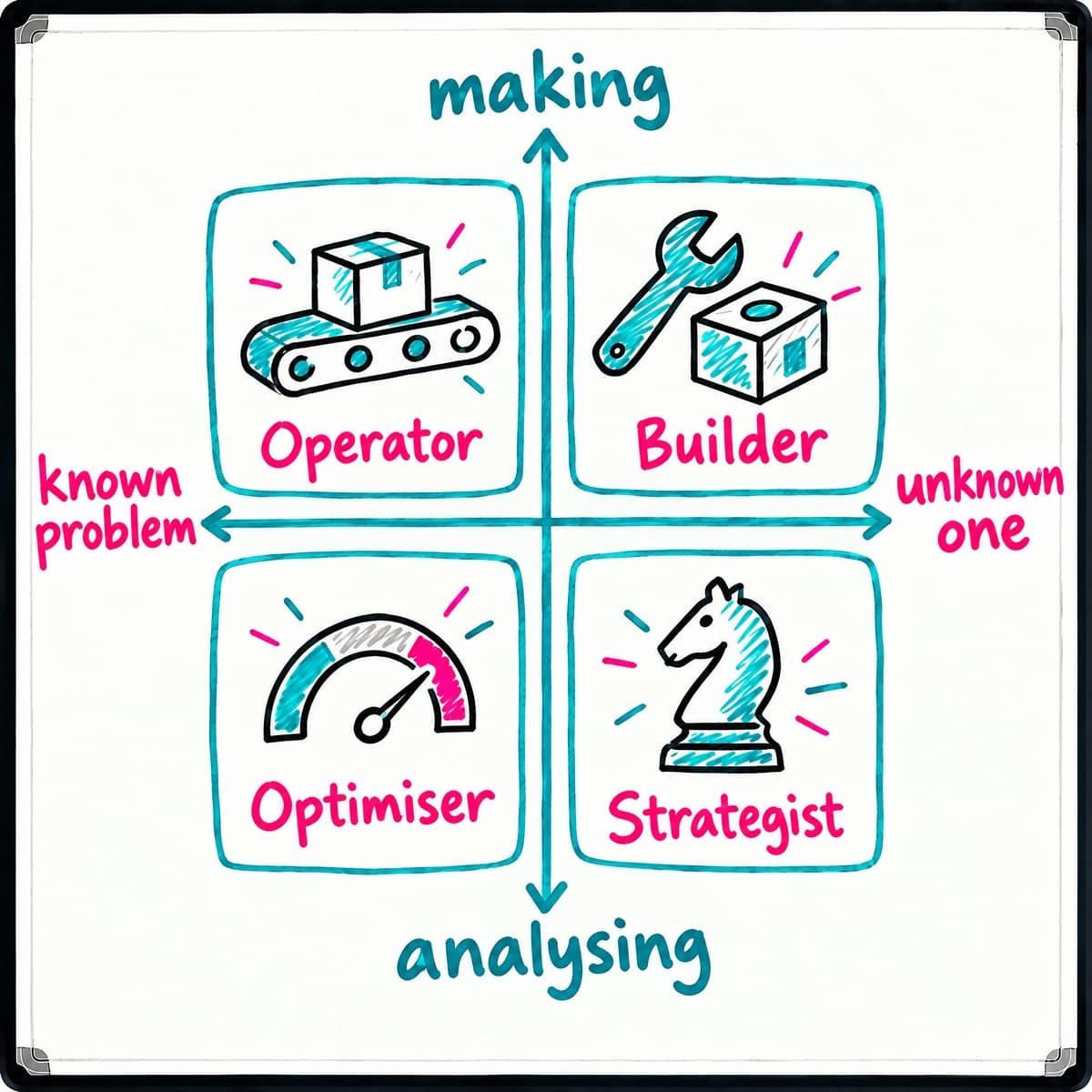
The four archetypes sit on two lines. The first runs from a known problem to an unknown one. A known problem has a clear goal and a clear route; the work is execution. An unknown problem has no agreed answer yet; the work is finding one. The second line runs from making to analysing: do you move forward by producing something, or by thinking it through?
Put those together and you get four modes. The Operator makes, on known problems. The Builder makes, on unknown ones. The Optimiser analyses known problems. The Strategist analyses unknown ones. None of them is the best. Each is the best fit for one kind of problem and a poor fit for the other three.
The Operator delivers the plan
The Operator is at their best when the problem is clear and the job is clean delivery. The goal is agreed, the scope is set, and what the team needs is someone who gets it over the line without drama.
It breaks when the goal changes and the Operator keeps running the old plan. The roadmap made sense in January. By April the market has moved, and the team is still hitting every milestone on a plan that no longer matters.
Watch for motion mistaken for progress. The question to ask yourself: am I delivering value, or just the plan?
The Builder builds to find out
The Builder is at their best when the problem is fuzzy and a prototype beats a meeting. Instead of debating what users want, they put something in front of them by Friday and learn from what happens. With AI, this mode got far cheaper, which is exactly why it's tempting to overuse.
It breaks when you keep building after you've got the answer. The prototype told you what you needed on day three, and you're still iterating on day thirty because building feels like progress and deciding feels like risk.
Watch for building instead of deciding. The question: am I building to learn, or to dodge the decision?
The Optimiser tunes what works
The Optimiser is at their best when the system works and only small gains are left. Conversion, retention, onboarding, pricing pages: a known product with a clear metric, where careful iteration compounds.
It breaks when you refine something that should be scrapped. The funnel is a little better every month, and the product it feeds is heading for a wall. Optimisation is a great way to avoid the bigger question, because it always produces a number that went up.
Watch for polishing a dead end. The question: am I improving this, or dodging a bigger bet?
The Strategist rethinks the game
The Strategist is at their best when the market has shifted and the old logic no longer holds. A new competitor, a new technology, a new buyer: someone has to step back and ask what game you're now in.
It breaks when the team needs a decision and the Strategist keeps rethinking. Every week brings a new framing, a new deck, a new angle, and the team waits for a direction that never quite arrives.
Watch for slides instead of product. The question: do I know enough to decide, or am I stalling?
Flip the order: problem first, then mode
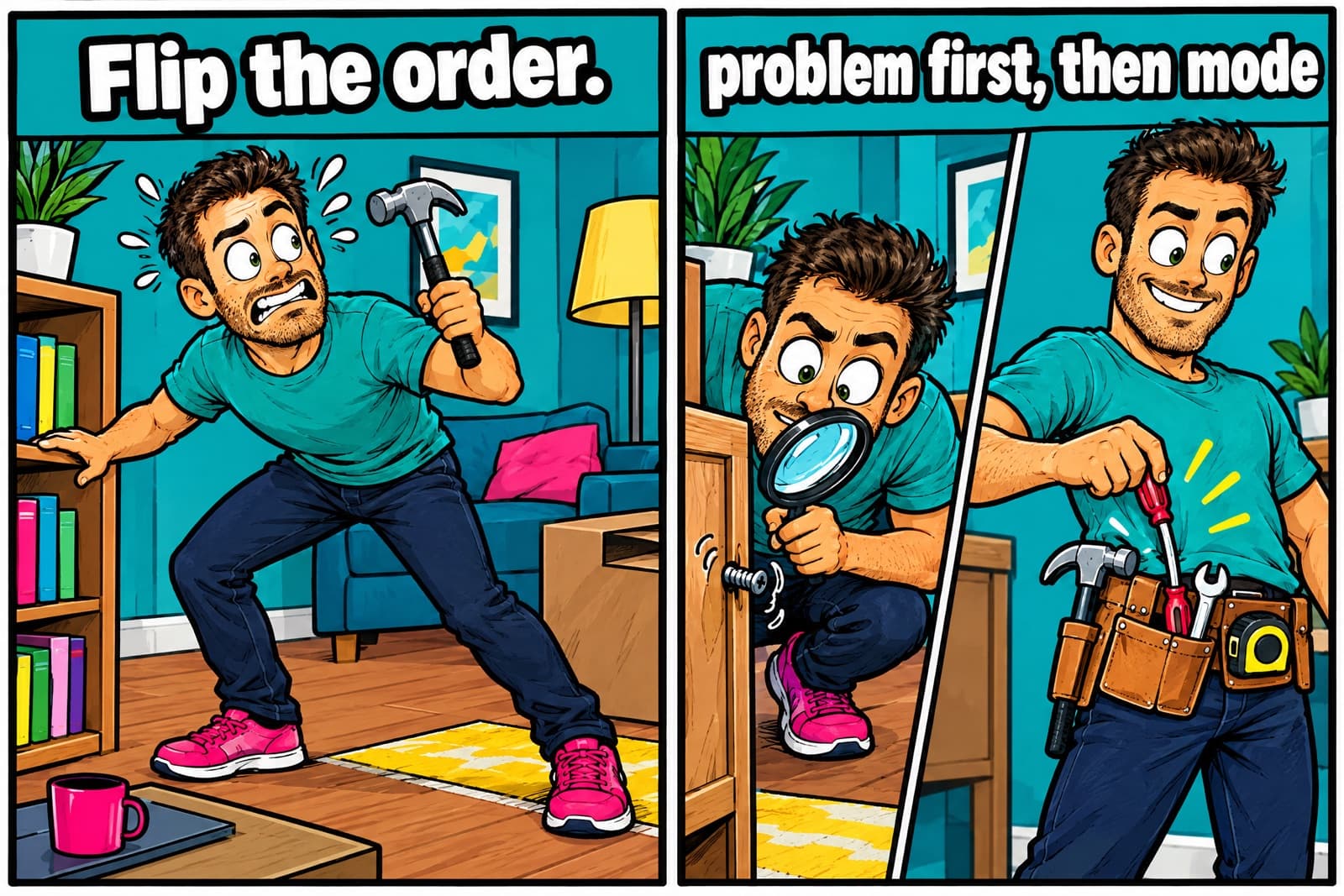
It's easy to do this backwards: start with your default mode and apply it to whatever problem turns up. The Operator writes a plan for a problem nobody understands yet. The Strategist runs a strategy offsite for a problem that needs shipping. The Builder prototypes a question that needs a decision.
Flip the order. Look at the problem first. Is the answer known or unknown? Does progress come from making something or from thinking it through? Then pick the mode the problem needs, not the one you'd reach for out of habit.
This matters more now than it did five years ago. When building was expensive, a mismatch cost you a slow quarter. Now that AI makes building cheap, more of your problems sit on the unknown side of the map, and the cost of the wrong mode is learning slowly while competitors learn fast.
The skill that matters now
I've stopped rating a product manager by how good their best mode is. What matters now is how fast they catch themselves using the wrong one.
That's a learnable skill. Name your default mode. Write down the question from its quadrant and keep it where you plan. When a piece of work feels stuck, check whether the problem moved and your mode didn't. The PDF puts all four archetypes on one grid, with the best-when, breaks-when and watch-for for each, so you can spot yours on the next hard problem.