Ideas don't die in the decision room. They arrive there already dead.
Approve the wrong idea and your team loses a quarter. Do it twice and your judgement is in question. So the feedback you gather before the pitch matters as much as the pitch itself.
I often see teams default to the same feedback prompt: "Any thoughts?" Everyone leans into their usual angle. The engineer looks at the build, the analyst looks at the numbers, and whoever is most sceptical looks for holes. You get overlap, not coverage. Some angles get covered three times and some don't get covered at all.
Where the five roles come from
I found a better way to run pre-pitch feedback. I learnt it doing discovery in a 36,000-person organisation.
The facilitator gave each of us one lens. When we compared notes, the variety was striking. Five angles, and far more than any of us would have found alone.
I've used it ever since. The trick is simple: instead of asking everyone for their thoughts, give each reviewer one role and one question. Here's how you can use it before the room.
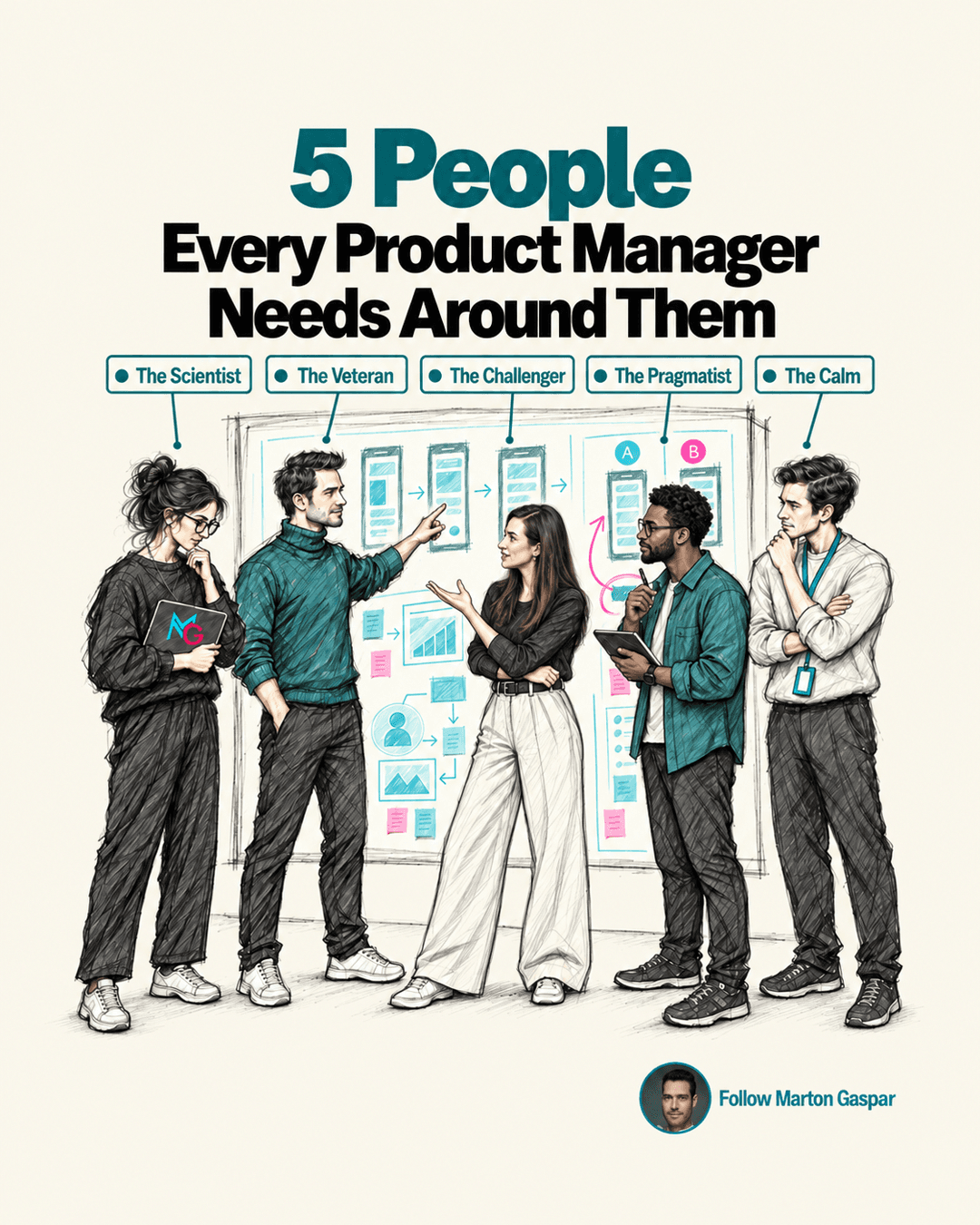
The Scientist: knows the data
The Scientist's question: "What proof do we have, and what are we guessing?"
This role separates evidence from assumption. A pitch can sound well supported when half of it rests on guesses nobody has labelled. The Scientist makes you mark which is which before someone in the room does it for you.
The Veteran: has seen it before
The Veteran's question: "Where have we seen this, and what's different now?"
This role brings history. Most ideas have a cousin that was tried before, inside the company or outside it. The Veteran asks what happened then, and what has changed since that makes it worth trying again.
The Challenger: argues against it
The Challenger's question: "What would kill this in six months?"
This role argues against the idea on purpose. Because it is an assigned role, the objection carries no personal cost, and the reviewer can push harder than they would as themselves. You hear the strongest case against the idea while there is still time to answer it.
The Pragmatist: knows the build
The Pragmatist's question: "What's the smallest version we can test?"
This role shrinks the idea to something you can learn from quickly. A big pitch asks the room for a big commitment. A small test asks for much less, and gives you evidence for the next conversation.
The Calm: no skin in the game
The Calm's question: "What happens if we do nothing?"
This role sees it objectively, without skin in the game. Everyone else is reacting to the idea. The Calm asks about the baseline. If doing nothing is fine, the idea needs a stronger reason to exist. If doing nothing is costly, that cost belongs in the pitch.
The five roles on a real request
Try it the next time sales says: "We need this to close the deal."
Scientist: how many other customers have asked for it?
Veteran: what happened last time we built for one deal?
Challenger: what gets pushed off the roadmap, and who feels it?
Pragmatist: could a workaround close the deal instead?
Calm: what happens if we say no?
Five questions, and the request looks very different from the version that arrived in your inbox. You know whether it is one customer or many, what the trade-off costs, and whether there is a cheaper way to the same result.
How to run it before the room
The method needs no special meeting. It fits into the week before a pitch:
Pick five reviewers and give each one a role and its question. One role per person keeps the angles separate.
Ask each reviewer to answer only their own question. The constraint is what turns overlap into coverage.
Compare the notes side by side. The value is in the variety, so look for the answers that surprise you.
Change the pitch. Add the proof the Scientist asked for, answer the Veteran's history, address the Challenger's six-month risk, offer the Pragmatist's smaller test, and state the cost of doing nothing.
You can also run all five lenses yourself if there's no time to gather reviewers. It won't match five real people, but it is still better than one angle repeated.
Walk in with the questions already answered
Take the five answers and fix your pitch. Walk in with the questions already answered.
The room isn't there to approve it. It's there to make the decision better. A pitch that has already been through all five lenses gives the room something better to do than find the obvious holes.
Which of the five is your next pitch missing?