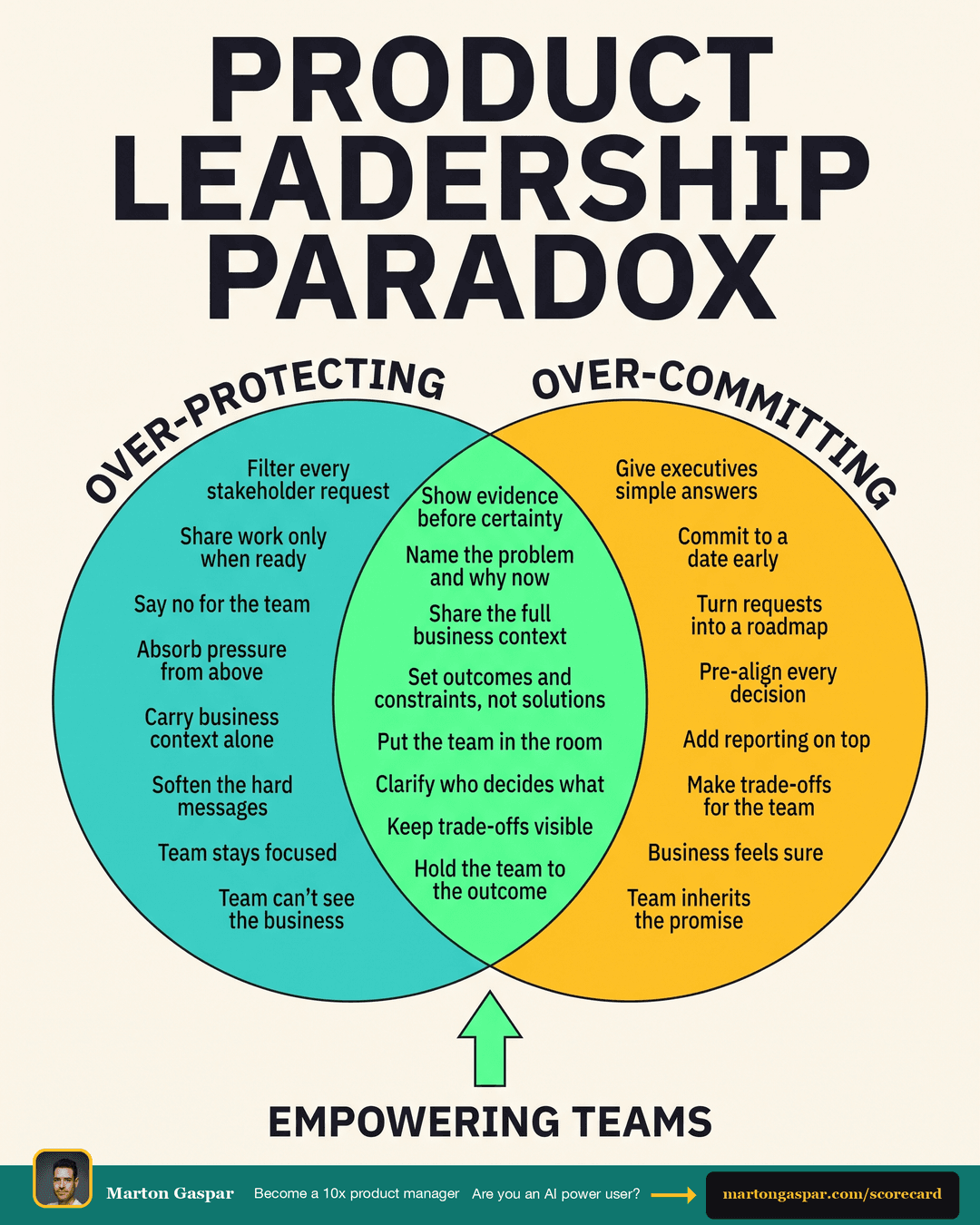
Every senior PM faces the same impossible choice. Almost none admit what it turns them into.
Protect the team too hard, and they stop seeing the business. Reassure the business too hard, and they stop owning the outcome. One role, two traps, and the same good intention behind both.
Trap one: over-protecting the team
Over-protecting looks like care. You filter every stakeholder request. You share work only when it is ready. You say no on the team's behalf, absorb the pressure from above, carry the business context alone and soften the hard messages before they arrive.
The team stays focused. That is the benefit, and it is real. The cost is that the team can't see the business.
In practice it shows up in three ways. The team guesses what the business actually wants. Every stakeholder question lands on you first. And nobody decides anything while you are on leave.
Trap two: over-committing to the business
Over-committing looks like alignment. You give executives simple answers. You commit to a date early, turn requests into a roadmap, pre-align every decision, add reporting on top, and make the trade-offs for the team.
The business feels sure. That is the benefit. The cost is that the team inherits the promise.
In practice, the team hears the promise after it is made. Work bends around a date, not a problem. And you end up defending a plan you no longer believe in.
Why the buffer feels like leadership
Here is the tell. When did your team last speak to a stakeholder without you in the room?
A buffer removes friction now but creates dependence later. Both sides keep working through you instead of learning to trust each other. The team never builds a direct line to the business, and the business never sees how the team learns.
The buffer pattern is sticky for a simple reason. Removing friction gets you promoted. Creating dependence is why you stop there. Being the buffer feels like leadership. Staying the buffer becomes the ceiling.
Both traps start from the same good intention. Over-protecting comes from wanting the team to do focused work. Over-committing comes from wanting the business to feel confident in the team. Neither is a bad instinct. The problem is that each one routes everything through one person, and a role that runs on one person stops scaling the moment the team or the business grows.
Redesign the middle
The answer is not picking a side. It is redesigning the middle, the overlap where empowered teams sit. That middle has its own habits. Show evidence before certainty. Name the problem and why now. Give the team the full business context. Set outcomes and constraints, not solutions. Put the team in the room. Clarify who decides what. Keep trade-offs visible. And hold the team to the outcome.
Notice what those habits have in common. Each one gives the team and the business direct sight of each other, instead of a filtered version passed through you. The team sees the business context and the constraints. The business sees the evidence and the trade-offs. You stay accountable for the outcome, but you stop being the only channel.
Three moves get you started on the next contested decision. First, put the people who disagree in one room. Second, write down the question they have to settle. Third, name who decides, and set a review date.
The written question keeps the meeting on the decision rather than on positions. The named decider stops it from ending in another meeting. The review date makes it safe to decide now, because the call can be revisited with real evidence later.
You stop being the answer. You become the architecture. Let the team see the business. Let the business see the learning.
If you want more on building a team that does not wait on you, the 15 traits at /vault/traits-of-great-product-leaders go deeper on that habit.
What is one decision you stopped making that your team now owns?