You solved the hard thing. Again. Now nothing gets decided without you.
Presence gets taught as gravitas: how you speak, how you hold a room, how senior you sound. That is what built this problem. Presence measured by how much the room needs you ends with every decision waiting for your slot.
Here are ten plays for product managers who want to build presence that scales. Most presence advice makes the problem worse, not better. These ten split into three jobs. Start with the one that stings.
Job 1: Make the decision better (plays 1 to 5)
None of this work happens in the room. It happens in the twenty minutes before the call, when you work out the real options and what each one costs the quarter.
The symptom when this job is missing: the same call gets made twice. It gets settled, then reopened a month later by someone who can't say what changed.
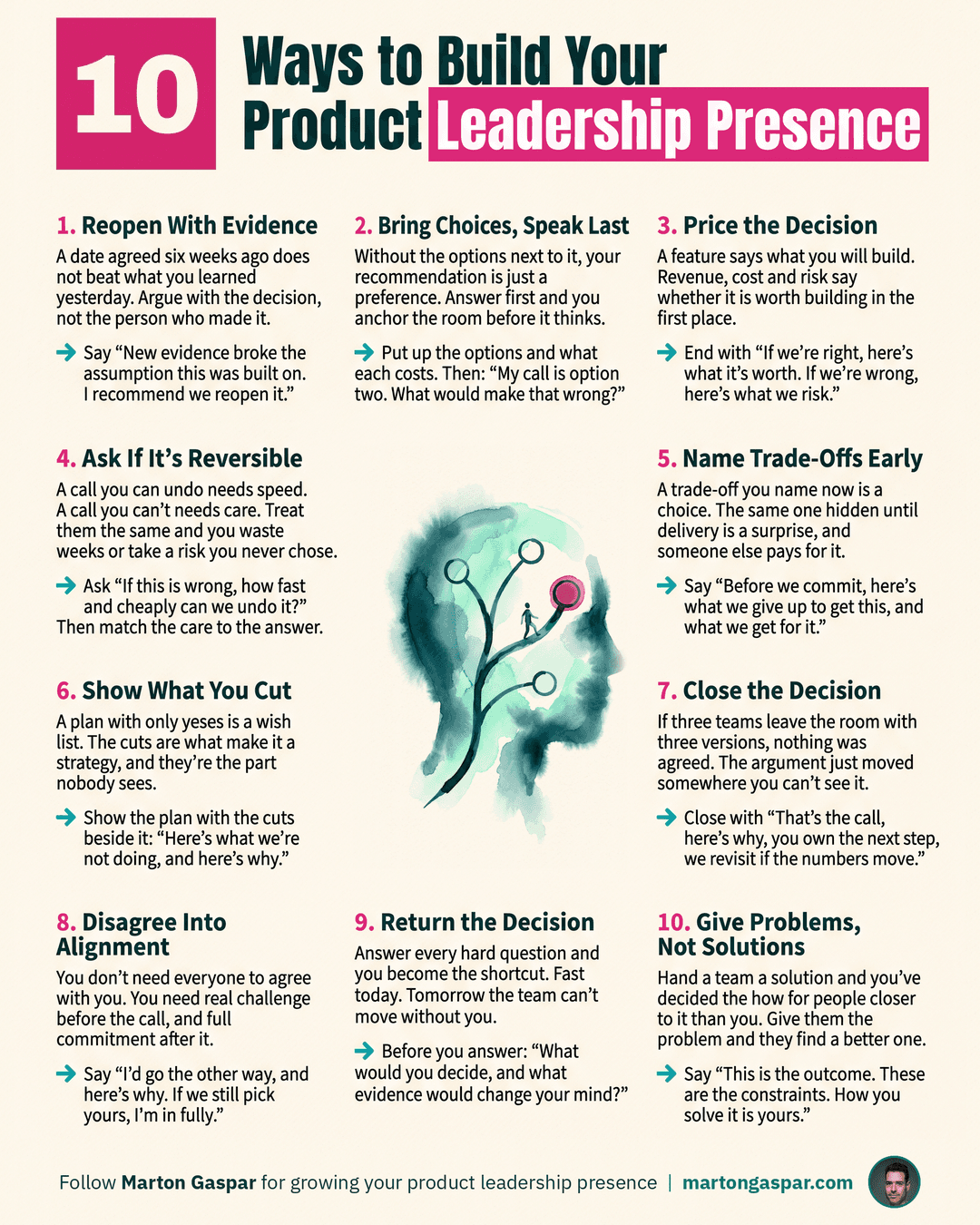
Play 1 is reopen with evidence. A date agreed six weeks ago does not beat what you learned yesterday. Argue with the decision, not the person who made it: "New evidence broke the assumption this was built on. I recommend we reopen it."
Play 2 is bring choices, speak last. Without the options next to it, your recommendation is just a preference. Answer first and you anchor the room before it thinks. Put up the options and what each costs, then: "My call is option two. What would make that wrong?"
Play 3 is price the decision. A feature says what you will build. Revenue, cost and risk say whether it is worth building in the first place. End with "If we're right, here's what it's worth. If we're wrong, here's what we risk."
Play 4 is ask if it's reversible. A call you can undo needs speed. A call you can't needs care. Treat them the same and you waste weeks or take a risk you never chose. Ask "If this is wrong, how fast and cheaply can we undo it?" and match the care to the answer.
Play 5 is name trade-offs early. A trade-off you name now is a choice. The same one hidden until delivery is a surprise, and someone else pays for it: "Before we commit, here's what we give up to get this, and what we get for it."
Job 2: Make the decision visible (plays 6 to 8)
A decision only exists if the people who have to build it can repeat it back.
The symptom: everyone agrees in the room and a different thing ships. You find out who disagreed when the sprint is already late.
Play 6 is show what you cut. A plan with only yeses is a wish list. The cuts are what make it a strategy, and they're the part nobody sees. Show the plan with the cuts beside it: "Here's what we're not doing, and here's why."
Play 7 is close the decision. If three teams leave the room with three versions, nothing was agreed. The argument just moved somewhere you can't see it. Close with "That's the call, here's why, you own the next step, we revisit if the numbers move."
Play 8 is disagree into alignment. You don't need everyone to agree with you. You need real challenge before the call, and full commitment after it: "I'd go the other way, and here's why. If we still pick yours, I'm in fully."
Job 3: Make the team need you less (plays 9 and 10)
Nobody works on the third job, because it costs the thing that got you noticed.
The symptom: your calendar is on the critical path. A squad sits on a decision for a week waiting for your slot.
Play 9 is return the decision. Answer every hard question and you become the shortcut. Fast today. Tomorrow the team can't move without you. Before you answer, ask: "What would you decide, and what evidence would change your mind?"
Play 10 is give problems, not solutions. Hand a team a solution and you've decided the how for people closer to it than you. Give them the problem and they find a better one: "This is the outcome. These are the constraints. How you solve it is yours."
Presence is what they can do without you
Don't run all ten. Pick one play from the job that stings and use it in your next call.
Presence isn't what people see in you. It is what they can do without you. The way up is a product team that decides better than you found it.
If the third job is the one that stings, two related pieces go further: /vault/every-question-only-you-can-answer on why decisions keep routing back to the product lead, and /vault/traits-of-great-product-leaders on the small habits that stop a team waiting on its leader.