Good results used to tell me the thinking was right.
It shipped on time. Stakeholders aligned. Targets hit. Those are real signals, and they're worth celebrating. But they answer a different question from the one that matters most for the next decision.
Most reviews stop at the result. This cheat sheet starts there, then goes one level down, to the thinking that produced it.
Two questions, not one
Every piece of product work can be judged with two questions. Did it work? And was the thinking behind it right?
A fast delivery answers the first one. It doesn't answer the second. A team can hit the target for reasons that had nothing to do with the plan: good timing, or a market that moved their way. A team can also make a well-reasoned call that doesn't pay off, because a bet is still a bet.
If you only ask the first question, you learn to repeat whatever happened to work. If you ask both, you learn which of your decisions to trust.
A clean quarter can hide a lucky call. The second question is how you find it.
The problem underneath the request
Years ago I was handed something scoped at two years. We had it live in two months.
Not because we moved fast. Because we found the right problem first.
That's the part a result on its own never shows you. The build is easy to point to: the dates and the launch. The problem underneath the request is harder to see and harder to talk about, and it's usually where the real decision was made.
The speed came from the thinking, not the other way round.
Review the decision, not only the outcome
Here is what I look at now. Before the decision: what you knew and what you assumed. After it: what happened and what it changed.
The "before" half is the one that tends to go missing. Once a result is in, it's hard to remember what you actually believed at the time. Write it down when you decide, even in two lines, and the review becomes useful. You can see which assumptions held, which didn't, and whether the result came from the reasoning or despite it.
A decision you can review is a decision you can learn from.
Four layers of product craft
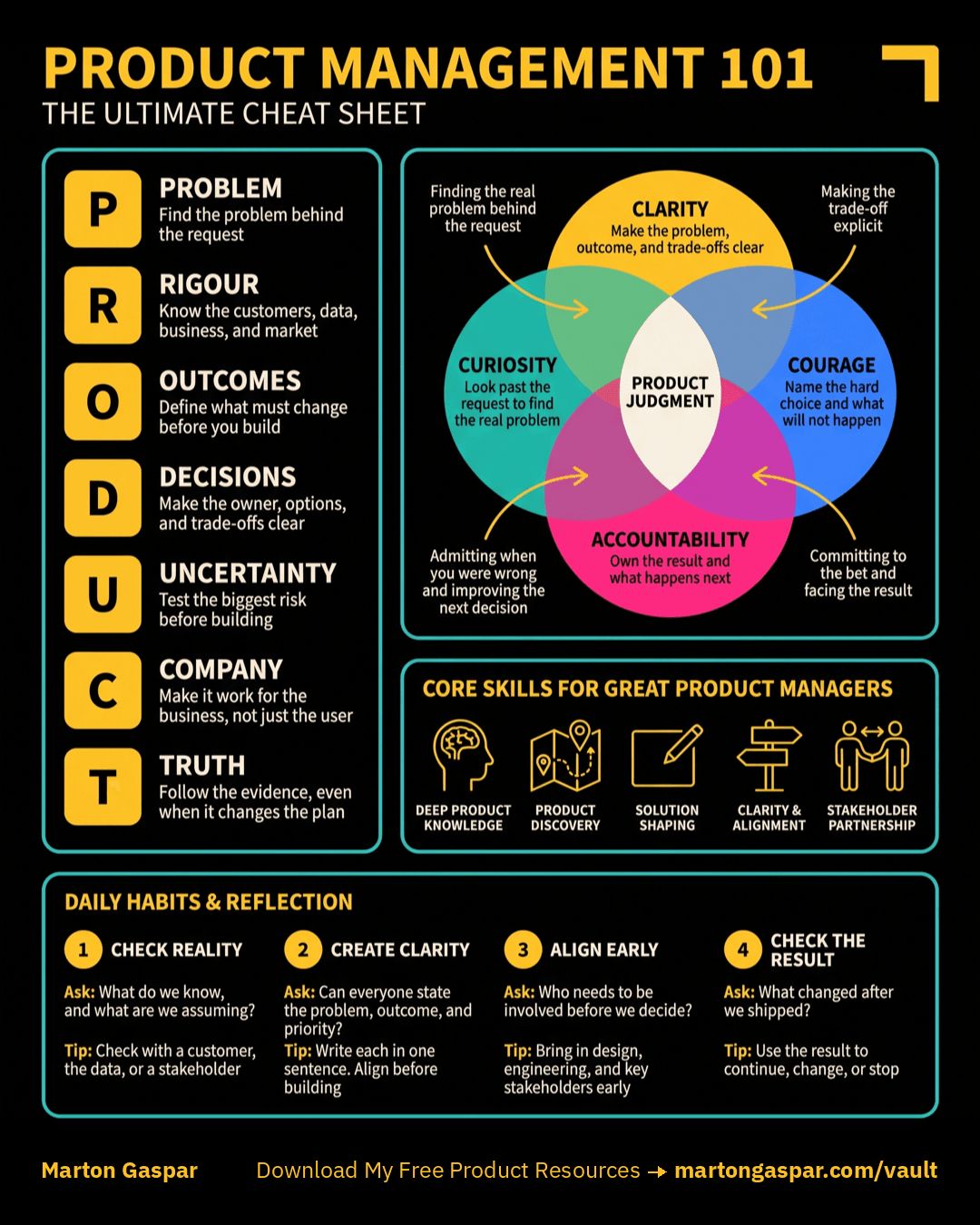
Most career frameworks stop at the result. This one starts there and goes through four layers, and each one maps to a part of the cheat sheet.
The standard of the work. The judgement behind the decision. The skills you are actually building. The habits you can name.
Every one of those layers can be learned. Only one of them compounds, and we'll come back to which.
The standard of the work
The left side of the cheat sheet spells PRODUCT. It's a standard to hold the work against, one letter at a time.
Problem: find the problem behind the request. Rigour: know the customers, the data, the business and the market. Outcomes: define what must change before you build. Decisions: make the owner, the options and the trade-offs clear. Uncertainty: test the biggest risk before building. Company: make it work for the business, not only the user. Truth: follow the evidence, even when it changes the plan.
If you've read the 7 essential skills of product managers article, you'll notice that one also spells PRODUCT. The two are companion pieces. That one is about skills and the impostor versions that look like them. This one is a check you run on a piece of work before and after the decision.
The standard tells you what good work looks like. It doesn't tell you whether you made the right call.
The judgement behind the decision
The centre of the cheat sheet is a Venn diagram, and product judgement sits where four things overlap.
Curiosity: look past the request to find the real problem. Clarity: make the problem, the outcome and the trade-offs clear. Courage: name the hard choice and what will not happen. Accountability: own the result and what happens next.
The notes around the circles are the behaviours that connect them. Finding the real problem behind the request. Making the trade-off explicit. Committing to the bet and facing the result. Admitting when you were wrong and improving the next decision.
That last one is where the two questions come back in. You can only admit you were wrong if you wrote down what you thought before the result arrived.
The skills you are actually building
Under the Venn, the cheat sheet names five core skills: deep product knowledge, product discovery, solution shaping, clarity and alignment, and stakeholder partnership.
These are the ones that show up in the work every week. A useful check is to look at your last few decisions and ask which of the five each one actually used. The skills you practise are the ones you're building, whatever your job description says.
A skill you never use in a real decision is a skill you only have on paper.
The habits you can name
The bottom of the cheat sheet turns all of this into four habits, each with a question to ask.
Check reality: what do we know, and what are we assuming? Check with a customer, the data or a stakeholder. Create clarity: can everyone state the problem, the outcome and the priority? Write each in one sentence and align before building. Align early: who needs to be involved before we decide? Bring in design, engineering and key stakeholders early. Check the result: what changed after we shipped? Use the answer to continue, change or stop.
A habit you can name is one you can repeat, and one you can teach.
Judgement is the layer that compounds
Standards can be learned from a page. Skills grow with practice. Habits stick with repetition. Judgement is different. It's the only layer that gets better every time you review a decision against what you knew at the time, and that improvement carries into every decision after it.
That is what product craft actually looks like. You won't find it in a title or a clean quarter. It shows up in decisions that stand up to review, and that is what moves a product career forward.
Think of one recent decision with a result you can see. I always start at the top, with the problem. The build is easy to point to. The problem underneath the request is where the conversation usually goes quiet.
Download the one-page version and keep it next to your next decision review.