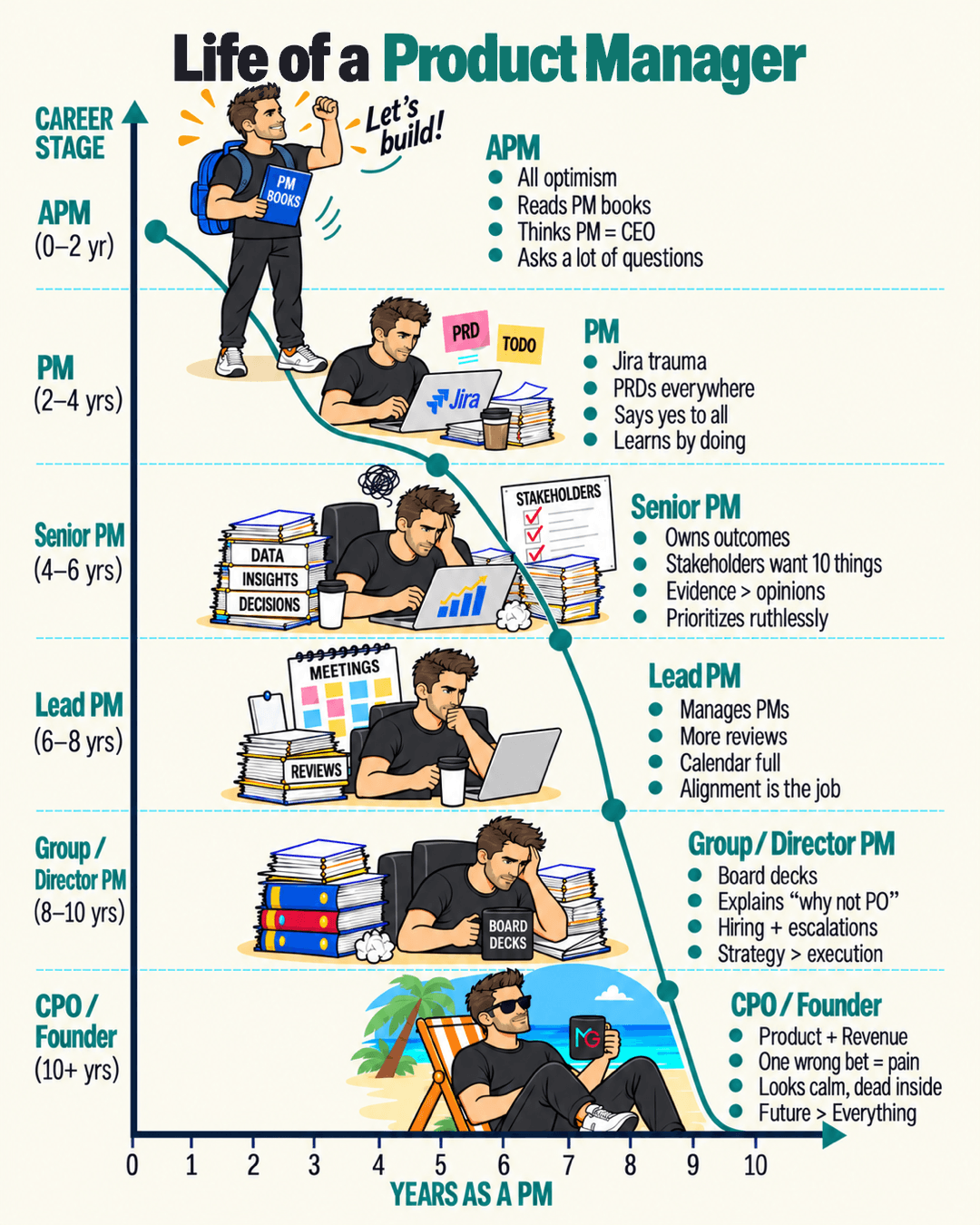
Moving up in product isn't what it looks like.
The thing you're promoted for is the thing you lose.
At every level of the product manager career path, the habit that earned the promotion becomes the trap at the next one. It worked, so you keep doing it. Then the job changes underneath you, and the same habit starts holding you back.
Below are six levels, from APM to CPO or founder. For each one: the trap, the question that gets you out of it, and one thing to try.
APM: treating "task done" as "problem solved"
Early on, you earn trust by finishing things. Tickets closed, notes written, follow-ups sent. That reliability is what gets you noticed.
The trap is treating "task done" as "problem solved". A finished task is evidence you did the work, not evidence the problem went away.
The question to ask: "What would I see if the problem were fixed?"
One thing to try: Write down that one sign before you start. Check for it after, and show your PM what you found. It turns a list of done tasks into a record of problems that actually changed.
PM: treating "shipped" as "users are better off"
As a PM, you earn your place by getting things out of the door. Shipping is visible and it feels like the job.
The trap is treating "shipped" as "users are better off". A feature going live tells you the team delivered. It tells you nothing about whether anyone's behaviour changed.
The question to ask: "What should users do differently, and did they?"
One thing to try: Write the change you expect before you build. Check real usage on a set date. Bring the numbers to your next review. Doing it before the build matters, because a target written afterwards tends to fit whatever happened.
Senior PM: treating agreement as proof
At senior level, you get good at alignment. You can bring a room round, and getting people to agree feels like progress.
The trap is treating people agreeing as proof the idea works. Agreement means the idea is persuasive. It doesn't mean it's right. And now your calls cost other teams weeks of work.
The question to ask: "What must be true before other teams commit weeks to the idea?"
One thing to try: Name your weakest assumption. Test it cheaply before any team commits to building. If it survives, the agreement you built is worth something. If it doesn't, you saved everyone weeks.
Lead PM: always having the right answer
By the time you lead PMs, you have seen a lot. You usually know the answer before the PM in front of you does, and giving it feels like helping.
The trap is always having the right answer for your PMs. Every time you hand it over, they learn to wait for you rather than to decide.
The question to ask: "Could my PMs make this decision well without me?"
One thing to try: Ask a PM for their recommendation and evidence first. Then ask what would change their mind, instead of giving your answer. You are building their judgement now, not showing off yours.
Director: treating every team on target as the product winning
As a director, you run several teams, each with its own goals. When every team hits target, it looks like success.
The trap is treating every team hitting target as the product winning. Team goals can conflict. Each team can win its own game while the product as a whole goes nowhere.
The question to ask: "When team goals conflict, which result matters most?"
One thing to try: Put two conflicting goals side by side. Choose the one worth more to the product and business, and say plainly what the other goal loses. Saying the loss out loud is the part most plans leave out.
CPO or founder: treating a plan of good ideas as one you can afford
At the top, you are surrounded by good ideas. Every team has a strong case. A plan full of them looks ambitious and well thought through.
The trap is treating a plan of good ideas as one you can afford. Every idea on the list is competing for the same people and the same money.
The question to ask: "What do we fund now, what waits, and for how long?"
One thing to try: For each big investment, write what stops or slows to pay for it, and how long you can wait for the return. A plan that names its costs is one you can actually defend.
What earned the promotion becomes the trap
Read the six levels together and the pattern is the same at every step.
What earned the promotion becomes the trap. So the job isn't to do more of what worked. Finishing more tasks, shipping more features or winning more agreement won't carry you up the next step.
The job is to decide well at a bigger scale, and to build a team that makes good calls without you in the room. Each question above is a step in that direction: from your own tasks, to users, to other teams, to your PMs, to the product, to the business.
If you want the shorter version, the levels of product management can also be read as one question you own at each stage. That view is at /vault/pm-levels.
Find your level above, and try the one thing listed for it this week.