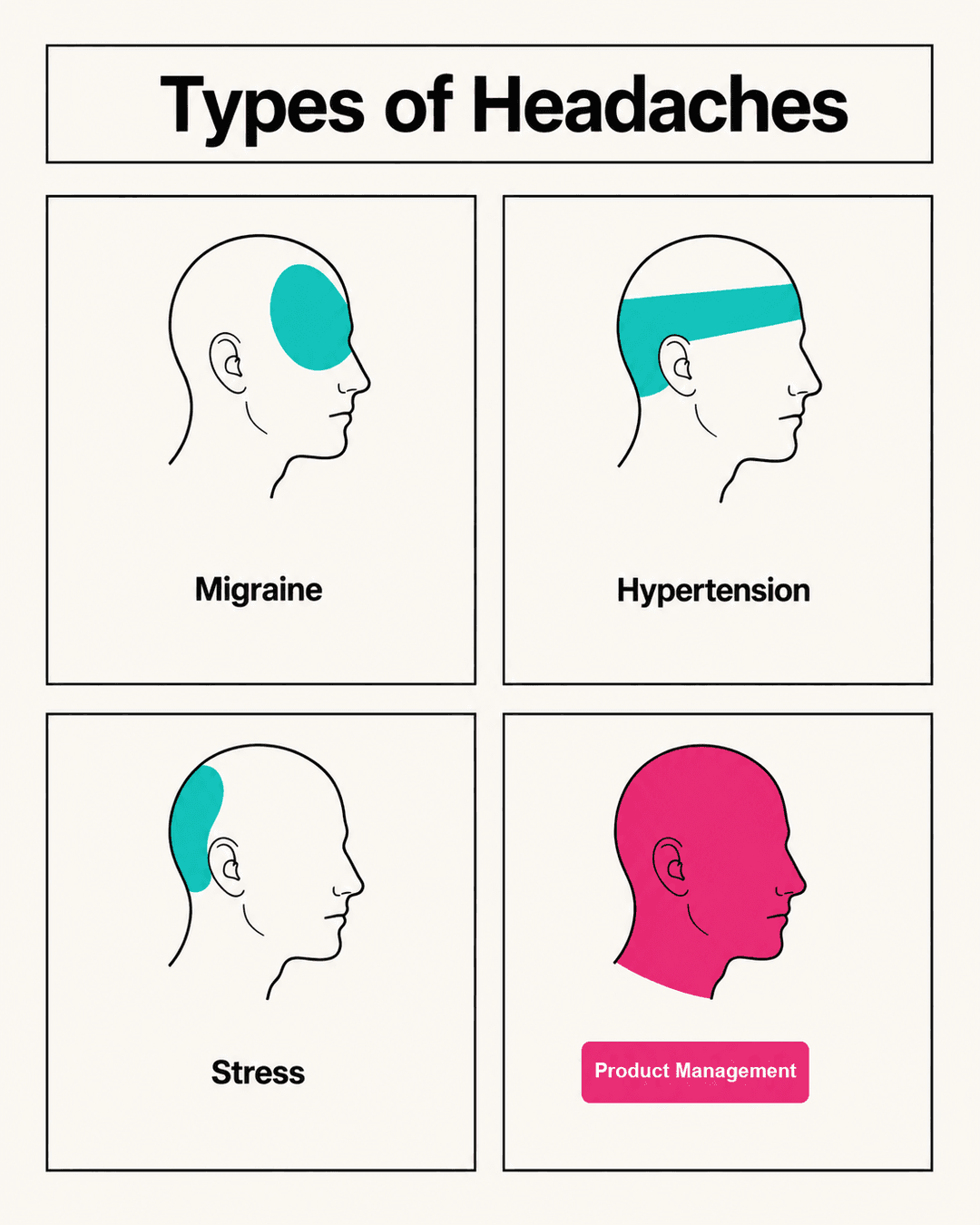
Product managers get a different kind of headache.
Some product headaches come from deadlines. Some come from stakeholders. And some begin with one harmless sentence: "It's a small change." "Let's not overthink it." "Sales already promised it." "It should only take a sprint." "We'll validate it after launch." "The CEO saw a demo at the weekend." And the all-time classic: "AI can just do it?"
Each of these sounds like a request for a little work. Each one can turn into a lot of it. This piece looks at how that happens, what a senior PM hears behind the request, and why the skill that stops it is the hardest one to prove.
How one innocent sentence grows
The cost of a "small change" rarely shows up on day one. It shows up as a chain.
First come two "quick syncs" to work out what was meant. Then a re-prioritised roadmap, because the small thing had to go somewhere and something else had to move. Then an OKR nobody can explain, written to justify work that had already started. And at the end, a feature nobody uses, with your name on it.
None of those steps feels like a big decision when it happens. That is the trap. The real decision was made in the first sentence, and nobody stopped to price it.
What a senior PM hears behind the request
A senior PM doesn't just hear the request. They hear what sits behind it.
They hear the trade-off: the work this will push out of the way. They hear the dependency: the team, system or promise that has to move first. They hear the assumption nobody tested: the belief about customers that the whole request rests on. And they hear the quarterly business review, months from now, where someone asks why the number didn't move.
Hearing those things is not pessimism. It is the job. A request usually arrives as a solution. The product manager's work is to see what it will cost and what it is meant to change before the team spends a sprint finding out.
Questions are not a delay
So a senior PM asks questions. Not to slow things down. To stop a "small change" from eating a quarter.
The questions are plain. What problem does this solve, and for whom? What do we stop to make room for it? What has to be true for it to work? How will we know, a month after launch, whether it did? A few minutes of questions at the start costs very little. A quarter spent on the wrong thing costs a lot.
The same move sits behind pushing back on urgent work, which is covered step by step in /vault/how-to-push-back-on-urgent-requests.
The catch: nobody counts what never got built
Here's the catch. Nobody counts the features that never got built.
A shipped feature leaves a trail: a release note, a demo, a line in the quarterly review. A bad idea stopped early leaves nothing behind. The quarter it saved never appears on any slide. So the thing that makes you senior is the hardest thing to prove.
That's not overthinking. That's product judgement. When anyone can build fast, it's worth more than ever. Building got cheaper. Deciding what deserves to be built did not.
But what the org can't see, it can't value. If some of your best work is work that never happened, it helps to make it visible: what you stopped, why you stopped it, and what that freed the team to do instead. For more on deciding what stays off the roadmap, see /vault/how-to-cut-a-product-roadmap.
So here's a question worth sitting with: what's the best thing you ever killed, and what did it save?