Most weak product interview answers are not wrong. They are just empty.
"I prioritise with RICE." "I owned the roadmap." "Everyone was aligned." Each one is true for a lot of candidates, which is exactly the problem. None of them shows how you think, and how you think is what the interviewer is trying to see.
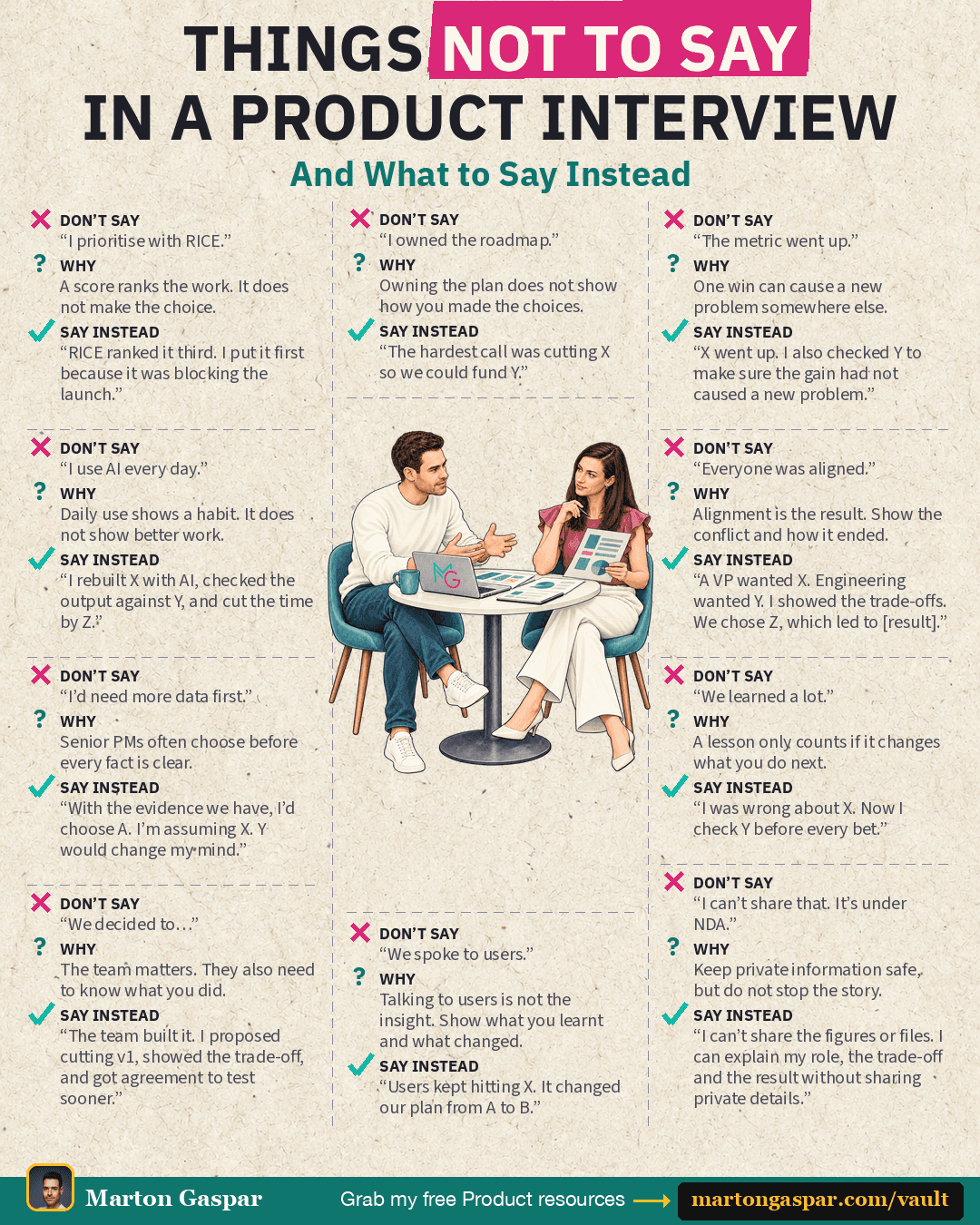
Below are 10 things not to say in a product interview, why each one falls flat, and what to say instead. They group into four habits: show the choice, show what changed, show your part, and show the story even when the details are private.
Show the choice, not the method
The first habit is to talk about the decision, not the tool or the plan that sat around it.
Don't say "I prioritise with RICE." A score ranks the work. It does not make the choice. Say instead: "RICE ranked it third. I put it first because it was blocking the launch." Now the interviewer can see you use a framework and still own the call.
Don't say "I owned the roadmap." Owning the plan does not show how you made the choices. Say instead: "The hardest call was cutting X so we could fund Y." One trade-off tells them more than a job title.
Don't say "I'd need more data first." Senior PMs often choose before every fact is clear. Say instead: "With the evidence we have, I'd choose A. I'm assuming X. Y would change my mind." That answer shows a decision, the assumption under it and what would move you.
Show what changed, not what happened
The second habit is to show the result and its effect, not just the activity.
Don't say "The metric went up." One win can cause a new problem somewhere else. Say instead: "X went up. I also checked Y to make sure the gain had not caused a new problem." That one extra check shows you think about the whole product, not one number.
Don't say "We spoke to users." Talking to users is not the insight. Show what you learnt and what changed. Say instead: "Users kept hitting X. It changed our plan from A to B."
Don't say "We learned a lot." A lesson only counts if it changes what you do next. Say instead: "I was wrong about X. Now I check Y before every bet." Admitting the mistake and naming the new habit is far stronger than a vague lesson.
Show your part, not just the team's
The third habit is to make your own contribution clear without dismissing the people you worked with.
Don't say "We decided to…" The team matters. The interviewer also needs to know what you did. Say instead: "The team built it. I proposed cutting v1, showed the trade-off, and got agreement to test sooner."
Don't say "Everyone was aligned." Alignment is the result. Show the conflict and how it ended. Say instead: "A VP wanted X. Engineering wanted Y. I showed the trade-offs. We chose Z, which led to [result]."
Don't say "I use AI every day." Daily use shows a habit. It does not show better work. Say instead: "I rebuilt X with AI, checked the output against Y, and cut the time by Z." The check in the middle matters most: it shows the judgement stayed with you.
Show the story, even when the details are private
The fourth habit covers the answer that ends many good stories too early.
Don't say "I can't share that. It's under NDA." Keep private information safe, but do not stop the story. Say instead: "I can't share the figures or files. I can explain my role, the trade-off and the result without sharing private details." You protect the company and still give the interviewer what they need.
Every good answer shows a decision
Read the 10 together and the pattern is clear. Each weak answer describes activity: a method, a plan, a meeting, a tool. Each strong answer shows a decision: what you chose, what it cost, what changed, and what you would do differently.
That is what a senior product interview is testing. Not whether you know the frameworks, but whether you can make a call, explain it and learn from it. Before your next interview, take your three best stories and check each one for a choice, a trade-off and a result.
The interview is also your chance to test the team. The Product Manager Interview Question That Shows If a Team Is Really Empowered at /vault/product-manager-interview-question covers the question to ask them.